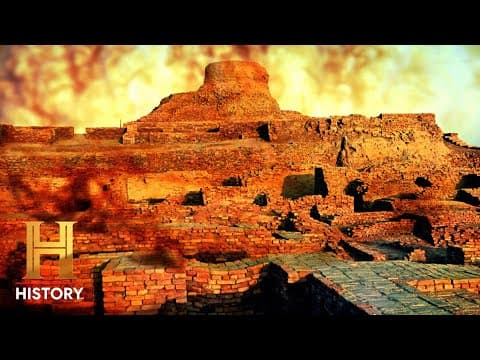
[0:02]Sindh province, Pakistan, 1922. An officer of the archaeological Survey of India is led by a Buddhist monk to an area believed to have been a religious monument. But under the mounds of dirt, archeologists find instead an ancient Indus Valley City dating back to 2000 BC. It is called Mohenjo-Daro, or Mound of the Dead, and it is one of the oldest civilizations discovered in the world. Mohenjo-Daro was very advanced for that time. They had sanitation. They had all kinds of good things going, and they had a lot of trade going with Mesopotamia. The city of Mohenjo-Daro rivaled the ancient civilizations in Egypt and Mesopotamia.
[1:06]Archeologists believe that over 35,000 people once occupied the city. However, only 43 skeletons have been discovered at the site.
[1:22]There are many theories surrounding the mysterious disappearance of the Indus people from Mohenjo-Daro. In 1977, British researcher David Davenport discovered that part of the archaeological site showed evidence of having been destroyed by an extremely powerful explosion. He found what remains of the blast, and he believed that this area was the the epicenter of something that he believe was an explosion that destroyed part of the city. And he found the evidence of vitrified pottery, bricks that were totally fused, melted, or vitrified. Scholars claim that several calcified skeletons found at the site suggest they suffered an instantaneous death.
[2:22]And Mohenjo-Daro, they found bodies arm-in-arm, skeletons arm-in-arm that had been vitrified, virtually vitrified.
[2:33]For years, restricted access to the site has prevented scientists from analyzing the vitrified ruins. But in 2014, mineralogist, Dr. Sam Iyengar was able to obtain a piece of fused pottery from Mohenjo-Daro and put it through a series of tests. When I did the elemental analysis, it showed me that the Mohenjo-Daro rock contained mostly silicon, aluminum, with some calcium and potassium. So, my thought was maybe it could be some type of a clay. Till I did the X-ray diffraction.
[3:14]X-ray diffraction is able to determine exactly how a material was formed. When I did the X-ray powder diffraction, this is the pattern I got. And you can see some crystalline peaks here along with an amorphous hump, which usually results from a glassy phase in the rock. The composition is very similar to volcanic rock. The only way the clay can be converted into something which we saw is subjecting the clays to a very, very high temperature. I'm talking 4 to 5,000 degree Fahrenheit. That is not something an early civilization can do intentionally. It has to be something supernatural.
[4:10]Could this pottery sample, which shows irrefutable evidence of having been subjected to extreme heat, be definitive evidence that Mohenjo-Daro really was the site of some type of powerful explosion in the ancient past? David Davenport and other researchers of India's ancient Vedic texts have suggested that this is the case, and that Mohenjo-Daro may, in fact, be the Kingdom of Lanka. A city whose destruction is detailed in the Indian epic known as The Ramayana. In The Ramayana, it is described that the God Vishnu decides the leader of Lanka, a mortal named Ravana has grown too powerful. Vishnu takes the human form of Rama and does battle with Ravana, who has become like the gods himself. Ravana was a very formidable enemy. In fact, most of his power, it was acquired from from God Shiva himself, because he was a great devotee of Shiva. During the battle between Rama and Ravana, they use particular weapons of energy, weapons of the gods.
[5:37]They have a very big power of destruction. It was described as the sun turning into 50 even more brighter suns with this incredible blast. So some people have suggested that perhaps at Mohenjo-Daro some type of a nuclear blast occurred. Not only do we have a textual reference to a possible nuclear blast, but we also find physical evidence that show vitrification of stone. And the only way that stone can be vitrified is if it's exposed to extreme heat.
[6:24]This is not mythology, this is not superstition, this is documented historical events of people that are warring with each other using advanced technology. I happen to believe that mankind possessed incredible technology, incredible knowledge, and that they did things that we're doing right now. And then something happened.
[6:51]And they had to literally start all over again.


