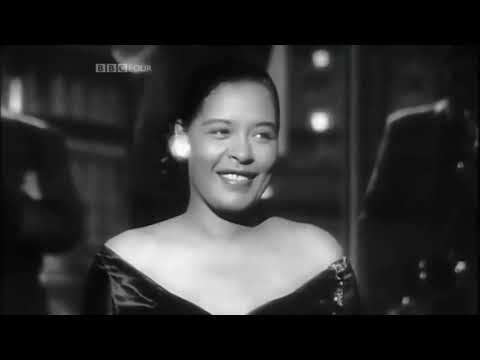
[0:20]Thank you, and now I'd like you to know my favorite vocalist, and America's number one song stylist, Miss Billy Holiday.
[0:44]This is one of Jazz's greatest singers in her prime. But within 10 years of this performance, she was dead. A body wrecked by drink and drugs. Partly thanks to the movie of her life, Lady Sings the Blues, she's come to be seen as a sad victim. A weak woman buffeted by forces beyond her control, forces which eventually swept her away.
[1:10]But that's not the real Billy Holiday. I don't think she had a sad life. She was living her life the way she wanted to live it. She did as she pleased. She made a lot of money, and she spent it all. She never took any nonsense from anybody. We don't want to be too patronizing, condemning her as a tragic figure. Reefers, alcohol, heroin, men, women, she had a great appetite for sensation.
[1:47]Billy Holiday was born Eleanor Harris on the 7th of April, 1915. Her mother Sadie was an 18-year-old cleaner, and her father, a 16-year-old guitarist called Clarence Holiday. Her parents weren't married. They never even lived together, and Billy's independent spirit was forged fending for herself on the streets of Baltimore. She learned a lot of filthy language, and she would shout 'Suck my ass!' at somebody in the street, and chances are, whoever it was would chase her down and punch her. But she'd do it anyway, because she didn't want to take any nonsense from anybody.
[2:31]One night, when she was 11, Billy was raped by a neighbor.
[2:37]He was sentenced to three months, but Billy, the victim of the crime, was punished too. She was sent to the House of Good Shepherd for colored girls. Billy's street smart ways didn't go down too well with the nuns. One she claimed they forced her to spend the night with the body of a dead girl to teach her a lesson.
[3:01]In 1928, Billy and her mother moved to Harlem. They arrived to find the Jazz Age in full flow.
[3:20]Billy already loved to sing, and she would spend her evenings at rent parties. Private parties where people like Duke Ellington or Fats Waller would turn up and play, and the door money went towards the rent. But Sadie and Billy were paying their rent in a different way, working in a brothel.
[3:42]The two of them are arrested for prostitution. Billy, who was still barely 14, claimed to be 21. She was sent to Welfare Island, just off Manhattan. Here she spent 100 days in a workhouse for vagrant and dissipated adults.
[4:04]A change of career was called for.
[4:10]There was a little gang of singers and dancers and comedians who would go from club to club performing for nothing. They do that all night long. Billy would go from table to table singing the same song and singing the chorus differently each time, teaching herself to improvise. This was priceless training. The singers would go around the tables for their tips.
[4:39]But they were not allowed to take the money in their hands. They had to take their tips through another part of their anatomy, in an intimate part of their anatomy. They all did it, but Billy, she wouldn't do it. She was singing in a club called Covans one night, when young record producer John Hammond walked in. He'd never heard an improvising singer like that. So Billy Holiday blew them away. Hammond teamed her up with Benny Goodman, and the 18-year-old Billy cut her first record.
[5:20]She was now a recording artist, but she hadn't acquired too many airs and graces. Her friends described her character as 'don't care-ish'. We were coming down Broadway, and she reached in, pushed the cigarette lighter in to light a cigarette, lit the cigarette, and threw the lighter out the window. She used profanity with the deftness of an ice skater doing a figure eight. Motherfucker. Motherfucker. Bitch. Bitch. Motherfucker. But from her, it didn't sound so offensive, because it sounded so natural. It was just the way she was. This short Duke Ellington film was her next breakthrough. Billy played the role of a rejected woman. She complained she had to do so many takes of a scene, she was black and blue by the end of the filming.
[6:41]Billy felt she needed someone to help her organize a burgeoning career. She turned to agent Joe Glaser, who was already representing Billy's idol, Louis Armstrong. Glaser was a real tough guy, having come out of the Al Capone mob in Chicago. Joe was a foul-mouthed tough guy. He scared me, because he was so rough. The first thing he wanted her to do was lose weight, and look after herself. Her weight was always up and down. But he always gave her money when she asked for it. He was very supportive. Billy's profile was rising. She was appearing regularly at the Apollo and making more and more records in what was a unique singing style.
[7:38]She had enough courage to play with the music. And the beat is insistent. It says, 'Follow me.' I mean, 'Hit me, be right on this beat'. But she just hung behind it.
[7:58]It touches everybody. You hear, people who don't even know music who say, 'Oh, Billie Holiday!' Yes.
[8:10]She didn't jump around a lot. All she would do is stand in the spotlight, throw her head back a little bit, and she would snap her fingers. And, you know, she had you in the palm of her hand.
[8:29]In 1937, Billy's father Clarence died. He'd had pneumonia but hadn't been able to find a hospital that would take blacks. Billy, although she'd never seen that much of her father, was distraught. Her way of dealing with the grief was to throw herself into her work.
[8:52]She decided to go on tour with a Count Basie band. The physical discomforts of being on the road didn't bother her too much. She spent most of her time playing dice at the back of the bus and fleecing the rest of the band. Sometimes they had to borrow money back just so they could eat. But this was the 30s, and for a black band, life often proved demeaning as well as uncomfortable. You could not stay in a hotel. You'd stay with black families in that town. Couldn't eat where everybody else ate, you'd eat where the black folks ate or in the back of the restaurant.
[9:29]And somebody said, there weren't even outhouses for black people. It was degrading. She played a gig in Detroit where the management demanded that she black up, put on dark makeup, because she was too light for the band. Everybody else in the band was darker. Foolish insult. One compensation for the hardships was the presence in the band of sax player, Lester Young.
[10:02]That relationship is one of the most beautiful parts of her whole life story. They were such close friends, they were soulmates. They weren't even lovers, according to their contemporaries. They just delighted in each other's company. My man, she would say, 'That's my man.' He'd call anybody 'lady' of any gender, and he dubbed her 'Lady Day'. They were just meant for each other musically. They caressed each other through the microphone. The ardour is clear in every note.
[10:49]After touring with Count Basie, Billy went on the road with Artie Shaw and his all-white band.
[11:03]They had a gig in New York, ironically enough at the Hotel Lincoln, and she was told that she had to take the freight elevator. As a black person, she couldn't ride in the regular elevator, presumably because it would upset the other guests in the hotel. And she was so irked by this that she quit the band.
[11:33]Billy was back in New York at just the right time. A few weeks later, she was invited to be the opening attraction at a radical new nightclub. Cafe Society was quite an extraordinary place. It was the first and only integrated nightclub in New York. It was started by a left-wing guy named Barney Josephson, a former shoe salesman, who was determined that blacks and whites should have a place where they could fraternize together, watch entertainment together, where the racial barriers that existed really in the rest of the country, and even in much of New York City, would no longer exist.
[12:10]At Cafe Society, Billy was approached by Abel Meeropol, a communist poet. He had a song he wondered if she might be interested in performing. It was a song about lynchings.
[12:44]Lynchings had been a national scandal for many years, and they were still very much a part of the black consciousness in America. Everybody knew somebody who'd been lynched, or knew somebody in whose family there'd been a lynching.
[13:14]She was a quintessentially political person, with a highly developed race consciousness and a sense of injustice. And she developed this intensely personal relationship with the song.
[13:32]As I think of it now, I can feel that I'm kind of changing inside. I don't want to think about it. I don't know whether that's good or bad, but it was, in a way, it was a revolting experience to listen to Billy tearing her heart out.
[14:20]The way that she put so much heart and soul into it, you know, uh, made it indelible.
[14:35]In 1941, she married Jimmy Monroe, a small-time wheeler dealer who introduced Billy to opium, or hop smoking. The relationship was short-lived, partly thanks to Jimmy's roving eye, which prompted her song, Don't Explain.
[14:59]But sexually, Billy was at least as free wheeling as Jimmy. I can remember her saying to me, if Jimmy accuses me of having an affair with somebody, I'm going to do it. Orson Wells was one lover, but Billy was casting her net wider than men. I must have been about 15, and I was saying to my father that Billy Holiday could really sing a love song. And he said, 'She's your girl.' He said, 'But if you think she can sing a love song to a man, you should see her singing one to a woman.' Billy had lady friends, and she had men friends. She, I think, she was liked both sexes. I don't think she had any preference, really. Her female lovers probably included wealthy heiress Louise Crane and actress Tallulah Bankhead. I remember one time this woman kept shouting at Billy, saying, 'I understand you know Tallulah Bankhead.' Well, after about the third time, Billy looked at her and said, 'Knew her, had her.' In the Dunbar Hotel, where the black performers stayed on Central Avenue in Los Angeles, which is where I grew up. They had these peepholes in the bedrooms.
[16:19]And so one guy told me, when he was working there, she's going to be in there with another woman. I don't believe that. He goes, 'Oh, yeah, right there.' So he said he saw her in there having fun, the scissors, as they used to call it. When I learned that Billy Holiday had had partners of both sexes, I was delighted, because I like to think that there were women who were equally as savvy, equally as canny, and equally as voluptuous, and equally as loving, and as fierce as Billy Holiday, and that they had a wonderful time. One guy said he walked in on her and two other women one time, but, uh, you never know, that could be an exaggeration. But it could also be true.
[17:07]Her next male partner was trumpet Joe Guy. Who got who involved is unclear, but before long, they were both addicted to heroin.
[17:25]Lady was an addictive personality, no doubt. And, uh, anything that was out there, she was going to try it.
[17:37]Joe Guy became her dealer as well as her lover. As her addiction took hold, she would turn up later and later for her shows. If her supply didn't arrive, there'd be other problems. We couldn't get her to dress, and the whole night, until they had people come in and went on for her in her place, and she said she couldn't do it.
[17:58]So she just stayed there, uh, waiting to be, uh, never did come out.
[18:18]Glaser decided he had to tackle Billy's addiction. He persuaded her to take her into a New York hospital to be weaned off. She stayed there two to four weeks, supposedly cured. I understand later that the nurse was getting her drugs. Soon afterwards, Billy was performing in Philadelphia. After the last show, pianist Bobby Tucker was collecting her things from the hotel, when the police arrived. They entered the drawers, turned them over, underneath the sink, in the bathroom, the toilet up top, and they found this, uh, stocking, a lady's stocking, with the drugs in it. And, uh, he said, 'Aha!' So they took her down. Bobby Tucker was quickly released, but Billy was charged with possession of heroin. On Joe Glaser's advice, she declined legal representation. The whole business of the way she was convicted is tragic, because she didn't know what she was doing. And Glaser let her down completely. I think he felt at the time that this might be good for her, strange as that may sound, but that this would be a way that she could finally, you know, kick the drug addiction. Billy Holiday had been expecting to be sent to a hospital. Instead, she was sentenced to a year and a day in a women's prison in Alderson, Virginia.
[19:54]She refused to sing a note all the time she was there.
[20:00]Her train from Alderson stopped in Washington. She got off and scored. And I met her in New York, and when she got off the train, she gave me a big hug, and I could see, 'Oh, lady,' she was high in the sky. She said, 'There's no hope.' She said, 'I guess not.' Her conviction meant she lost her cabaret card. Without one, singers couldn't appear anywhere in New York where alcohol was served.
[20:29]Unable to perform in nightclubs, a comeback concert was organized in Carnegie Hall. Billy was convinced no one would show up.
[20:53]It was completely sold out, to such a degree that there were seats on stage, which was, I think, the first time that had been done in Carnegie Hall. And, uh, she'd prick my base over the crowd. Billy was nervous, so much so that when she was trying to pin her gardenia in her hair, she accidentally stuck the pin into far, and her hand started to bleed. And it bled like crazy, and, uh, she's wearing a black gown at that one anyway. So, uh, I, I said, 'Just cancel the concert. You can't make it.' She said, 'I'll be all right.' And she performed. But the audience couldn't see the blood stains on her dress, because it's black.
[21:39]But, uh, I think she was happy because, after being treated like a pile of crap, you know, and to come out and see that many people that truly care.
[21:53]This triumphant return didn't solve Billy's problem of not being able to perform in the clubs, which were her natural terrain. But then she met John Levy, part owner of Club Ebony, on 52nd Street. He was really a pimp and a hustler as what we called him in those days. Levy told Billy he could fix it for her to get a cabaret card. Before long, they were lovers, and Levy became her unofficial manager, too. I used to go down to get her to do a show, and she's on the floor, and he's kicking her. You never ever hit her in the face or anything where it was visible when she went on stage. He didn't want her to not be able to work. But he'd beat her around her ribs, and I recall one time in Philadelphia, Bobby and I had to go and get large tape bandages and bandage up her ribs so she would be able to stand up while she sang. He's a beast. I can't think of a nice word to say about him. For whatever reason, Billy chose to take physical abuse from her male partners. She would sometimes even encourage it.
[25:59]But she was more than capable of sticking up for herself when she wanted to. She would fight like a man, if necessary, even when it wasn't necessary, she would.
[26:11]She was at the bar drinking her regular drink, which was white creme de menthe, and, uh, and Crème de Cassis. But in a double or triple shot glass, you know, and they were very heavy.
[26:27]And, uh, the seam and that she, uh, went to the bartender, and she said, 'Since when do you start serving N-word bitches at the bar?' And she took the glass and turned it around, and she beat the crap out of him, beat him over the face, and, uh, they sued her for a lot of money. Two white men who were very, um, culturally, uh, ignorant, put out their cigarettes on her fur coat. And she, apparently, said, 'Well, you know, let's go outside,' and she took off her fur coat, and she proceeded to beat them both, you know, wonderfully well.
[27:10]So that's, that's the lady, you know, that's the Lady Day. I mean, if you're going to be a lady, be a lady with fists, you know, as well as, you know, your lipstick and your, your high heels.


