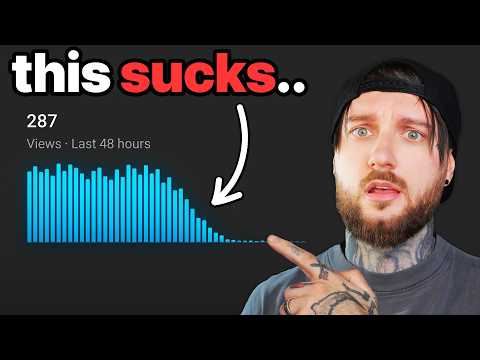
[0:00]Shadowban. It's one of the scariest words on YouTube. And if you're watching this right now, there's a good chance you've already thought to yourself, I'm Shadowbanned. Maybe you posted a video and it got 100 views. Maybe it got 2000 views. Maybe it just stayed at zero views. And after a while of this happening, your brain starts looking for an answer. And the easiest answer is shadowban. It's YouTube. It must be YouTube. They put me on a blacklist. That's what you tell yourself. But I want to be honest with you. After making YouTube videos for more than 10 years, after running channels in different niches and after helping a lot of creators grow, I can tell you that real shadow banning, the kind where YouTube secretly blacklist your channel forever, is not a real thing. There's no proof it exists. YouTube has even said it themselves. Now, I already know what some of you are thinking. Yeah, but I don't trust YouTube. They probably hide it. And honestly, I understand the feeling. It's hard to trust big platforms these days. But based on everything I've seen on my own channels, the truth is different. When a channel stops getting views, it's almost never because of a secret ban. It's because of a few real mistakes, mistakes you can actually fix. So, in this video, I'm going to walk you through those mistakes. I'll show you why your channel might feel stuck, what's really happening behind the scenes, and how you can start getting views again. Because once you understand what's actually going on, the whole thing stops feeling like a punishment and it starts feeling like a game you can win. Mistake number one, you don't understand the YouTube policy. This is the biggest one, and almost nobody talks about it the right way. YouTube's algorithm in 2026 is extremely advanced, way more advanced than most creators realize. It doesn't just look at your title or your description anymore. It can listen to your audio, and builds a transcript, it reads the transcript to understand the video. It can look at your thumbnail, it can compare your video to thousands of similar ones, and see if your engagement matches what those videos usually get. Basically, AI changed the whole game. The algorithm understands your video almost better than you do. And because it's so smart, it can detect almost instantly if your video is breaking a policy rule or even if it's just getting close to one. That's where the shadow ban feeling usually starts. Let's say your video has a thumbnail that looks a little too clickbaity, or your script touches on something sensitive, or your voiceover talks about a topic that's too close to the line. YouTube doesn't have to ban you. It just quietly stops pushing the video, not because they hate you, but because they're protecting themselves. YouTube is a massive company. They don't want lawsuits. They don't want trouble.
[2:49]If your video looks risky to them, they'll slow it down. That feels like a shadow ban to you. But to them, it's just damage control. The biggest policy update this year was about AI content. And this is where a lot of small creators are getting stuck right now. So let me explain it properly. You can use AI on YouTube. I use AI on my own videos. Even this video you're watching now had AI involved in the thumbnail. But there's a right way to use it and a wrong way. The right way is to use AI as a tool, as a helper to speed up the boring parts of making a video. The wrong way is to let AI make the entire video. Full AI script, full AI voiceover, full AI visuals. That's where YouTube draws the line. Their policy says they want authentic content, which basically means content made by a real human. When the entire video is AI from start to finish, YouTube systems can detect it. Tools like Google's sent ID watermark, plus pattern detection in voice, motion and visuals give YouTube enough signals to know. So when you generate a full AI video, upload it and it gets zero views, that's not a shadow ban. That's YouTube doing exactly what they said they will do. They're not pushing AI only content. The fix here is simple, use AI to help you, not to replace you. Aim for around 70% human and 30% AI assistance. That ratio keeps you safe and lets you grow faster. So let me actually show you how I use AI on my channel you're watching right now, Danny Why? For thumbnails, I use Higgsfield. It's an AI image and video generator that I use almost on every single thumbnail I make. And it's actually super easy to use. Basically, after you create an account on Higgsfield, you go to their dashboard, you click on image, and then you click on create. Over here, you can pick a model, and I usually pick Chat GPT2, because right now it's the best model for generating realistic images. And then the second thing I do is to add a reference photo of myself. And then I ask Higgsfield to change the facial expression or the clothes. In a few seconds, I get a clean image of me with a totally different look. That saves me hours of setting up the camera, the lights, fixing my hair, my beard, taking the photo, and then editing the photo myself until it's ready. Now, with the help of Higgsfield, I can generate an image of my face with a different facial expression in just a few seconds and use it in my thumbnail. That's how I use AI to help me speed up the process of creating thumbnails. But that's not the only way I use it, I also use it to help me create the videos. And for that, I also use Higgsfield. Basically, Higgsfield has a new tool called supercomputer. What I do, I click on supercomputer and inside the chat, I paste my entire YouTube script. After I paste my entire YouTube script, I ask supercomputer to help me generate visuals that fit with my script. And in just a few minutes, I have all the visuals I need for my script. And these can be motion graphics or icons or text or whatever your video needs. And then all I have to do is download those graphics on my computer and add them in my video. This right here literally saves me days of video editing. Because instead of thinking what kind of graphic I need to create, what kind of icon I need to create, by using Higgsfield supercomputer, I literally have all the icons, all the graphics that actually fit with my script in just a few minutes. And all I have to do is drag them on my video. And trust me, this saves me so much time from editing. Instead of finishing a video in six to seven days, now I can finish a video in less than two days because I can automate all those things. And using AI this way is completely okay because it's transformative. AI is doing the boring parts. I'm still recording the voice, I'm still editing the video myself, I'm still recording myself. I'm still a human on YouTube. So if you want to create better thumbnails and you want to edit videos faster, there's going to be a link down in the description where you can try Higgsfield yourself. Now, mistake number two. You created a new channel and expect instant views. This one feels obvious when I say it out loud, but most people don't really accept it. A new channel takes time. Even one or two months old is still a baby channel in YouTube's eyes. There are millions of videos uploaded every single day. The algorithm doesn't have unlimited space to show every new creator. So when you upload your first few videos and they get 50 views, that's normal. It's not a punishment, it's just how the system works for new channels. This is the part that feels unfair. You look at a big creator posting a video that has similar quality to your video and they get 500,000 views. You posted something just as good, but you get 200 views. So your brain says, it must be shadow banned. My channel is shadow banned. But it's not. It's actually trust. The bigger creator has been on YouTube for years. They've uploaded hundreds of videos. The algorithm has watched their content perform over and over again. It knows their audience, it knows their niche. It knows what their videos look like and how viewers react to them. So when they upload, YouTube already trust them enough to push their video out wider and faster. You, on the other hand, haven't built that trust yet. And that's okay. Everyone starts there. Even those big creators started with channels that got thirty views per video at some point. The fix here is patience and consistency. Not the empty kind of patience where you just wait, the active kind. You post good videos, you give the algorithm data, you upload 10, 15, 20 videos, so YouTube can figure out who you are and who your audience should be. The more clear signals you send, the faster the algorithm starts to trust you. Now, mistake number three, you're confusing the algorithm. This is the one most growing creators get stuck on. Even after 20 videos, even when they understand their niche, they still can't grow. And the reason is usually this. Most creators today understand that you shouldn't mix totally different topics. You can't do a cooking video, then a gaming video, then a vlog, then a finance video. Everyone knows that. Everyone understands niches. So, let's say you picked gaming as your niche. You post gaming content. Gaming is huge. Inside gaming, there are sub niches. There are Minecraft viewers, there are Fortnite viewers, there are League of Legends viewers, there are retro gaming viewers, and these are not the same people. A Minecraft viewer doesn't usually want to watch a League of Legends video, so they have completely different interests inside the same big niche, the same big category. So, if you post Minecraft on Monday, Fortnite on Wednesday, and League of Legends on Friday, you're putting the algorithm in a tough spot. At first, it pushed your Minecraft video to Minecraft fans. But now you post a League of Legends video. The algorithm sends those same Minecraft fans to the League of Legends video. And what usually happens, they're not going to watch. And this is how the algorithm gets confused and stops pushing your League of Legends video because the Minecraft viewers didn't watch your League of Legends video. And the algorithm thinks that maybe they just don't like your video. Maybe your video's not good enough. Here's the thing you have to understand. As a small creator, viewers don't come for you yet. They come for the topic. So if you post gaming videos about Minecraft, the viewers come for Minecraft, not your face, not your voice, not even your personality yet. The fix is to pick a sub niche and stick to it. Not forever, just long enough to grow. Once your channel gets bigger, you can branch out. Big creators can post almost anything they want because their audience came for them. But until you are at that level, narrow is better than wide. I know it feels unfair, but this is the game. Now, here's mistake number four, the mental one. This is the hardest one to fix because it's not about your videos, it's about your head. When I was younger and making YouTube videos that weren't getting views, I believed in shadow banning too. And the problem with believing in it is that it slowly becomes who you are. In your head, you become the creator who's shadow banned. You stop trying, you start hating YouTube, you start hating yourself a little bit. And every time you upload, in the back of your mind, you already think the video is going to fail. That mindset is poison. And I'm not going to pretend I have some magical solution for it. But I'll say this, shadow ban as a word is doing damage to you. Because if it's YouTube's fault, then nothing you do matters. And if nothing you do matters, you'll never try to get better. Now, the truth is harder, but it's also more freeing. So please listen, nobody is against you. YouTube isn't sitting in a room deciding to hurt your channel. The algorithm doesn't even know who you are. It's just a system, a system that responds to data. Good data, good results, confusing data, confusing results. So instead of just saying, I'm shadow banned, try saying, what signals am I sending the algorithm? That one switch in language changes everything. It puts the power back in your hands. And I get the unfairness thing. It is unfair that some creators have it easier. They've built their channel years ago when YouTube was different. They have audiences, sponsor, teams and trust with the algorithm. And because you're just starting, it's going to feel harder for you. And it's going to feel more unfair. But you have two options. You can sit there and complain about it, blame the platform and stay stuck, or you can accept where you are, learn the game and start playing it well. Now, if you want to learn how you can go viral on YouTube with one single upload, you might want to watch this video over here for me because inside this video, I show you how some creators go viral with just one single upload. So if that sounds interesting, you might want to click on this video and watch it.


