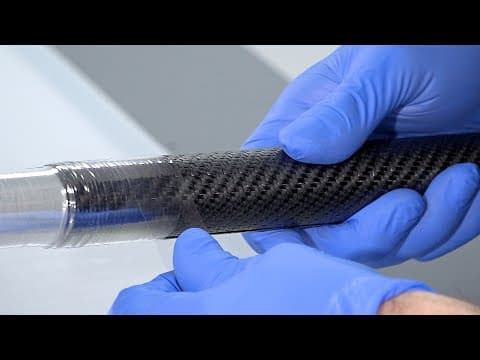
[0:00]Here at Easy Composites, we carry a huge range of ready-made tubes. But what if you're looking for something that we don't have in our stock range? So maybe you need a particularly thin or thick wall, or you're after a very specific diameter that we just don't carry. Well, it's actually quite easy to manufacture your own tubes. And so in this video, we're going to be looking at the roll wrapped manufacturing process, which is particularly well suited to making straight or tapered tubes. If you're looking to make more complex shapes such as this S-bend or components on a bicycle, maybe handlebars or a frame, you need to be looking at a molding process. And we've got another video dedicated to this process specifically. Manufacturing tubes using the roll wrapping method is actually very simple and very quick to do. In essence, it involves tightly wrapping a pre-preg reinforcement around a suitable mandrel, then consolidating this using a composite shrink tape before curing it in an oven. The first thing you need to consider when making a roll wrap tube is what you're going to use as the mandrel. There's a few factors that are important in selecting an appropriate material for this. The first is the surface finish, it needs to be very smooth and consistent, and also dimensionally, it needs to be very accurate and true. This is really important so you don't get a mechanical lock when you come to release the final part. Another important factor is the material that the mandrel is made from. We're using aluminum and that's particularly well suited because it has a high rate of thermal expansion, which means having cured at elevated temperature, when it cools down, it will shrink away making extraction of the final tube easier. Steel is also suitable, but because the thermal expansion isn't quite as high as aluminum, you have to pay particular attention to the surface finish and the straightness of the tube to ensure that you will get a release. In common with nearly all composite manufacturing processes, we need to use a release agent between the mold surface and the part.
[1:54]We're using a chemical release agent here, which is particularly well suited because it can be used at elevated temperature and also it builds a very thin film which won't bind or impede the release on this parallel draw surface. So we're going to be applying around about eight applications and just using the standard method, wiping a thin film on, allowing that to cure between coats, approximately 15 minutes, and then repeating.
[2:22]When cutting the X-preg pre-preg material, it's very straightforward to include almost any fiber type or orientation to suit your particular requirement. The width should be cut to the exact circumference of the tube. This will need to be extended on each wrap to allow for the increasing diameter as the lay up increases in thickness. This is the kit of parts for the layup, so we have a 210 gram 2-2 twill as the first layer, which will be the layer that goes on the inside of the tube. Then we have unidirectional fiber, so this is 300 gram unidirectional and all the fibers running down the length here. So that will give us strength down the length of the tube and there's enough material here to do three laps around. And then we're going to finish again with another layer of 210 gram twill on the end there. So on a clean surface, we're going to lay out the materials. So that's our first ply. Our unidirectional and we're just going to put a very, very slight overlap to keep these tack together.
[3:31]And the, uh, that layer of twill on the end there. To get the material started onto the mandrel, if you use some of the release paper off the back of the pre-preg under the first section, that will then allow you to take your mandrel, firmly press down, and if you roll back and forth, it should tack it down onto the mandrel. You can lift the paper just to help it along and then firmly press it on. Once it's started, it's very important to keep a really positive pressure all the time pressing the mandrel down onto the material, that ensures that it wraps very tightly. So something that can help in this is a flat board over the top. And as soon as you've got the pre-preg there, it will allow you to keep a downward pressure and roll forwards. In volume production, a dedicated rolling press is used for this process. As this is quite a short tube, it's perfectly possible to do single-handed. However, if you're making a longer tube, it would be a good idea to have more people to assist to ensure an even and firm pressure is applied. If the carbon is not wrapped tightly enough, it will wrinkle when the shrink tape contracts, which would structurally and cosmetically compromise the part. Just prior to doing the shrink wrap, I'm going to wrap a few extra layers of material just around the end here. And what that's going to do is provide a step, which if we have difficulty releasing this from the mandrel, will give us something that we can hold on to and actually pull the part from the mandrel.
[5:25]This is composite shrink tape. And this consolidates the material down onto the mandrel. So it's wrapped very tightly. The consolidation comes in two ways. The first is when you actually wrap it, you want to maintain a nice consistent tension. And then also when it's put into the oven, heat makes it contract even more, which puts quite a lot of pressure onto the tube. So we've got the shrink tape firmly tacked in place and then we're going to just tightly wrap around leaving around a three or four millimeter step over between each one. Doing this by hand is quite a slow process, especially on longer tubes. In mass production, a dedicated machine automatically winds the tape. But with a little ingenuity, it's also possible to adapt a standard lathe with auto feed to do the job. With the part now wrapped, it's ready for its final cure. We're going to be using a very simple cure cycle, which is 120 degrees flat. Now, that's high enough temperature to get the shrink tape to shrink, and we're going to be putting it in for an hour and a half, which with the XE110 system is plenty long enough for the resin to reach full cure.
[6:40]The tube's now cured, and as it's cooling down from being in the oven, you might hear it clicking and cracking a bit. And that's because of the difference in thermal expansion between aluminum and carbon fiber. The aluminum shrinks much more when it cools, and that will release it from the carbon and hopefully, once it's fully cooled, it'll be much easier to extract the carbon from the aluminum mandrel.
[7:11]In this case, I expect the release to be very easy and I should just be able to pull the mandrel out by hand. However, if it was being more stubborn for any reason, this extra bit of material I've got here, you could use a bearing puller hooked over the top and actually drive it off the mandrel.
[7:33]And so there's the completed roll wrap tube.
[7:39]A quick trim and de-burr to the ends will leave us with the serviceable component. If we take a closer look at the finished tube, you'll see we've got excellent consolidation throughout. We've also got a very even wall thickness, and you will notice that it has these ridges, and that's what's been left by the shrink tape. Now that is completely normal for a roll wrap tube. In our stock tubes, we actually grind that surface finish out and then apply a clear lacquer. So if you want a really high surface finish, that is an option for you. One of the main advantages to using carbon fiber for tube production is its incredible mechanical strength. So we're going to do a couple of non-scientific tests to see if we can establish just how strong this tube actually is. So under my 75 kilos, you can see the tube barely deflects at all. We're going to need a lot more load than this if we want to actually take it to the limit. This is our mechanical test machine. Today, I'm going to be doing a very primitive test. So I'm not working to any official standards, but it will tell us exactly how much load this tube can take over a 320 mm span. In order to avoid really high concentration of stress and point loadings, I've made these saddles which will spread the load from the machine into the tube more evenly.
[9:14]You can see on this stress strain graph that the tube deflected nearly 12 mm before it broke. But amazingly, at that point, it was under 700 kilos of load. That's over nine times my body weight. Thanks for watching. I hope you found the information in this video interesting and useful. If you've not done so already, go and check out some of our other videos where we cover a wide range of composites manufacturing processes, including other methods of making carbon fiber tube. And of course, if you want to support our channel and encourage us to make more videos, hit like and hit subscribe.