[0:00]They're called the world's 'most persecuted people'. The Rohingya are a predominantly Muslim ethnic minority who mostly live in Rakhine State in majority Buddhist Myanmar. The UN says their persecution in 2017 was a textbook example of ethnic cleansing. And the UNHCR says that the Myanmar government has been killing men, slaughtering children, raping women and burning entire villages to the ground, forcing them to flee to Bangladesh. But where did the Rohingya come from and why are they being persecuted? Myanmar says the Rohingya are illegal immigrants from Bangladesh. The Rohingya say they've lived in Myanmar for centuries. The Rohingya have faced persecution for decades, especially after a 1982 law which stripped them of citizenship. But the story of the Rohingya goes back much further than that. Some historians trace the origins of the Rohingya back to the 8th century. They lived in an independent kingdom in Arakan, or what is now known as Rakhine State. Arabs traded in the region between the 9th and 14th century. They brought Islam to the region and some of them settled and inter-married. But in 1784, the independent kingdom was conquered by a Burman king named Bodawpay. Hundreds of thousands of refugees fled the Burmese army into Bengal. Hiram Cox, a British diplomat, was sent on behalf of the crown and the East India Company to deal with the issue. Cox's Bazaar, the town where many of the Rohingya fled, is named after him. His mission was to maximize tax collection by settling the refugees and others on areas of fertile land and to create markets for trading. In 1824, after a series of wars, the British began colonising Burma. They decided to run it as a province of British India. The British encouraged migrant labour from what is now Bangladesh and India into Arakan so that they had more labour available for rice cultivation and infrastructure. The British saw the migration as internal, but many Burmese didn't. Then came the Second World War. In 1942, Japan invaded Burma. At first, Burmese nationalists supported Japan. The Rohingya supported Britain because Britain had promised to give Arakan autonomy by declaring a 'Muslim National Area'. As the British retreated and the Japanese advanced, the Rohingya were targeted and displaced by Burmese who believed that the Rohingya had unfairly benefited from British rule. By 1945, the British finally drove away the Japanese with the help of both Burmese nationalists and Rohingya fighters. After the war, many Rohingya felt betrayed that Britain didn't come through on its promise of a separate state. In 1948, Burma won independence. At the time, many of the Rohingya wanted Arakan to join East Pakistan, which eventually became Bangladesh. The new government vetoed this and said the Rohingya were actually illegal migrants. Tensions grew between the government and the Rohingya. The government imposed restrictions on movements of the Rohingya and even refused the Rohingya to be resettled in villages that they were driven out from during the war. Most displaced Rohingya who had fled in 1942 to what was now India and East Pakistan, weren't allowed to return to Arakan and had their land and property confiscated. The Rohingya were ostracised. Rohingya Muslims were removed from government posts and replaced with Rakhine Buddhists. Unhappy with being marginalised, in the 1950s some Rohingya took up arms. The government quickly crushed these groups and the rebellion died down. But in 1962, there was a coup. Burma became a military dictatorship under General Ne Win's Burma Socialist Programme Party. They took an even harder line on the Rohingya by dissolving all of their social and political organisations. And in 1977, things got much worse for the Rohingya. Operation Nagamin or Operation Dragon King began. It was intended to root out 'foreigners'. The army began persecuting the Rohingya through widespread killing and rape. 200,000 Rohingya fled to Bangladesh. The military junta said the Rohingya fleeing to Bangladesh was just more proof that they were illegal. Bangladesh couldn't handle the influx of refugees, so they struck a deal with the UN and Burma so that most of the Rohingya refugees would be returned. In 1982, a new citizenship act was declared in Burma. Citizenship was automatically given to people based on them being a part of the 'national race'. Anyone who had come to Burma after British rule was considered illegal. The act applied to all of the Rohingya despite their long history in Arakan. If they wanted to apply for citizenship, the Rohingya would need to prove they had lived in Arakan since 1824. Due to poor documentation most Rohingya weren't able to do this. Almost all the Rohingya were effectively made stateless. Their persecution continued. In 1991, 250,000 Rohingya fled to Bangladesh because of abuse by the military. In the late 90's, 230,000 Rohingya were returned back to Burma through a repatriation agreement. In 2011, Myanmar's military junta was dissolved. But even though a democratically elected government was installed, things didn't get any better for the Rohingya. In 2012 and 2016, tens of thousands of Rohingya had to flee a brutal crackdown. And then in 2017, all hell broke loose. More than 742,000 Rohingya have fled to Bangladesh since 2017. Repatriation agreements to get refugees back to Myanmar have failed. The Australian Strategic Policy Institute, which has been analysing satellite images, estimates that at least 40% of Rohingya villages damaged by the 2017 violence have since been completely demolished. A BBC investigation found that some Rohingya villages had been destroyed to make way for government facilities. But more than half a million Rohingya are still believed to be living in Northern Rakhine. And the UN says there's a serious risk that genocidal acts may occur or recur. In January 2020, the UN International Criminal Court of Justice ordered Myanmar to protect the Rohingya. But the army says it's fighting Rohingya militants and denies targeting civilians. The country's leader, Aung San Suu Kyi, has reportedly denied any acts of genocide and has downplayed the atrocities as intercommunal violence. What does the future hold for the Rohingya still in Northern Rakhine and Rohingya refugees?
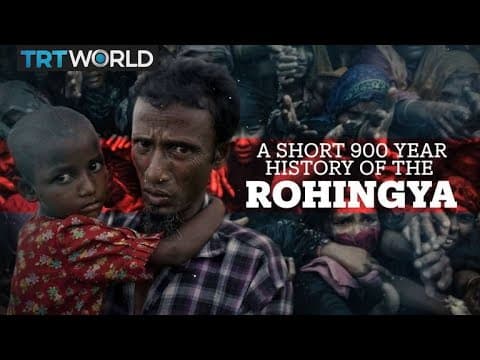
A short history of the Rohingya people
TRT World
5m 41s1,018 words~6 min read
YouTube auto captions
Transcript source
YouTube auto captions
This transcript was extracted from YouTube's auto-generated caption track. The transcript below is server-rendered so it can be read, searched, cited, and shared without opening the original YouTube player.
Pull quotes
[0:00]The Rohingya are a predominantly Muslim ethnic minority who mostly live in Rakhine State in majority Buddhist Myanmar.
[0:00]The UN says their persecution in 2017 was a textbook example of ethnic cleansing.
[0:00]And the UNHCR says that the Myanmar government has been killing men, slaughtering children, raping women and burning entire villages to the ground, forcing them to flee to Bangladesh.
[0:00]The Rohingya have faced persecution for decades, especially after a 1982 law which stripped them of citizenship.
Use this transcript
Related transcript hubs
Watch on YouTube
Share
MORE TRANSCRIPTS


