[0:00]In this video, I'm breaking down the exact science of running faster for longer. Whether you want to crush your 5K or go for your first marathon. My name is Nicholas, I'm a sports scientist, physiotherapist, and former professional triathlete, and I've helped thousands of runners get new personal bests. And in this video, I want to cover everything: biomechanics, training strategies, nutrition, and recovery. And then I want to go over running gear, so you know exactly what you need to run faster for longer and avoid spending your hard earned money on stuff that really doesn't matter. So by the end of this video, you'll have a complete plan on how to run faster for longer without getting injured. But what does it really take to run faster for longer? To understand speed, we first need to break it down into two components: biomechanics and physiology. In general, there are three ways to run faster. You can take longer steps, you can take more steps, or a combination of the two. So let's start by looking at some common beliefs surrounding your stride. Belief number one is that a shorter ground contact time, which is how long your foot stays on the ground when you're running, will make you more efficient. And a meta-analysis from 2024 actually looked at how different running biomechanics affect running economy. Running economy being how efficiently you use oxygen when you run. The researchers found that ground contact time doesn't seem to have any effect on running efficiency at all. Whether your foot stays on the ground for a shorter or longer period, doesn't seem to have much of an effect on how much energy you use. Which brings us to common belief number two, which is that a higher step frequency, meaning how many steps you take per minute, will make you more efficient. Well, according to the study, runners who took more steps per minute tended to be slightly more efficient. This means that increasing your cadence can in some cases make you run faster for longer. Another meta-analysis from 2022 looked at how changing your steps per minute affect your injuries, your performance, and also your running biomechanics. They found that increasing your step rate by 10% can actually help reduce the impact on your knees and your hips. That means that if you run with 160 steps per minute, and then you increase it to 176 steps per minute, then your joints take less impact with each step. And this may help you reduce knee pain and overuse injuries. But one of the biggest takeaways is that vertical movement or how much you bounce up and down has a noticeable effect on your running efficiency. If you reduce excessive vertical movement, then you tend to have a better running economy because you don't waste energy bouncing up and down, and you can use that energy that you save to make you go forward. So, what does these findings mean if we want to run faster for longer? If you want to improve your efficiency, then you should focus on avoiding bouncing up and down too much, and then you should try to have a slightly higher cadence. But biomechanics alone only explain about 4 to 12% of the differences in running economy between runners. That means that factors like fitness level and muscle efficiency still play a much bigger role in overall performance. So let's talk about what those factors are and how to influence them. You've probably heard of training zones. Maybe you've also heard about periodization, things like base and build phases. Or training intensity distribution, things like 80/20 training or threshold or pyramidal training. If all of that sounds confusing, I get it. It was for me at first too. So let's make it simple. Let's start with the training zones. Some people use three zones, some people use five zones, and some people even use seven zones to describe how hard they're training. But in scientific terms, when it comes to endurance training, we really only have three zones. And to understand how these zones are divided, you first need to learn about something called lactate. Now, I know it's not the sexiest thing in the world, but stick with me here. I'll make it simple. Think of lactate as a molecule you create more and more of, the harder and harder you train. When you start to run faster, at some point you'll start to make more lactate, and when it starts to accumulate in the blood, it's called the aerobic threshold, or the first lactate threshold, LT1. Then you train even harder, and at some point, the amount of lactate in your blood will start to make a steep incline in your blood, like this. When it does that, it's called the anaerobic threshold, or the second lactate threshold, LT2. See how LT1 and LT2 divides our training into three different zones? Zone one, which is before the first lactate threshold. Zone two, which is between LT1 and LT2, and zone three, which is above the second lactate threshold. This is something we can use to structure our training to run faster for longer, and I'll show you exactly how in a moment. But if you don't have access to measuring lactate, like most normal people don't, then zone one is roughly below 70% of your heart rate max. And zone two is roughly between 70 to 90% of your heart rate max, and zone three is above 90% of your heart rate max. You could also simply think of it as easy, medium, and hard. Like mentioned earlier, some coaches use a five zone model where they divide the training like this. Zone one and zone two is before LT1, zone three and zone four is between LT1 and LT2, and zone five is above LT2. But for simplicity's sake, we'll just use three zones in this video. Now that we know about these training zones, how do we use it to our advantage? Or put another way, how much time should we spend in each zone? This is where training intensity distribution or TID for short comes in. TID is how much time we allocate to each zone. There are three main TIDs that have been studied and proven by science to be the most effective. The first one is a pyramidal model where you spend around 80% in zone one, 15% in zone two, and 5% in zone three. The second one is an 80/20 distribution, meaning that you spend around 80% in zone one, then 0 to 5% in zone two, and then 15 to 20% in zone three. The reason that is not exactly 80/20 is that in order to go from zone one to zone three, you first have to go through zone two, so there'll always be a couple of percentages there. The last training intensity distribution is called threshold training. With this TID, you spend around 55 to 60% in zone one, at least 35% in zone two, and 0 to 5% in zone three. So now you're probably wondering, okay, so should I just pick one of these TIDs and then stick to that forever? Not exactly. This is where things get a bit complicated, but stick with me here. I'll try to make it as simple as I can. So, over the years, scientists have discovered that if you mix up your TID in phases, so you train differently, depending on the type of phase you're in, then you're going to run faster than if you just stick to the same thing over and over again. This is known as periodization. So think of periodization as the big picture training plan. Basically, how your training and your intensity evolves over time to help you peak at the right time. It's about changing focus at different times to get the best result. On the other hand, training intensity distributions is how hard each workout is in that period. Think of it like this: the periodization is the when, so what phase you're in. The TID is the how. So how your workouts are split between easy, medium, and hard. In a normal linear periodization, we have four different phases: the base phase, where the goal is to build endurance, the build phase, where we get a bit more race specific and the intensity increases. The peak phase, where it's all about fine tuning performance, and the taper phase, where the goal is just to get ready to perform. Most elite athletes also have a fifth phase, which is off-season or deloading. But here's the key. Progression is what ties it all together. Each phase builds on the one before it. You don't just jump straight into high intensity training. You gradually increase volume, intensity, and specificity, so your body adapts one step at a time. So, that was a lot. How do we make sense of all this? Let me give you an example. In the base phase, the goal is to build endurance. Most of the training is low intensity, so we could follow something like a pyramidal model. As we move into the build phase, intensity increases. Maybe more training shifts towards threshold work, making it more of a threshold training split. Then we hit the peak phase, and things shift again. High intensity sessions might become more specific with VO2 max work and speed drills. For this, we might use the 80/20 model to fine-tune our performance. Finally, in the taper, the total training volume decreases, but intensity remains, so we might still use the 80/20 split. The goal here isn't to gain fitness, but to absorb all the hard work you've done and get ready for race day. So in simple terms, periodization is the how and the when your training changes over time. And TID is how the training intensity is split up within each phase. Your TID might evolve as you go through periodization to help you train smarter and peak at the right time. So now that we know how to structure our training to run faster for longer, what types of workouts should we do? When it comes to endurance training, most people think that your VO2 max or how much oxygen your body can take is the ultimate measurement of performance. But it turns out it's not the best predictor of who wins races. A scientific review from 2010 found that while VO2 max sets the upper limit for how much oxygen your body can take in and use, it doesn't tell the full story. Instead, running economy, so how efficiently your body uses that oxygen, is often a better predictor of your performance. Think of it like fuel efficiency in cars. Two cars can have the exact same engine size, but if one uses fuel more efficiently, it will go further and faster given the same amount of fuel. The same thing goes for runners. Those with a better running economy, uses less oxygen at a given speed, so they are more effective and so they can run faster for longer. So while VO2 max gives you the potential, running economy determines how much of that potential you can actually use in a race. So what can we make of all of this? If you want to run faster for longer, you should focus on increasing your VO2 max. But you should also work on improving your running economy. Besides focusing on your running biomechanics, like we talked about earlier or just running more, there are four more ways you can do that. A systematic review from 2024 found that strength training improves running economy in highly trained runners by increasing force production and reducing oxygen demand at a given pace. The best exercises to use was squats, deadlifts, and power cleans to enhance lower body strength and improve force application. But single leg exercises like Bulgarian split squats can also help by developing balance and stability. And both are essential for efficient running mechanics. If you want a full strength training protocol designed specifically for runners, then check out the link in the description below. The second key to better running economy is what's called plyometrics. Simply put, plyometrics helps us use energy more efficiently. There are a million ways to do plyometrics, but in my experience, doing something like box jumps, and then standing tall jumps, and something called bounding, does the trick nicely. Think of your training this way: When you push your body hard and then recover, your body gets better. It's like your body thinks, whoa, that was hard. I need to evolve, so I can do that better next time. Over time, this makes you faster and less tired on race day. So what's the best way to train for this? Well, there are five main workouts. The first one is called VO2 max intervals. Workouts like a 4x3 minutes best average pace with a rest of two minutes, or the classic 10x800m with a 200m jog in between. These workouts will, as the name suggests, help you improve your VO2 max. The second one is short hill sprints of around 10 seconds. These helps you improve your power and your efficiency. The third way is what's called tempo runs. These intervals are typically longer, so something like 3x10 minutes at a hard pace, but still sustainable. So think close to that LT2 line. These type of workouts will help you sustain a higher pace for longer by improving your ability to clear lactate. And finally, there are long and easy runs. These balance out your training, helps you build endurance, and helps you keep that training intensity distribution in check. By combining all five, you build speed, efficiency, and endurance. So come race day, your body is ready to perform at its best. But we are still missing one crucial aspect. You see, running economy isn't just about strength and endurance. It's also about how smoothly and efficiently you move. Think of it like fine tuning a car. When everything works together and runs smoothly, you use less fuel to go the same distance. By doing coordination drills, you basically teach your body to move more efficiently, making you able to run faster for longer. Some of the best drills for this are what's called A-skips, B-skips, and high knees. The reason most runners use these drills is because they reinforce proper posture, your foot strike, and your stride mechanics. But now you're probably wondering, do I need to do all of that all the time? No. It's important to note that overtraining or training too much reduces your neuromuscular efficiency and increases your injury risk. In fact, a meta-analysis from 2023 found that you need to have about 21 days of taper leading into a race, and you need to do a deload week where you train less every three to four weeks. And to avoid overtraining, your training volume matters, but so does your nutrition. The right fuel can mean the difference between hitting your new top speed and getting injured. So let's break down exactly what your body needs to perform at its best with precise numbers to optimize your fueling strategy. A scientific review from 2017 found that carbs are the most efficient and fastest way of getting energy for high intensity running. That means that if you are running anything shorter than an ultra marathon, then carbs are your best friend. So, how much do you need? It turns out it depends on your training load. On light training days, aim for around three to five grams of carbohydrate per kilogram of body weight, or 1.4 to 2.3 grams per pound of body weight. On moderate training days, increase that to around five to seven grams of carbohydrate per kilogram of body weight, or 2.3 to 3.2 grams per pound of body weight. And on heavy training days or race days, you might need as much as 8 to 12 grams of carbohydrate per kilogram of body weight, or 3.6 to 5.5 grams per pound of body weight. And what about during your runs? What should you eat? If you're running for more than 60 minutes, research suggests taking in 30 to 60 grams of carbohydrate per hour. This will help you sustain endurance, but it's important to note that the ability to absorb carbs itself is trainable. So you could hit numbers as high as 90 grams of carbohydrate per hour if you've trained your gut. This is why ultra marathons and Iron Man's are often referred to as eating competitions, as much as a competition on endurance. The athletes who can absorb the most amount of carbs has a huge advantage. But what types of carbohydrates should we eat then? Research suggests that the best combination of carbohydrates mid-run or for endurance is a two to one mixture of glucose to fructose. This combination has been shown to speed up absorption and avoid stomach issues. Most sports drinks and energy powders follow this recommendation, so if you go with any of the major brands, you're pretty much home safe. But one thing is performance. The other thing is recovery. And those two can't live in a vacuum. It's a constant battle between training hard and recovering. And to recover, you need protein. A scientific review from 2017 found that around 1.6 grams of protein per kilogram of body weight per day, or around 1 gram per pound of body weight per day will help you build muscle and get better endurance. Even though there's a lot of talk about timing protein after training, it's not as important as most people think. The most important thing is getting enough protein throughout the day. Some of the best sources are lean meats, fish, poultry, eggs, and even protein shakes. But protein won't help you if you don't have your hydration and your electrolytes dialed in. So let's talk about it. Let me just come straight out and say it. Dehydration slows you down. Research suggests that even a 2% loss in body weight due to sweat will reduce your speed and your power output. So how much do we actually need per day? Aim for 35 to 45 milliliters of water per kilogram of body weight per day. Or 0.5 to 0.7 ounces of water per pound of body weight per day. Then add about 500 to 750 milliliters per hour of exercise, depending on your sweat rate. On top of that, the American College of Sports Medicine recommends 300 to 600 milligrams of sodium per hour during prolonged exercise and 100 to 200 milligrams of potassium per hour to support muscle contractions. Although most people get enough potassium through their normal diet. I've found that the easiest way to hydrate is sports drinks, electrolyte tabs, and coconut water. So now you're probably wondering, what about when to eat? Does that matter? Well, what you eat and when you eat directly impacts your performance. A study from 2011 found that pre-run meals high in carbs helps sustain energy levels during races. So here's a simple way to approach when you eat: Two to three hours before your race, eat the following: 1 to 4 grams of carbohydrate per kilogram of body weight. About 10 to 20 grams of protein for muscle support, and low on fats to avoid digestion issues. During the race, if the race is longer than 60 minutes, eat the following: Aim for 30 to 60 grams of carbohydrates per hour with a mixture of a two to one glucose to fructose. Get small amounts of sodium, so 300 to 500 milligrams per hour, and maybe even some potassium with 100 to 200 milligrams per hour. And after your race, eat the following: Around 1 gram of carbohydrate per kilogram of body weight within the first 30 minutes after your race to replenish your glycogen stores. 20 to 40 grams of protein to help you rebuild muscle, and then rehydrate with electrolytes. But what about gear? Can the right gear actually make you faster? Yeah. A scientific study from 2018 actually found that carbon plate shoes, also known as super shoes, improve your running economy by 4% on average. And let it be up to you if a 4% increase in running economy is worth the money, but to me, it is. Then there's heart rate monitors and foot pads, and they can help you with pacing. But research has also shown that excessive tracking can backfire and actually make you perform worse. So what about supplements? Research has found that caffeine and what's called beta-alanine improves performance for endurance runners. And creatine may help with sprints, but not with VO2 max and endurance. There's also some promising research surrounding ketones, but to be honest, most other stuff don't really work, so be careful how you use your money. So, if you want to run faster for longer, it's not just about running more. It's about training smarter, getting stronger, fueling the right way, and choosing the right gear. And if you want a complete 50-day plan that uses all of these principles, then go check out this video next.
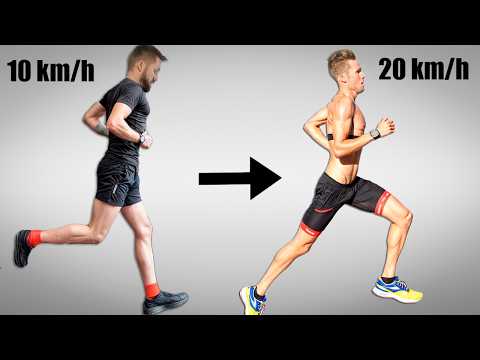
The Smartest Way To Run Faster For Longer (Science Explained)
Nicklas Rossner
21m 23s3,561 words~18 min read
YouTube auto captions
Transcript source
YouTube auto captions
This transcript was extracted from YouTube's auto-generated caption track. The transcript below is server-rendered so it can be read, searched, cited, and shared without opening the original YouTube player.
Pull quotes
[0:00]In this video, I'm breaking down the exact science of running faster for longer.
[0:00]My name is Nicholas, I'm a sports scientist, physiotherapist, and former professional triathlete, and I've helped thousands of runners get new personal bests.
[0:00]And in this video, I want to cover everything: biomechanics, training strategies, nutrition, and recovery.
[0:00]And then I want to go over running gear, so you know exactly what you need to run faster for longer and avoid spending your hard earned money on stuff that really doesn't matter.
Use this transcript
Related transcript hubs
Watch on YouTube
Share
MORE TRANSCRIPTS


