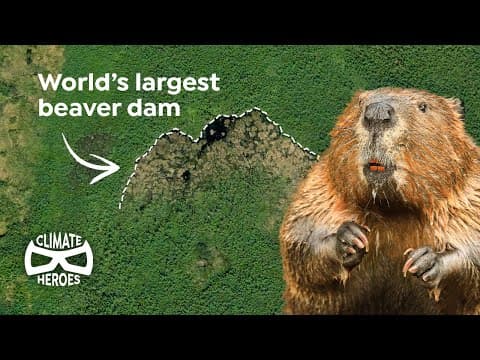
[0:01]A Canadian beaver family has created their own watery kingdom. They've built the biggest beaver dam the world has ever seen. The walls are not very tall, but the structure is more than twice as long as the Hoover Dam. It is so massive that it can even be seen from space. Back in 2007, researchers found the beaver dam by coincidence, while analyzing satellite images. Today, scientists are intentionally on the lookout for beaver dams. The rodents work even grabbed the attention of NASA, because these dams seem to have a huge impact on the landscape. But how is it that little rodents with a fondness for wooden sticks can have such an influence? Are they really rewilding areas just by doing their thing? And in what sense is their engineering work important for us humans? Beavers are capable of impressive architectural work when humans aren't holding them back. That's what beaver researchers suspected for many years. In 2023, NASA stepped in and teamed up with them to finally measure the impact of beavers on their surroundings. The team started tracking how beavers transformed the landscape. Their research started in Idaho. A significantly high number of beavers live here. And there's a special reason for that.
[1:27]A few hundred years ago, beavers were nearly extinct all over North America. Humans had hunted them for their fur and castorum. Until the species was left in only a few places. One of them was Idaho.
[1:42]But here, the beavers also came into conflict with settlers. In 1948, the Idaho Fish and Game Department decided to relocate them to remote areas instead of killing them. A load of beaver for the mountain. 76 beavers were put into wooden boxes and relocated by parachute to the Chamberlain basin. The adventure went well, all but one of them had a safe landing. Now, into the air and down they swing. Back then, nobody knew how huge the beaver's impact would be. And the most unusual and novel trip ends for Mr. Beaver. Today, more than 75 years later, NASA analysts can see the effect of all those parachuted beavers. Shortly after the translocation, something remarkable happened to those remote areas. The beavers transported there had started building dams, breeding and storing food. The areas became lusher and greener than the neighboring land. Baugh Creek, which received many animal packages from the sky, became so verdant that the greenery clearly stood out from space. Satellite imagery shows that in 2018, during massive forest fires, these beaver-rich areas were resilient. Beavers turned out to be efficient mini-firefighters.
[3:06]Studies also showed that the beaver presence boosted the diversity of plants by one third. So, in a nutshell, beavers make their natural surroundings more resilient just by doing what they do best, building dams. It might look like beavers are trying to put their dams everywhere. But in fact, they are very choosy about where they build. Following the sound of running water, a beaver will search heavily wooded areas to find a medium-sized stream that's not too steep or too deep. Then it combines vegetation, mud, and sticks to create a bank along the stream's edge. Using its teeth, which are three times stronger than those of any other mammal this size, the beaver choose nearby logs into sturdy sticks, rolls them into the water, and spikes them into the mud bed. Everything is anchored with heavy rocks that the beaver brings to the site. The larger the dam, the larger the beaver's territory. Beaver dams come in several shapes and sizes, but none of them stops the water entirely. They all just slow it down. The water eventually finds its way around the sticks and through the dams. So beaver dams change the water flow just enough for it to spread out, pool, soak the soil, and create wetlands. Remember the world's biggest beaver dam. The generation of beavers that maintain it have created a pond containing roughly 70,000 cubic meters of water. That's 1,600 hockey ranks of water. And what's the beaver's reward for this hard work? By converting a stream into a pond, beavers are creating the perfect surroundings for their family. Their webbed hind feet and flattened tail serve as efficient paddles and rudder, which makes them weigh faster in water than on land. So, a deeper watercourse means that the animals can move more efficiently. Deeper water means also more safety for their family and their house. Beavers don't live inside their dams. Dams are more like their workplace. Their actual home is the Beaver Lodge, which is located behind the dam. Beaver lodges may look like a mess of sticks and logs, but they are complex and well structured. The entrances are underwater to keep young ones safe from predators. Above is a suite of rooms. There's a mud room where they can dry off, a family room where they eat and sleep. The roof is kept loose to let in fresh air. And as a finishing touch, they excavate the mud from the shore of the site, so that their home will be totally surrounded by water.
[5:50]The beaver channels also connect bodies of water, increasing the biodiversity areas between water and land. And their lodges often serve as nesting sites for various bird species. But it's not only the rodent itself and other wildlife that profits. Humans also benefit from beaver construction projects. Dam building beavers are helping stave off some of the worst effects of climate change, droughts and floods. A professor and beaver expert at Boston University says that beaver activity may be also the most cost-effective method of creating functional wetland systems. Their dams help control water levels in rivers and streams. This is helpful during big rains because it stops flooding. Plus, it keeps water around during dry times, which is great for plants, animals and people. The wetlands they create serve as effective carbon sinks. And as already mentioned, beavers also help prevent wildfires. They make the land around them wetter. When wildfires happen, these wet areas act as natural barriers, slowing down the fire and keeping it from spreading too fast. So, in short, beavers aren't just furry architects. They're also true climate heroes.
[7:16]That's why today, beaver translocations take place not to get rid of them, but to preserve them and nature. And good for them, humans have learned how to relocate them in an appropriate way. Not with parachutes, but with horses.
[7:35]Want to meet more wild climate heroes? Check out our playlist.