[0:00]Imagine stepping outside into a world where the temperature plummets to a bone-chilling minus 71 degrees Celsius. That's so cold your breath instantly turns into tiny ice crystals and falls to the ground. This isn't science fiction, it's a reality in some of the most extreme places on Earth. Like the Vostok Station in Antarctica, which recorded a staggering minus 89.2 degrees Celsius. But what would actually happen to a person exposed to such brutal cold? Well, let's just say it's not a place you want to be without some serious protection. In just a few minutes, the cold would start to cause severe frostbite, freezing your skin and the tissues beneath it. Your fingers, toes, nose, and ears would be the first to go. Your body would shiver uncontrollably, trying desperately to generate heat. But soon, that shivering would stop a very dangerous sign. Confusion and disorientation would set in as hypothermia takes over, slowing down your heart rate and breathing until eventually, everything just stops. It's a grim picture, but it highlights the raw power of nature. So, what about the world around you at minus 71 degrees? It behaves in some truly bizarre ways. If you were to throw a cup of boiling water into the air, it wouldn't even hit the ground as water. It would explode into a cloud of ice crystals, a phenomenon known as the Mpemba effect, but on an extreme level. Have you ever wondered what would happen if you touched a piece of bare metal at this temperature? Your skin would freeze to it instantly, and trying to pull it away could rip your skin right off. Even simple things become impossible. Your car? The engine oil would be as thick as concrete, and the battery would be completely dead. Your smartphone? The liquid crystal display would freeze and the battery would fail in seconds. Your own eyelashes and the moisture in your eyes would freeze shut if you blinked too slowly. It's a world where the very air you breathe can hurt you. The cold air can cause a painful burning sensation in your lungs, and doctors advise against talking too much or breathing too deeply when outside. But here's the truly amazing part. Life still finds a way. In these frozen landscapes, some incredible animals don't just survive, they thrive. Think of the Emperor penguin. These remarkable birds huddle together in massive groups to share body heat, with each penguin taking a turn on the frigid outside of the huddle. They have a thick layer of blubber and specialized feathers that trap air for insulation. Their circulatory system is also a marvel, designed to minimize heat loss through their feet. Then there are seals, like the Weddell seal, which have an even thicker layer of blubber. and can hold their breath for over an hour to hunt for fish under the ice, safe from the biting winds above. Even smaller creatures have adapted. There's a tiny insect, a type of midge that produces a natural antifreeze in its blood to keep from freezing solid. It's a testament to the incredible power of evolution. So how do humans, who are definitely not built for this kind of cold, manage to live and work there? Scientists stationed in places like Antarctica are like astronauts on another planet. Their survival depends entirely on technology and careful planning. They wear layers upon layers of specialized clothing. The outer layer is completely windproof and waterproof. The inner layers are made of materials like wool and fleece that trap body heat. Their boots are massive with thick insulation, and they wear special goggles to protect their eyes from freezing and from the blinding glare of the sun reflecting off the snow. They don't just walk outside. They prepare for an expedition every time they leave their heated research station. These stations are their lifeline, incredibly well-insulated buildings that provide warmth, food, and a safe place to work. They even have to bring in all their supplies, from food to fuel, on specialized ice-breaking ships or cargo planes that can land on ice runways. Let's try a little thought experiment. Imagine you're a rookie scientist stepping out of the research station into minus 71-degree air for the very first time. The moment the door opens, the cold hits you like a physical wall. It's not just cold, it's a searing, painful sensation. Every exposed bit of your face stings. Your nostrils feel like they're freezing together with every breath. You pull your face mask up tighter, your goggles immediately fogging from your breath before the anti-fog coating kicks in. The world is eerily quiet. The snow doesn't crunch under your boots. It squeaks, a unique sound it only makes at these extreme temperatures. The sky is a brilliant, clear blue, but the sun on the horizon offers no warmth at all. It just hangs there. A distant, powerless star. You see your own breath, not as a cloud of vapor, but as a glittering shower of tiny diamonds falling at your feet. It's beautiful and terrifying all at once. You feel incredibly small and fragile in this vast, frozen world. You check your watch, but the digital display is slow and faded. You know you only have a few minutes before you have to get back inside to safety. It's an experience that would change your perspective on the world forever. Here are a few more mind-blowing facts about this extreme environment. At minus 71 degrees, sound travels differently. The dense, cold air can make distant sounds seem much closer. Also, steel becomes as brittle as glass and can shatter on impact. This is why tools and equipment have to be made from special alloys that can withstand the cold. Even the simplest tasks, like turning a screw, become a major challenge because you have to wear thick, clumsy mittens. Forget trying to write with a normal pen, the ink would be a solid block of ice. Scientists have to use pencils. Living in such an extreme place teaches you to appreciate the simple things, like a warm room and a hot cup of coffee, in a way you never thought possible. From animals with natural antifreeze to humans living in high-tech survival pods, the coldest places on Earth are a stunning example of the struggle and triumph of life. Thanks for joining me on this journey to the coldest corners of our planet. If you were fascinated by these incredible facts, make sure to hit that like button and subscribe for more amazing stories about our world. See you in the next video.
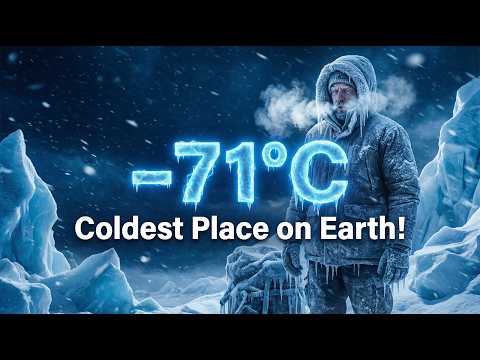
−71°C | Can Humans Survive? | The History Narrator
The History Narrator
6m 23s1,108 words~6 min read
YouTube auto captions
Transcript source
YouTube auto captions
This transcript was extracted from YouTube's auto-generated caption track. The transcript below is server-rendered so it can be read, searched, cited, and shared without opening the original YouTube player.
Pull quotes
[0:00]Imagine stepping outside into a world where the temperature plummets to a bone-chilling minus 71 degrees Celsius.
[0:00]That's so cold your breath instantly turns into tiny ice crystals and falls to the ground.
[0:00]This isn't science fiction, it's a reality in some of the most extreme places on Earth.
[0:00]Like the Vostok Station in Antarctica, which recorded a staggering minus 89.2 degrees Celsius.
Use this transcript
Related transcript hubs
Watch on YouTube
Share
MORE TRANSCRIPTS


