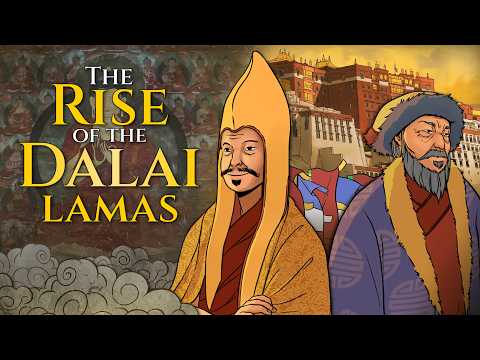
[0:02]For more than 300 years, the government of the Dalai Lamas dominated the political and religious world of Tibet. Based in the great city of Lhasa, at its height the Tibetan state was a complex bureaucracy which united the aristocratic clans and influential sects of Tibetan Buddhism under a single banner. At the head of this vast administration was the Dalai Lama himself, a monastic leader whose authority was passed on through a system of reincarnation, establishing a lineage of religious hierarcs that continues to this day. But who were the first Dalai Lamas and what historical forces shaped their rise to power? The answer to that question takes us back in time to the 16th century and the distant grasslands of Eastern Tibet where a young monk would soon forge a dangerous alliance that would reshape the political landscape of Central Asia for centuries.
[1:13]At the dawn of the 16th century, the political world surrounding the Tibetan plateau had changed dramatically from the soaring heights of the Sakya Hegemony. To the north, following the collapse of the Great Yuan Dynasty, the Mongol factions of the step had divided and were now loosely formed into Eastern and Western tribal confederations. As these vied with one another for control of the region's rich pasture lands, one by one, the Mongol Khans began to seek out new allies to the south, among the fractious Tibetan principalities. To the east, a new and powerful Imperial faction known as the Ming Dynasty had emerged in China. As they consolidated power, financing vast projects in infrastructure and agricultural development, the Ming also waged a series of grueling campaigns against their Mongol rivals. And as wars raged across much of Central Asia, within Tibet itself, ancient and bitter clan rivalries had spiraled into civil war.
[2:25]The ruling dynastic house, the Morabund Pagmadru, were in a state of steep decline, increasingly unable to assert themselves over the Clannish aristocracy of Central Tibet. Plagued by internal conflicts and weakened by civil war, by the late 16th century the Tibetan plateau had once again become a patchwork of petty kingdoms and feuding principalities. These feuding houses often formed strategic alliances with the great sects of Tibetan Buddhism, which sought to expand their own influence both within and without the Tibetan speaking world. This drew the great sects into direct conflict on numerous occasions, as they vied with one another for land, resources, and the patronage of powerful warlords and kings. It was into this landscape of competing clan and sectarian factions that the first historical Dalai Lama was born. The first man to bear the title Dalai Lama is known today as Sonam Gyatso, or the Ocean of Wisdom. Born in 1543 in the Central Tibetan Kingdom of U, Sonam Gyatso is the child of a regional governor with strong ties to the rulers of the neighboring Kingdom of Tsang. Shortly after his third birthday, Sonam Gyatso was recognized by the leaders of the Geluk sect of Tibetan Buddhism, as the reincarnation of a former abbot, and taken to the great monastic complex of Drepung, where he was educated and as a child enthroned as abbot in the year 1550. As a young man, he appears to have flourished in his studies to such an extent that within two decades he emerged as one of the leading Buddhist teachers in Central Tibet. Records show that in the early 1570s he began to serve as the personal tutor to the Pagmadru rulers of U, and his formidable reputation also spread to foreign lands. Reaching across the Eastern Mongol Khanates to the court of the Chieftan of the Tumed, the warlord Altan Khan, who had recently converted to Buddhism. In the year 1577, the Khan invited Sonam Gyatso to make the perilous journey to his realm, in an event that would prove decisive for the Geluk sect, and indeed for the future of Tibet itself. While later religious histories have often emphasized the fame of Sonam Gyatso in Mongol lands, contemporary scholarship suggests that there may have been additional strategic motivations underlying Altan Khan's invitation, as well as the Geluk sect's interest in cultivating patronage among the Mongol Khans.
[5:10]By the mid-16th century, the Gelukpa were in a unique position among the great schools of Tibetan Buddhism. Following decades of conflict with the Drigung Kagyu and their patrons among the Western House of Rinphung, the Geluk sect had gained a strong foothold in Central Tibet, where they controlled the great monasteries of Drepung, Ganden, and Sera, which dominated the political landscape of the Kichu River Valley, and with it much of the region's vital trade. Despite the strategic advantages of their position in Central Tibet, the Gelukpa founded in the late 14th century, were a relatively new religious movement and had historically struggled to find patrons among the Clannish aristocracy of Eastern and Western Tibet. Many of whom already shared ancient alliances with the older schools of Tibetan Buddhism. This made the Mongol factions natural allies for the young Sonam Gyatso. Centuries earlier, the Mongol Khans had once widely supported the schools of Tibetan Buddhism, and if they could be converted, perhaps the Khans would become great patrons once again.
[6:22]Intent on securing this vital line of patronage, in the spring of 1578, Sonam Gyatso met Altan Khan, by the shores of Lake Kokonor, in the northeastern region of Amdo. Over the weeks that followed, they traveled together to the distant encampment of Hohhot, crossing Tibetan, Ming, and Mongol lands. Shortly after arriving, in an exchange of spiritual and political powers, the two leaders reached an historic accord. By the terms of their agreement, Sonam Gyatso recognized Altan Khan as the reincarnation of Kublai Khan, thus providing Altan with a spiritual claim to the ancient Chinggisid lineage. In turn, Sonam Gyatso was himself identified as a reincarnation of the 14th century Tibetan statesman and religious leader, Drogön Chögyal Phagpa. As seen in earlier episodes, in the late 14th century, Kublai Khan and Pagpa had once shared a Priest Patron relationship, known as Chöyon in Tibetan. A unique religiopolitical alliance that once dominated the political world of the Tibetan plateau. This ancient alliance provided the historical and spiritual precedent for a new partnership that would once again bring Mongol armies to the fertile valleys of Central Tibet. Over the course of the following year, Sonam Gyatso stayed in Hohhot, teaching and performing elaborate rituals for the benefit of Altan's court. In return, he received a promise of patronage and a title crafted by the Mongols befitting of his new position. The wondrous Vajra holder, excellent, splendid, meritorious, Ocean. This was soon shortened by the Tibetans to Dalai, a Mongolian translation of his name, and the origin of the term, Dalai Lama. During the negotiations, two historical figures in the Geluk sect, the great abbot Gedun Drup and the scholar Gendün Gyatso, were posthumously declared to be the first and second Dalai Lamas. While these figures were long dead, in the eyes of many, this strengthened the title Dalai, aligning the position with the highly revered lineage of reincarnated monastic leaders in the Geluk tradition. For this reason, Sonam Gyatso is considered today to be the third Dalai Lama, despite being the first historical figure to hold the office. In spite of the resounding success of his mission to secure Mongol patronage, Sonam Gyatso would never again return to Central Tibet. In the year 1588, while traveling in Mongol lands, he would suddenly fall ill and die. Fearing that the political and spiritual partnership forged with the Tumed would collapse, the remaining Geluk hierarcs in Central Tibet, moved quickly to find a child who could be identified as Sonam Gyatso's reincarnation. After a brief search, the great grandson of Altan Khan was identified as a candidate, and brought to Central Tibet to be recognized as the fourth Dalai Lama. The enthronement of the fourth Dalai Lama formalized a powerful symbolic union. Using reincarnation as a form of institutional succession, the Gelukpa had bound themselves to the great military powers of the Eastern step. This move was greeted with great enthusiasm among the Tumed aristocracy, but it also significantly deepened tensions with the Gelukpa's rivals in Central Tibet. These tensions would soon come to a head, erupting in open monastic warfare.
[10:19]By the year 1600, much of the Tibetan plateau was governed by the Tsangpa Dynasty, a recently founded Clannish faction that had seized political power through a successful rebellion, and sought to expand their lands through military conquest. Ruling from the great fortress of Samdruptse, to assure religious legitimacy, the Tsangpa had allied themselves with the Gelukpa's chief monastic rivals, an older sect hailing from Eastern Tibet, known as the Karma Kagyu. Together, the Tsangpa and their monastic allies viewed the growing influence of the Geluk sect and the military power of their Mongol patrons with great concern. The rivalry between the Tsangpa Dynasty and the Geluk sect continued to grow. The presence of Mongolian clan aristocracy in Lhasa, which came with heavily armed detachments of cavalry, drew the ire of the Tsangpa regime. Blistering polemical texts were penned criticizing the Geluk, as the Tsangpa quietly bid their time and armed themselves for a war that seemed all but inevitable.
[11:31]Following the sudden death of the fourth Dalai Lama in the year 1617, as the Geluk hierarcs looked to secure new leadership, the Tsangpa saw an opportunity to strike. In the summer of 1618, they launched a surprise attack on the city of Lhasa, quickly defeating the Geluk's allied garrisons, and laying siege to the great monasteries of Drepung and Sera. While these were well fortified and provisioned to withstand a prolonged siege, many of the surrounding estates and temples were not spared in the assault. This attack on Lhasa began a 24-year bloody conflict, which historians sometimes call the U-Tsang Civil War. For two decades, much of Central Tibet was a battlefield.
[12:25]Despite repeated attempts, the Tsangpa were unable to breach the walls of the great Geluk stronghold surrounding the capital, however, leveraging their political and military power, they were able to seize the majority of the remaining Geluk lands, and shatter the sect's meager support among the Tibetan clans. Unable to call upon their old allies among the Tumed, who had been conquered by the Qing Dynasty in the early 17th century, the Gelukpa's list of allies grew dangerously thin.
[12:59]Amidst this turmoil, in the year 1617, the fifth Dalai Lama, Ngawang Lobsang Gyatso, was born in the Yarlung Valley, the cradle of Tibet's ancient imperial kings. In an effort to weaken the Gelukpa's position in Central Tibet, the Tsangpa had prohibited the search for the fourth Dalai Lama's reincarnation. However, acting in secret, using outlawed rituals, a council of Geluk elders worked to identify the reincarnation among the allied clan houses of U and Tsang. The infant was brought to Drepung Monastery and would spend his childhood in a world riven by sectarian conflict and shifting alliances. As the fifth Dalai Lama came of age, the Tsangpa had begun to tighten their grip over much of Central Tibet. Lhasa remained a Geluk stronghold, but was encircled and increasingly isolated from the trade and tribute that financed its great monastic institutions. It was in this moment of crisis that the Geluk leadership turned northward once again for patronage and military support. Among the rising powers in the Mongol world was the Khoshut clan, led by a new charismatic chieftain, named Gushri Khan, who, thanks to the efforts of distant missionaries, had recently converted and begun to stylize himself as a champion of the Gelukpa. At the behest of the Dalai Lama's chief counselor, Gushri began to assemble a league of Oirat Mongol chieftains under the banner of a new Khoshut-Geluk alliance.
[14:45]In the spring of 1637, as the last of the snows began to thaw, Gushri Khan entered the conflict in support of his monastic allies. Making extensive use of heavy cavalry, he launched a surprise attack, invading the lands of Choghtu Taiji, the Mongol patron of the Karma Kagyu, and a key ally of the Tsangpa regime. According to Tibetan language sources, Gushri Khan crossed into the grasslands of Amdo with a force of 10,000 soldiers, composed primarily of veteran heavy cavalry and light mounted archers. In response, Choghtu Taiji rallied the clans of the grasslands and assembled an army of nearly 30,000 fighting men, however, critically, he was unable to call upon his own considerable reserves of cavalry, as many horses were still spread across the grasslands of Amdo, grazing in the early thaw.
[15:47]The two forces met at a decisive battle near the shores of Lake Kokonor, known today as the Battle of Kokonor. With many of his warriors forced to fight on foot across open grassy terrain, and lacking sufficient reserves of heavy cavalry, Choghtu Taiji was unable to leverage his numerically superior forces. Meanwhile, the Khoshut, under Gushri Khan's command, made expert use of the terrain and their advantage in mobility, inflicting heavy casualties on the larger force before engaging them directly. The result was a decisive victory for the Khoshut Mongols and their allies among the Gelukpa. Choghtu Taiji was killed in the aftermath of the battle, and, leaderless, the nomadic houses of Amdo were quickly subjugated, swearing oaths to the new Khan. Leaving his lieutenants behind to consolidate the nomadic clans, Gushri continued his campaign against the Gelukpa's rivals, riding hard across the Tibetan plateau. Rather than confront the Tsangpa directly, which would expose his flank to attack from the east, the Khoshut forces moved quickly to the south, attacking the Bonpo chief of Beri in Western Kham, another strong ally of the Tsangpa regime. They too were quickly defeated, and before making camp in the winter of 1640, Gushri Khan had seized much of Eastern Tibet under the banner of the Khoshut-Geluk alliance. In the spring of 1641, the Khoshut again broke camp. This time, attacking the Tsangpa directly. Despite holding key mountain fortresses that commanded the river valleys of Central Tibet, the onslaught was overwhelming. In a series of bloody rear-guard actions, the Tsangpa forces were gradually pushed out of the Central Kichu River Valley, retreating to their stronghold, the great fortress of Shigatse Dzong. A prolonged siege ensued, one of the longest and bloodiest of Gushri's campaigns.
[18:03]Many details of the battle are lost to history, however, it is clear that in the summer of 1642, the fortress was finally sacked, its defenders put to the sword, and the last king of the Tsangpa Dynasty, Karma Tenkyong, was killed. This year, 1642, marks a watershed moment in the history of Tibet.
[18:31]Following his victory at Shigatse Dzong, Gushri Khan traveled to Lhasa to meet the fifth Dalai Lama, now a young man. In an elaborate ceremony, Gushri was awarded the title Tenzen Choki Gyalpo, or King of the Dharma. He was also named King of Tibet. However, instead of claiming the Tibetan plateau for himself, Gushri Khan did something unprecedented. He offered political sovereignty over the regions of Ngari, U-Tsang, and Kham to the young fifth Dalai Lama as a gift to seal the Khoshut-Geluk alliance for future generations. The grasslands of Amdo, however, with their rich pasture lands and reserves of horses, would remain for the moment, under Mongol control. Nevertheless, for the first time in hundreds of years, much of Tibet was politically unified, now under the leadership of the fifth Dalai Lama and his newly founded administration in Lhasa, which came to be called the Ganden Phodrang, and is often referred to as the Government of the Dalai Lamas. Under Gushri Khan's protection, the fifth Dalai Lama began an ambitious project of state building. He established a vast, highly complex bureaucracy in Lhasa and conducted a comprehensive census of Kham and Ngari, bringing the great clans of Eastern and Western Tibet into the Ganden Phodrang's new administrative state. The Gelukpa also dramatically expanded their authority under his reign, converting the monasteries of many of their rivals, and seizing the estates of clans that had opposed them in the long and grueling civil war. As the newly founded government of the Dalai Lamas consolidated its power, the fifth Dalai Lama also commissioned the construction of a new, monumental palace, the Potala, which would become the center of government on the Tibetan plateau. Though finally completed years after his death, the Potala Palace, which survives to this day, would grow to be a lasting symbol of the Tibetan state and its links to the past. The government of the Dalai Lamas, forged in the aftermath of the civil war, would endure for more than three centuries, leaving a deep imprint on Tibetan culture and the idea of monastic governance. Yet the foundations of this new political order rested on uneasy alliances that would soon shift, threatening to collapse the new administration and plunge the Tibetan clans, once again, into open war.


