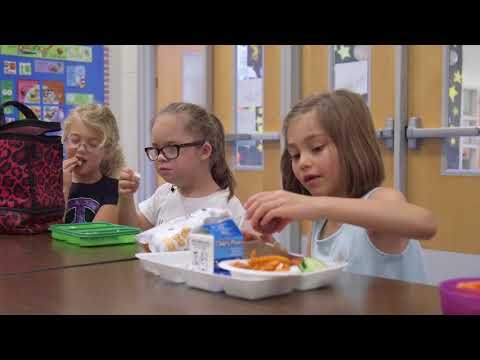
[0:00]As a mama, I really want the world to see what I see in my daughter. When Ruby was born, doctors told us that she was working an extra chromosome. At the time, we didn't know much about Down syndrome. What we did know is that we wanted Ruby to be fully included, not just within our own family, but especially at school. I really want the world to see what inclusion looks like. So many moms ask me, you know, well, what does it look like? What do I even ask for? We're going to do six minus one. All right, roll it to the middle so I can reach it. Ruby inspired me and my husband to start the nonprofit Ruby's Rainbow. And today, she's still inspiring us to turn our scrappy little organization into a movement to show the world what true inclusion can look like. From Ruby's Rainbow, this is the story of inclusion. All right, I'm looking for kids that are sitting down, who are reading quietly. It's just after 7:00 a.m. and Ruby's kindergarten class is just getting started. Good job, Ruby. I like how you got started. We feel super lucky to have Ruby here at Cowan Elementary, our local neighborhood school, where she's been placed within a general education class with 22 other typically developing kids. This is not the norm in all schools. A lot of families have to fight for just what you guys do here naturally. Totally. Um, I think it benefits everyone. I think it benefits the um, inclusion kids that are in there and everyone else in the classroom. It gives them peer role models and peers that they're their same age level. Two and five. Okay, so take off five. One, two, three, four, five. Okay, so break off that one. And you know, that's something that we would talk about anyway is including everybody and being good friends and being kind and caring. Yeah, it's not just you telling them, oh, this is how you're supposed to be, but them actually living it and and doing it every day. Yeah, and they, they totally get it. They get um, that we're different in a lot of ways, but that we're same in so many ways. To make it all work, Ruby's main teacher, Miss Springer, gets a little classroom backup. A few special education teachers and assistants join Ruby's class throughout the day. For one of those teachers, the work happening here is deeply personal. Selena Zapta grew up with an aunt with Mosaic Down syndrome. She remembers the days of segregated special ed classes and how that kind of mindset made an impact on the rest of her family. And I think if people were more open and honest, I think for us as adults growing up, we would have accepted more. Yeah. You know, I remember my mom not wanting my friends to come over because, well, your aunt. They might talk about her. And to me, I was like, no, I think that would help them learn about differences, you know, not just cultural differences but learning differences, you know. Absolutely.
[3:39]But this story has a wonderful message that I want you to listen for. They're just seeing their peers do something. They're lining up. They're sitting quietly. That's what friends do, lift each other over the cracks. Can you see that? And so I'm going to do what I see my peers doing. And then slowly it becomes a part of who I am and what my expectations are. Everyone deserves to be included, right? That is the most important lesson in that book. And so when I'm in the classroom and I see her now, she's getting something out on her own because she sees what her peers are doing and she knows, okay, now it's time for writing. So I'm going to get out my writing book. And so I see her much more wanting to be a part of the classroom. Okay, Ruby, what do you think? No, elephants. No elephants. You are correct. And the expectations of a classroom. She's aware of them now. Where three she wasn't, you know? She was not. And building now. And interacting, you know, during recess time and being able to interact with her friends. They were playing hide and seek at recess today and she was cheating pretty big time, but she was playing.
[4:52]She was like, five, six. All right, Ruby, come on up. But what about all those other kids? Some parents of typically developing children might wonder, how having someone like Ruby as a classmate impacts the quality of their own child's education? All right, Ruby, can you read to us what you wrote? Gracie, come over my house. She wrote that Gracie is coming over to her house. Ella's coming too. Ella is coming too. If you don't have them together, working with each other every single day, they're not going to be able to get that true experience. And that's real life. Who has a question or compliment for Ruby? Fiona. I like her picture and the details. I agree. They're very nice. All children have some kind of a learning difference. Some you can see more clearly, like down syndrome than others. But if you choose to separate them, then they don't get the opportunity to learn from each other. And that's what we do in life. We learn from each other. on a typical student. What am I going to get from Ruby, other than I can help her and I can assist her. But I'm also seeing a child who is so incredibly innocent and sweet. Children with special needs have that incredible gift that we miss sometimes with typical children. And so I think that's a huge benefit that get.
[6:25]What about your friends in school? What do they think about her? I think they all love Ruby because even the boys, because when she was going by one time, we were putting our stuff in the hallway and Luke, he asked Ruby for a high five. And I just that made me happy because now I know that Luke likes Ruby. He does. And knows that she's a good person. Ruby, can we do the secret handshake? Ruby, it makes me feel happy when I've seen Fiona ask Ruby to go play with her. That just makes me happy because I know that Ruby's being fully included in what other people are playing. And she's got friends, right? Lots of them. I think the only concern that I ever really had with her in the school system was the the hope and the longing for everybody else to love her as much as we love her. It's okay to let them try things that they're not going to succeed at. Right. You know, not everything we give her to do is super easy. So, it's not just we only give you things to do that because we know you can do them, is a lot of times we ask her to do things that she is going to struggle with, but that might be part of the reason why she really likes to finish things and succeed at things and why she can be so happy about accomplishing certain things. You are. Hamburger. Oh, that was so good, Ruby. Do it by yourself. Hamburger. You did it. To reinforce what happened at school, Ruby also gets speech therapy a couple times a week. Animal. You know, for so long, kids with disabilities, what's been highlighted is what they can't do. So, you know, you'll get reports back and it's all like these weaknesses keep them from doing this, this and that. I feel like kids with disabilities, like they have the they have they have but preceding them. So, they can do this, but this is limiting them. And with inclusion, it's we're replacing but with and. So you can say Ruby will be in second grade, and she has Down syndrome, and she can do this, this and that. All of a sudden, there's all these opportunities. So what advice would you give a parent that knows this is the right setting? I think I would show them examples like this. Examples of it working. Oftentimes, they're probably people in the school who agree and want it, but maybe they don't know how to work it, or they might not think they have the resources. But then, I think taking small steps, so maybe show something that you know can be implemented. Can we do this, or can we go into the Gen Ed classroom for this amount of time a day, and then building up to it. So let them show, look, my kid can do this, you know, believe in my kid, and then baby step it up to. Yeah, if you introduce it in small steps with, you know, the goal in mind that we want this at the end, but let's try this first. Let's, let's do a small step first. It is a right as a parent with a child with special needs, to be an advocate for your child. And in that, it is so important, and research stands behind this, that they need to be with their typical peers.
[10:07]And so that means if you isolate them from those typical peers, it hurts everybody. So if you don't have that core belief system that every single child deserves to be with their peers and in that classroom, then you can't do it. It will, it will find a loophole, it'll find a way out. You can find reasons not to do inclusion. You have to find reasons to make it work because you believe in it. Since I started Ruby's Rainbow, I've been thinking a lot lately about the word inclusion. It warms this mama's heart to see how many colleges, universities, and postsecondary schools are now accepting students like my Ruby. And here, at the very beginning of her educational journey, it has taken this amazing village of therapists, teachers, principals and allies, who believe in Ruby. And that has made all the difference. Why do you think that instead of her having an extra chromosome, we're all missing one? I love that she makes you feel like you're the only one in the room when you're hanging out with her.
[11:21]She does.
[11:24]I love everything about Ruby, just like I love everything about you. You guys are both little pieces of me and your daddy. You guys are both perfect.
[11:38]Good job. At the end of the day, as a parent, you realize that you are your kids' best advocate. There will be resistance. Do you don't want any mouthwash? There will be setbacks, disappointments. No. Do you want mommy to lay down with you or daddy? But more than anyone, it is us, the parents, who know what our kids are capable of and how they learn best. You stole my heart. What? You stole my heart. I stole your heart? Yeah. Follow your own heart, keep your expectations high, and keep doing what you know is right. I think that's my best advice. I love you. Good night. Good night.


