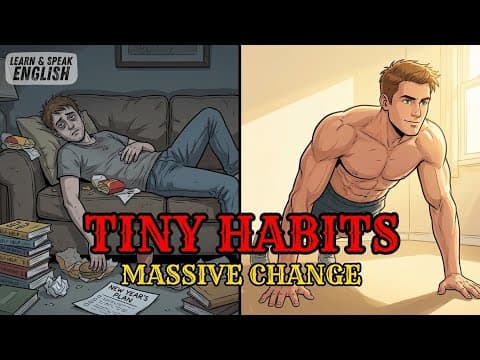
[0:00]Why do some people transform their entire lives with what seems like effortless change, while others try again and again, but always end up back where they started?
[0:13]Maybe you've promised yourself you'd exercise every day, but quit after a week.
[0:20]Maybe you wanted to read more, learn a language, or wake up early, but the motivation always faded.
[0:28]Maybe you're tired of setting big goals that make you feel like a failure when you can't keep them.
[0:35]If you've ever wondered why your willpower disappears just when you need it most, this story will change everything you thought you knew about change.
[0:44]Because once, there was a man who couldn't change anything about his life, until he learned that massive transformation doesn't come from massive action.
[0:55]It comes from something so small, you won't believe it works, stay with me, until the end.
[1:09]In a bustling city where everyone seemed to be racing towards success, there lived a 32-year-old office worker named Daniel.
[1:19]Daniel was the kind of person who had big dreams, but couldn't seem to make any of them real.
[1:25]His apartment walls were covered with vision boards and motivational quotes.
[1:30]His bookshelf held dozens of self-help books, most of them barely opened.
[1:36]His phone had 17 productivity apps, all abandoned after a few days.
[1:42]Every January 1st, Daniel would create an ambitious plan.
[1:47]This year, I will exercise for one hour daily. I will read 50 books.
[1:54]I will learn Spanish. I will wake up at 5am.
[1:57]I will meditate for 30 minutes. I will eat perfectly healthy.
[2:02]And every January 15th, the plan would collapse.
[2:07]The gym membership would go unused. The books would gather dust.
[2:12]The Spanish app would send reminder notifications that he ignored.
[2:16]He'd hit the snooze button at 5am and wake up at 7am 30, already late, already behind, already defeated.
[2:26]His colleague Sarah would ask, Daniel, how's the new workout routine going?
[2:33]He'd smile weakly and say, I'm taking a break. I'll start again next month.
[2:39]But next month never came.
[2:42]The worst part wasn't the failure. Daniel had gotten used to failing.
[2:46]The worst part was the shame.
[2:49]Every time he passed a gym, he felt it.
[2:52]Every time he saw someone reading on the subway, he felt it.
[2:56]Every time a friend asked about his goals, he felt it.
[3:00]That heavy, suffocating feeling of being someone who wants to change, but can't.
[3:05]His mother would call and ask, have you been taking care of yourself?
[3:10]Daniel would lie. Yes, mom, everything's fine.
[3:15]But nothing was fine. He felt stuck, paralyzed, like he was watching his life slip away while he stood frozen, unable to do the simplest things to improve it.
[3:28]Late at night, Daniel would lie in bed and think, what's wrong with me?
[3:33]Other people can change. Why can't I?
[3:36]Maybe I just don't have enough discipline. Maybe I'm just weak.
[3:41]He didn't realize that his problem wasn't weakness.
[3:45]It was strategy. One Tuesday morning, Daniel woke up with chest pain.
[3:50]Not severe, but enough to scare him.
[3:53]He went to the doctor, expecting to hear. You're fine. It's just stress.
[3:59]But the doctor's face was serious, Daniel. Your blood pressure is dangerously high. Your cholesterol levels are concerning. Your weight has increased significantly. You're on a path towards serious health problems, possibly a heart attack, if nothing changes.
[4:16]The doctor paused, looking directly at him.
[4:20]You're only 32, but your body is aging like you're 50.
[4:26]You need to make changes, not someday, now.
[4:30]Daniel left the doctor's office in a daze.
[4:34]He sat in his car and the parking lot as rain began to fall.
[4:39]The medical report lay on the passenger seat like a death sentence.
[4:43]He thought about all the times he'd promised to change.
[4:47]All the gym memberships, all the diet plans, all the motivational videos he'd watched at 2 a.m., feeling inspired, only to wake up the next morning and do nothing.
[5:01]For years, he'd been telling himself, I'll change when I'm ready.
[5:07]I'll change when I have more time. I'll change when I feel motivated.
[5:12]But now, looking at his medical report, he realized he was never going to feel ready.
[5:19]He was never going to have more time, and motivation was never going to last.
[5:26]Something inside him cracked, not the kind of crack that breaks you.
[5:31]The kind that breaks you open.
[5:35]He whispered to himself in that rain-soaked car, I can't do this anymore. I can't keep living like this.
[5:42]I can't keep failing the same way. There has to be a different way.
[5:48]That night, instead of Googling 30-day transformation programs, or how to completely change your life, Daniel typed something different.
[5:58]Why do I always fail at change?
[6:01]And that's when he found a video about a man named Dr. James Richardson, a behavioral psychologist who lived just outside the city, known for helping people who had tried everything and failed at everything.
[6:14]Before he could talk himself out of it, Daniel sent an email. Dr. Richardson, I've failed at changing my life a hundred times. Can you help someone like me?
[6:28]The next morning, there was a reply. Come see me tomorrow at 3 pm, and bring only one thing. Your willingness to start impossibly small.
[6:40]Daniel arrived at Dr. Richardson's office exactly at 3 pm.
[6:45]The doctor was younger than he expected, maybe in his 40s, with kind eyes and a calm presence.
[6:51]Daniel, Dr. Richardson said, tell me about your goals.
[6:55]Daniel began his usual speech. I want to exercise daily, eat healthy, read more, wake up early, meditate, learn...
[7:07]Dr. Richardson held up his hand. Stop. That's not a plan. That's a fantasy.
[7:15]He walked to the whiteboard and drew two stick figures.
[7:18]This person, he said, pointing to the first figure, decides to run five miles every morning, starting tomorrow.
[7:26]What happens? Daniel knew the answer. They run for two days, maybe three. Then they quit.
[7:34]Exactly. Now this person, pointing to the second figure, decides to put on their running shoes every morning.
[7:41]Just put them on. That's it. What happens?
[7:45]Daniel frowned. That's not enough to make a difference.
[7:50]Dr. Richardson smiled. That's what everyone thinks. And that's why everyone fails.
[7:59]He pulled out a small plant seed from his desk drawer and placed it in Daniel's palm.
[8:05]Look at this seed. If I told you to plant this seed, and then immediately dig it up tomorrow to check if it's growing, what would happen? It would die.
[8:17]Daniel said, exactly. Now what if I told you to plant it? Water it with just one tablespoon of water every single day, and not look at it for a month.
[8:29]What would happen? It would grow. Why?
[8:34]Daniel thought, because growth happens slowly, invisibly. You can't see a day-to-day, but it's happening.
[8:43]Dr. Richardson leaned forward. Daniel, your problem isn't disciplined. It's ambition. You're trying to plant an entire forest in one day, and when you don't see the forest the next morning, you quit.
[8:55]He wrote on the whiteboard, big goals, big pressure, big failure. Tiny habits, no pressure, inevitable success.
[9:07]Here's what most people don't understand. Your brain resists big changes. It sees them as threats.
[9:14]But your brain doesn't resist tiny changes. They're too small to trigger resistance.
[9:21]Dr. Richardson opened his laptop and showed Daniel a simple document. This is what you're going to do, and I know you'll think it's too small to matter, but I promise you, if you trust the process, in six months, you won't recognize your life.
[9:41]He handed Daniel a single sheet of paper with one habit written on it. After I brush my teeth in the morning, I will do two push-ups.
[9:51]Daniel stared at it. Two push-ups. That's it. Not three, not five, two.
[10:00]And here's the rule. You can do more if you want, but you must do at least two. Every single day, no matter what.
[10:09]Daniel, success isn't about motivation. Motivation is like weather. It comes and goes. Success is about automation, about making the behavior so easy, so small, so automatic that it happens even when you don't feel like it.
[10:25]He pointed to the paper, two push-ups after brushing your teeth. Your brain won't resist two push-ups.
[10:32]You won't negotiate with yourself. You won't need motivation. You'll just do it, and then something magical happens.
[10:40]What? Daniel asked. Once you're down there doing two push-ups, you'll often do ten, twenty.
[10:49]But even if you don't, even if you only do two, you're building the most important skill of all.
[10:56]The skill of keeping promises to yourself, the skill of being someone who does what they say they'll do.
[11:03]Dr. Richardson stood up. One tiny habit, Daniel. Just one. For 30 days, can you do that?
[11:12]Daniel looked at the paper, two push-ups. It seemed absurd. It seemed too easy.
[11:19]But for the first time in years, he thought, I can actually do this. Yes, he said, I can do that.
[11:27]The next morning, Daniel brushed his teeth, feeling slightly ridiculous.
[11:32]Then he got down and did two push-ups. It took eight seconds, he laughed. This is supposed to change my life.
[11:40]But he did it again the next day. And the next, day four, two push-ups. But then he thought, I'm already down here and did eight more.
[11:51]Day seven, two push-ups turned into fifteen.
[11:55]Day ten, something strange happened after his push-ups, instead of immediately getting ready for work.
[12:02]Daniel felt energized. He did ten jumping jacks. Then he drank a glass of water.
[12:09]Week three, the two push-ups had become automatic.
[12:15]But now, Daniel noticed something else. On his lunch break, he felt restless.
[12:20]So he walked around the block. Just five minutes.
[12:23]He didn't plan it. He didn't force it. It just happened.
[12:28]Week five. Daniel realized he'd been naturally choosing healthier lunches, not because he was on a diet, but because after exercising, his body craved better fuel.
[12:41]Week seven, he started waking up ten minutes earlier, not five a.m. like his old failed goals.
[12:49]Just ten minutes to have time for his morning routine without rushing.
[12:54]One morning, in week eight, Daniel stood in front of his mirror after his push-ups, which had grown to thirty, and realized something that made him freeze.
[13:05]He wasn't trying anymore. These behaviors weren't goals he was forcing himself to complete.
[13:10]They had become automatic, natural, part of who he was.
[13:16]Month four, Dr. Richardson added a second tiny habit. After I eat lunch, I will read one page of a book.
[13:25]One page, that's it. But one page led to ten. Ten led to a chapter. Daniel finished three books that month.
[13:34]Month five. A third tiny habit. After I arrive home, I will put on comfortable clothes and stretch for two minutes.
[13:42]Two minutes led to ten, led to yoga videos, led to evening walks.
[13:48]His colleague Sarah noticed, Daniel, you look different. Are you okay?
[13:55]He smiled. I'm better than okay. I'm becoming someone I didn't think I could be.
[14:02]His next doctor's appointment showed the numbers. Blood pressure down, cholesterol improving, weight dropping steadily.
[14:10]But the biggest change wasn't the numbers. It was how he saw himself.
[14:16]For the first time in his life, Daniel was someone who kept promises to himself, someone who followed through, someone who changed, not through massive effort, through tiny, consistent, automatic actions.
[14:32]My friend, Daniel's story isn't just about push-ups. It's about understanding how human beings actually change.
[14:41]We've been lied to. We've been told that transformation requires massive willpower, extreme discipline, and radical motivation.
[14:50]But the truth is simpler and more beautiful. Transformation happens through tiny habits repeated consistently over time.
[15:00]Remember these three truths. First, your brain doesn't resist tiny changes.
[15:06]Make the habit so small, it's impossible to say no. Two push-ups, one page, two minutes, start laughably small.
[15:15]Second, consistency beats intensity. Two push-ups every day for a year beats 100 push-ups once a month.
[15:22]Show up small, but show up every day. Third, tiny habits create identity change.
[15:29]Every time you do your tiny habit, you cast a vote for the person you want to become. You prove to yourself, I am someone who exercises, I am someone who reads, I am someone who keeps promises.
[15:44]So here's your assignment. Choose one area of your life you want to change.
[15:50]Just one. Now ask yourself, what's the tiniest possible action I could take every single day?
[15:59]Not what you think will impress others. Not what seems worthy of transformation. The smallest, easiest, most automatic action.
[16:09]Want to exercise? Don't commit to an hour, commit to two push-ups after brushing your teeth.
[16:16]Want to read more? Don't commit to a book a week. Commit to one page after lunch.
[16:22]Want to meditate? Don't commit to 20 minutes. Commit to two conscious breaths when you wake up.
[16:29]I promise you this, if you start impossibly small, if you make it automatic, if you trust the process, in six months, you won't believe how much has changed not through force, through consistency.
[16:47]If this story changed how you think about change, give it a like and share it with someone who's tried to transform their life, but keeps falling back.
[16:58]And drop a comment right now. What's one tiny habit you're committing to starting tomorrow?
[17:04]Make it specific, make it small, make it something you absolutely cannot fail at. Let's build a community of tiny habit champions.
[17:15]I want to hear yours. I'll be back next week with another story to help you grow. Until then, remember, you don't need to change your entire life tomorrow.
[17:27]You just need to change one small thing today, and then do it again tomorrow, and watch as the impossible becomes inevitable.


