[0:08]This morning we're coming to one of the great figures of church history, always mentioned along with Luther as the two great personalities that are associated with the Protestant Reformation, and that is of course John Calvin.
[0:23]insofar as the Presbyterian Church looks back to its roots, really, Calvin would be the name that was first, well, would certainly come to mind early in that discussion.
[0:36]We actually as a church were founded in Scotland by John Knox, but Knox himself was deeply, heavily influenced by Calvin and certainly readily acknowledged all through his life that the great mentor that formed the underpinnings of his own thought and his understanding of the church and of theology and so on was clearly Calvin.
[1:01]In fact, uh Knox shows up with a little cameo in our conversation today, although we won't be looking at him directly, but we will be moving after our conversation today to a discussion of John Knox.
[1:14]As I say this morning, we're looking specifically at John Calvin and so I'd like to uh get underway with that.
[1:21]But first, let's have a word of prayer.
[1:25]Father, we are again grateful that you out of your abundant grace have given to the church gifts.
[1:32]Those individuals who rise above the ordinary processes of history to be so important, use so mightily, so influential, and that we are the continuing beneficiaries of those gifts that you have given.
[1:49]And again this morning as we come to this one who so often misunderstood and indeed maligned by those who hardly understand him, we pray that our own view of him and discussion about him would be fair to the historical facts, would appreciate those things that are certainly the expression of your grace.
[2:07]recognizing at the same time the weaknesses and faults that may be there, so that our discussion of John Calvin would serve to strengthen us in our own faith and help us to understand the way in which you can use each one of us to the building of your kingdom.
[2:20]To that end, we commit these moments together now in Jesus name.
[2:25]Amen.
[2:28]I think it's probably safe to say that of all of the people that we regard as the famous people of church history, uh Calvin may be one of the most controversial.
[2:40]Uh he certainly uh doesn't tend to have people, if they know anything about him, who are neutral.
[2:46]You either find the people love him, probably too much, as your Sunday school teacher would, uh you know, count himself in that number, or uh those who just are hostile to him and uh really think the world would have been better off without him.
[3:00]But I I've hardly ever met anyone who was a sort of neutral on the subject if they had any understanding at all or awareness of uh Calvin.
[3:06]The negative impressions of him usually picture Calvin as this kind of uh ecclesiastical policeman, who wandered the streets of Geneva looking for anybody committing sin, you know, so that he could immediately uh commence some kind of terrible church censure against them.
[3:25]And he's pictured many times as a kind of dour, dark, brooding uh individual who never had any humor, never had any light in his life, and so that's the kind of negative impression that we'll sometimes be conveyed concerning him.
[3:40]This is always compounded by the one point, which certainly has been highly controversial concerning Calvin's life.
[3:48]And that is the incident involving the burning of the at the stake of a guy named Michael Servetus.
[3:55]If you know anything about the life of Calvin, you know that that particular chapter is almost always raised by his critics as evidence of the fact that Calvin was just this malicious church policeman, as I say, who was always trying to find people doing evil things and and commit them to terrible consequences.
[4:16]The story of Michael Servetus itself is typically misstated and caricatured uh to such an extent that you'd hardly recognize Calvin's role in it.
[4:27]And if you're familiar with it, I might just say this much about it.
[4:31]Michael Servetus himself uh was a famous heretic at the time.
[4:37]Uh he was a great critic of the doctrine of the Trinity and he traveled around Christian Europe more or less raising at a very vociferous level his assault on what amounted to orthodox Christianity of either Protestant or Catholic varieties.
[4:54]He had already been tried and condemned to die by burning at the stake by the Roman Catholic Church, and he narrowly escaped that fate and fled as a refugee to Geneva.
[5:07]At which time Calvin was uh working and laboring in that city.
[5:13]This was uh sometime around uh 1546 sometime in that time frame or a little later.
[5:19]Uh while there, he uh rather than kind of being grateful that he'd found some place to hide out as it were, a kind of refuge from the uh storm that was chasing him from the Catholic side, continued his efforts, uh launching again a vitriolic attack against the doctrine of the Trinity and other matters, and personally assailing the character of Calvin and raising all kinds of specific charges against him, which were all fabricated and false.
[5:49]Uh so the city council of Geneva met with Servetus and told him he was not welcome in Geneva.
[5:57]And uh then he came back about uh three or four years later, even more filled with this kind of flaming anger, uh and really made quite a nuisance of himself again in town, not only because of his uh heretical views of the Trinity, but also again uh in terms of his hostility toward Calvin and the whole reformed movement in Geneva.
[6:20]Again, he was arrested.
[6:24]This time, he stood trial for his crimes and was indeed by the city council of Geneva condemned to be burned at the stake in Geneva.
[6:32]Uh Calvin was not an immediate player in that process.
[6:36]Uh he was he was certainly there and he was influential in the town, but it wasn't that he was the prime mover behind that process at all.
[6:44]The night before Servetus was to be uh burned at the stake, Calvin himself wrote a letter seeking from the city council clemency on behalf of Servetus.
[6:55]Even though Calvin had been treated to quite a bit of the severe assaults by Servetus, he nevertheless lobbied for some clemency on behalf of Servetus.
[7:05]The city council took that letter under advisement, declined it, and indeed the next day Servetus was executed by burning at the stake in Geneva.
[7:15]Uh Now that's the story, I'm not necessarily proud that that's a, you know, a chapter in the history of the Protestant movement.
[7:20]We've got worse chapters, believe me, than that one, but that's the one that you typically hear will be raised as this exhibit A of the terrible and demonic character that Calvin was alleged to be.
[7:32]I don't think it leads to that conclusion, but I wanted to at least touch on that one in advance before we actually dive in to his story.
[7:41]Part of the problem with Calvin is that he is hard to describe personally.
[7:48]He is a very private man, unlike Luther.
[7:52]Luther really was in terms of his personality, big, and his writings and all of his influence, uh sort of made Luther a major part of the story.
[8:03]Calvin himself was retiring, he preferred the life of a scholar, uh he didn't give us much in terms of personal anecdote.
[8:14]We don't have a, you know, table talk such as we have from Luther, in which, uh, you get the off the cuff Luther, the off the top of the head Luther kind of thing.
[8:21]Uh you don't have any of that with uh Calvin.
[8:24]He never wrote a confession, such as we have with Augustine, who gives the story of his life, and so everything we know about his life and his personality really comes through the lens of other people.
[8:35]Some favorable, some not so favorable. Uh what we do have from Calvin is his voluminous writings.
[8:42]He produced what amounts to probably one of the largest libraries that was the literary production of any single person in the modern world, uh in the modern age.
[8:52]He wrote 59 major works, some of these were multi-volume works, he wrote thousands of shorter works, pamphlets, tracts, uh serious theological letters, that sort of thing as well.
[9:07]So that's what we really have.
[9:10]If you read his writings, you'll find that they are practically void of any personal allusions.
[9:17]You don't find him getting into the fray in terms of his personality as such, again, unlike Luther and and others that we study along the way.
[9:24]And so again, we don't get a whole lot of insight into his personality through those kinds of of uh experiences.
[9:30]It may be that his reticence to be part of the public eye uh originated with his early career as a literary person in the first place.
[9:41]His first, his first publication was when he was 22 years old, he had just graduated from law school, and he wrote a commentary on Seneca's work called De Clementia, that is of clemency.
[9:57]Calvin himself was fascinated with the idea of juridical clemency all through his life, it's a very interesting uh unknown, uh relatively unknown aspect of his life.
[10:05]But this was before his conversion, his first publication before his conversion, and at that time he was really aspiring to be a great humanist scholar.
[10:14]Uh he wanted to be known as a man of letters, and this first effort was a very respectable contribution that would normally lead him in that direction.
[10:24]But he was so filled with ambition that he just kind of was constantly looking at that and seeing how it was doing.
[10:32]He'd be the kind of guy that showed up at his publisher every day, well, how's it selling?
[10:35]Do they like it? What are the reviews saying, you know, that kind of thing, very, very concerned about whether this uh initial work of his was being well received by the academic public.
[10:45]It's interesting his next publication, which took place shortly after his conversion, when he was 25 years old, was entitled The Institutes of the Christian Religion.
[10:57]Now, if you're familiar with the institutes, you know that that's been regarded as one of the ten most influential works in the history of the world.
[11:06]This was a huge uh and important contribution at the time of the reformation, and it was uh early in his career, and the thing is everybody, it swept through Europe kind of like the 95 Theses had.
[11:19]Nobody knew where to find the author though because he had published it pseudonymously.
[11:24]That's how much his uh he had been influenced by his own conversion to not seek the light line, not seek that public exposure.
[11:33]Uh I might mention, by the way, if you're familiar with the Institutes, you may think it's utterly astonishing that he could have published that after his first tour a couple of years of uh having been converted.
[11:43]Uh this major work, it's, you know, thousands of pages long, uh but that what we think of as the Institute was a much later version of it.
[11:53]This was a work in progress throughout his life.
[11:57]So the original Institute was really rather short, a kind of handbook on basic Reformation teaching, uh so that was uh that was uh in any event very widely received at that time.
[12:06]At the time of Calvin's death, uh he was probably given one of the greatest compliments that uh he ever received.
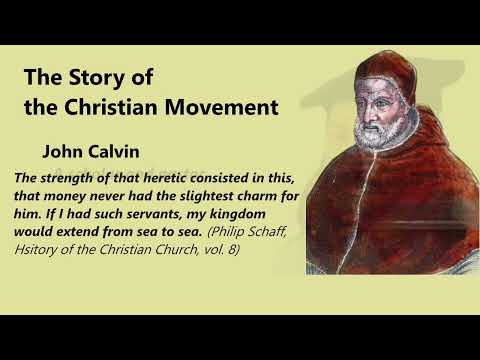
[12:12]This came from the Pope that was reigning at that time, Pius IV, who said of Calvin these words, quote, the strength of that heretic consisted in this, that money never had the slightest charm for him.
[12:28]If I had such servants, my kingdom would extend from sea to sea.
[12:34]And uh so the Pope here giving a kind of left-handed compliment to the uh life of Calvin.
[12:40]Calvin was along with being a pastor, also, I'm sorry, along with being a scholar and theologian was also a pastor.
[12:50]And through his years in Geneva, uh never left or abandoned that particular role as often as he would have been given the opportunity to do so.
[12:57]And he was a pastor uh that who really did pastoral work.
[13:03]This was particularly highlighted when for example, during his life there occasionally, there would be uh outbreaks of the plague in and around Geneva.
[13:11]As you know, that was a major problem during that period of time.
[13:14]And because the plague was so contagious, pastors would go and visit people stricken with that dread disease in shifts or in turns, and so there was a kind of expectation that you get your name on the list and when your time came you would go.
[13:28]And many times pastors themselves in doing pastoral ministry would contract the plague and would die as a result.
[13:37]Every time that occurred, the city council of Geneva convened and specifically passed an ordinance requiring that John Calvin not go through his turn for fear that he himself would be lost to them, and his value was deemed to be so great that uh they didn't want to run that risk.
[13:56]That's the only time we know of that Calvin ever engaged in civil disobedience at that time.
[14:02]He would not submit to that ordinance and he did cheerfully and repeatedly go and engage in pastoral ministry to those who had contracted the plague.
[14:11]And so again, I just say that to indicate that uh that he was a man who was devoted to his pastoral ministry as well as to his theological work.
[14:20]He's been widely regarded as the person who really opened the door to what's called modern exegesis of the Bible.
[14:30]He's the first one who really did clearly and successfully divest himself of the older medieval kind of allegorical and symbolic approach to scripture.
[14:37]Even Luther, though he set that as an objective, never quite escaped it, but Calvin certainly did.
[14:44]And so as you read his you his commentaries, you can't help but be impressed with the depth of his insight into the scriptures.
[14:51]Calvin was along with being a Bible teacher and exeg, was also quite a satirist, although that again is not necessarily uh widely known concerning him.
[15:01]He would love to poke fun at the Catholic Church, for example, for various things that he found to be truly humorous in their teachings.
[15:09]For example, at the time the Catholic Church tended to be very fascinated with relics.
[15:15]The crusades had produced a virtual avalanche of relics coming back to Europe, uh which came as a result of all of the traveling back and forth.
[15:23]And so you had all kinds of stuff that were claimed as relics.
[15:28]Many churches claimed to have a vial of milk from the breasts of Mary, you know, that kind of thing, or uh uh a thorn from the crown of the crown of thorns that was on Jesus' head at his crucifixion, or one of the most popular, chunks of the cross that had been brought back.
[15:46]Calvin on one in one occasion pointed out that there were enough pieces of the cross falling around Europe to sink a battleship.
[15:55]And he was uh he was constantly drawing attention to that kind of thing uh for purposes of uh making his own case.
[16:04]Sometimes Calvin is regarded, uh not so much as an innovator in the reformation, but more as a consolidator.
[16:13]Many times I've heard the description that Luther was the one who was the original genius in the Reformation, and certainly he was, and Calvin acknowledged that many times.
[16:23]But the Calvin's contribution was more one of taking all of those things that others had said and organizing them into a systematic whole, kind of a coherent organization of these things.
[16:34]And while that's certainly true that he did that, uh Calvin was also a great innovator and made huge contributions that were really unprecedented up to that time.
[16:45]There's many that I could name, I'm just going to mention a couple here for purposes of illustration.
[16:50]One that has been critically important, it was it was finally Calvin who came up with a model for a relationship between church and state.
[17:00]If you've been in this class for since the beginning, then you know that on several occasions I've talked about how the church was engaged in experiments of different ways in which church and state could relate to each other.
[17:13]And we've talked about, I think we've covered maybe a half a dozen different experimental models as it were along the way.
[17:19]It was finally Calvin who developed the notion that the church and the state should have equal but separate dignity and responsibility.
[17:29]That there should be a division of labor, a clear distinction between church and state, so that neither dictates to the other, but each operates under the authority of God, performing that which God has uniquely instructed that particular institution to do.
[17:43]That idea, as obvious as it may be to us, was really had never been developed or attempted before.
[17:53]That notion of a distinction, a separation, if you will, of church and state with equal separate authority to each, was picked up by the Puritans, worked out to some degree certainly in Scotland with John Knox and with the Puritans in England, but eventually brought to America.
[18:11]And we of course developed in our whole constitutional theory of government and the establishment clause and the free exercise clause of the first amendment.
[18:19]And this particular idea that we more or less have, you know, assumed here as Americans, really could be traced back to Calvin.
[18:27]He's the one that gave us, in fact, I heard one historian remark once that Calvin was virtually the inventor of America.
[18:36]Because so much of what we have in our own constitutional history is traced back to the political science of John Calvin, which comes out of his theology.
[18:46]So that would be one point where he was a great innovator.
[18:49]Another point would be his whole understanding of Christ in working out what was called the munus triplex, or the threefold principality or threefold authority of Christ.
[19:01]That is, the Christ is to be understood as prophet, priest, and king.
[19:06]Again, something we take for granted, it's kind of a standard way of understanding Christ, but it had never been developed prior to the time of John Calvin.
[19:14]Uh the whole understanding of the Holy Spirit really had never been worked out anywhere near the degree to which it was worked out by Calvin.
[19:22]And much of what we take for granted in terms of ways that we understand the work of the Holy Spirit, the gifts of the Holy Spirit, regeneration, sanctification, conviction, all of those ideas, while they were certainly there in some kind of inco sense prior to Calvin, Calvin was the one who worked out in immense depth and uh profundity those understandings of the Holy Spirit, which again, we tend to take for granted.
[19:48]And in other areas as well, he was one that made huge contributions to our whole understanding of the Christian faith.
[19:54]And so for all of that, we should be grateful because those were innovations, that was not simply consolidating, you see, but it was really him making new contributions, working out the implications of scripture in new ways that have become classic and really uh widely assumed in succeeding Christian thought.
[20:14]All right, well, pardon me for that lengthy preamble, but I just wanted to give you a few thoughts more or less randomly about Calvin's life before we jump into his story.
[20:21]He was born in 1509, July 10th in Noyon, Picardy in France.
[20:28]He was John Calvin. He was the son of a devout Roman Catholic mother, a father who was a successful lawyer, uh who had in fact run for elected office successfully on multiple occasions in his uh region there.
[20:44]His family was rather well to do, they were professionals, and he himself was given from the earliest days uh the very best possible educational opportunities.
[20:53]He was born and lived in the shadow of the great cathedral at Noyon, uh and uh so that was really his home for his first few years.
[21:00]When he was 12 years old, he was assigned a benefit through the cathedral, which would be typical for bright and talented and gifted children, essentially preparing them and putting them on a stipend, uh anticipating that they would eventually be ordained into the priesthood of the Roman Catholic Church.
[21:18]He was distinguished not only for his intellectual abilities as a child, but also for his very serious demeanor.
[21:24]He was a serious child, uh and so while other kids were out playing, he tended to be studying, even from his very earliest days.
[21:32]So much so that he had a nickname when he was a child, and the nickname was the accusative case.
[21:39]Now, if you know any Latin or or Greek, you may have some appreciation for that, but that was his nickname, the accusative case.
[21:45]When he was 14, uh he was sent to Paris to enroll at the grammar school called E.Cole de la Marche, which was uh a very uh prestigious grammar school, although this was nobody's picnic.
[21:58]Grammar schools in those days, I think if we could go back and look at them, we would think the people that ran them probably had more in common with the Marquis de Sade than a classroom teacher.
[22:10]I mean, the floggings, the whippings, uh the scourging, the, uh the kind of atmosphere of terror that tended to reign in these schools would probably uh make a CPS worker go berserk, you know, if they could see that.
[22:22]But nevertheless, that was that was the way it was in those days, and many students didn't survive it.
[22:27]It was just too severe, and they would wash out.
[22:30]Uh there are stories of children who would, uh you know, open their uh their breakfast or their lunch to find Vermin, cockroaches and other alien creatures crawling in their food, but they would never voice protest because they feared the scourging that came from complaining more than dealing with the uh aliens and their food.
[22:48]And so that was the kind of atmosphere of the uh grammar school of those days.
[22:52]But in any event, Calvin did survive all of that, and in fact did quite well, so that upon his graduation from grammar school, when he was about 16, he went to Paris to the school at Montaigu to continue his studies in uh medieval thought and theology and philosophy and so on.
[23:09]Uh this was all of course preparatory toward the expected career as a priest.
[23:14]At that time he was a strong defender of and had fierce loyalty to the Roman Catholic Church.
[23:23]He had heard by then, of course, of Luther's movement in Germany.
[23:28]Uh in France, these were called the gospelers.
[23:31]Later they were called the Hugenots. If you're familiar with French history along these lines, you know the Hugenots of course had a whole separate story that's very interesting, and at points somewhat bloody, the Saint Bartholomew Day massacre and other things, that was a little later in history, but at this time the the uh gospelers were infiltrating France.
[23:51]It was an illegal religion, and indeed it was a capital crime to be involved in some ways in this movement.
[23:57]Calvin subscribed to that, he believed that this was an evil thing, uh that should be put down, and uh so he was fully uh committed to supporting the church in that regard, until he became aware, painfully and slowly over a period of time, that probably the person at that point that he admired the most outside of his father, a man by the name of Peter Robert or Peter Robert, was apparently somewhat sympathetically involved with the gospelers.
[24:28]This is when when probably Calvin was 16, 17 years old, and he held this man in the highest esteem.
[24:34]In fact, if he ever idolized anyone, it probably was Peter Robert.
[24:38]And yet, uh he became aware over time that Peter was in fact involved with this movement and indeed was one of the ring leaders of it, and was himself personally involved in translating into French the Old Testament scriptures.
[24:53]Peter Robert was a was a Hebrew scholar.
[24:58]Calvin was conflicted on that because his sense of conscience seemed to say on the one hand that he should turn in his, this was his cousin, by the way, Peter Robert, and yet on the other hand, his loyalty to him made it, you know, almost impossible for him to conceive of doing that.
[25:14]And he really went through some agony over it.
[25:17]Finally, Peter actually admitted to John his involvement with the gospelers and urged John to use his own very gifted mind to look at the evidence, to read the scriptures and see if they didn't reflect the theology that was actually being advocated by Luther and others that were involved in the Reformation.
[25:37]And it may have been that in itself that dissuaded Calvin, at least for a time from blowing the whistle on these because he really was at that point still very strongly committed to the Catholic Church.
[25:48]But this did begin to drive a wedge into his confidence to have someone in whom he had so much respect taking that apparent left turn, it made Calvin himself somewhat wonder about his own views of things.
[26:00]This was all somewhat highlighted on one occasion when he was returning home from studies late at night, which would be typical for him.
[26:06]He was wandering down the, I shouldn't say wandering, but he was walking down the dark street there toward his apartment after late night studies at the library, and he was approached unexpectedly out of the shadows by a very elderly man who just walked up to him unexpectedly and confronted him right there in the street and asked him the question, Have you heard of God's free gift?
[26:33]And this man with his bright eyes looked right into the face of John Calvin and immediately began to launch into a rather intelligent and articulate presentation of the principles of the Reformation, justification by faith, that uh it's it's your faith in Christ that becomes the basis upon which you are accepted before God.
[26:52]Calvin for his part was terrified, even to be involved in this conversation, urged the man to be quiet, uh less not only he, but possibly John himself be arrested for having such a conversation, and uh and finally was able to disengage himself from this conversation, rattled somewhat, went back to his apartment.
[27:12]Uh the whole incident, uh uh kind of left his mind until about a week later when in the morning as he was walking to school, he saw a crowd milling at the end of a of about a block away at the end of a street as he was walking along, and realized that the incident that was trans piring down there, was that someone was about to be burned at the stake.
[27:33]Which wasn't all that uncommon in in those days, but nevertheless was something of a scene, and Calvin himself was drawn to the figure that he saw, uh tethered to that stake.
[27:47]And as he drew a little closer, he realized to his grief, it was in fact the very same old man that had come and confronted him only a few days earlier.
[27:55]And he approached more and more and he heard the crowd itself rising in protest against this.
[28:02]The whole thing was so uh outrageous that this this basically harmless old man was now about to be burned at the stake.
[28:10]Even the executioner was pleading with the man for forgiveness, for having to go forward with this, but the authority of the church and state were requiring it.
[28:20]And so he was tied to the stake, the fire was lit, and Calvin stood there watching and heard the old man began to sing uh a hymn that had become famous, although it was only recently written, entitled A Mighty Fortress is Our God.
[28:33]And as the flames leaped up around him, that impression of this man dying for his faith and his conviction as to the truth of the Reformation gospel, uh left a lasting impression on Calvin's own young mind.
[28:47]It was about that time that Calvin's father had a falling out with the Catholic Church, there were some political and financial dealings that had fallen through, and and Calvin's father decided that John would be better suited to go into the field of law.
[29:00]And so summoned his son to come home from studies at Paris and actually had him enrolled at the law school of Orleans, which was the most prestigious law school of the day, and Calvin did obedient to his father enrolled in law school, did it very, very well, graduated right at the top of his class after about uh uh a two-year uh period of study.
[29:23]However, uh his real interest, his real love were matters of uh scholarship and academics, and with his father's permission, he did after graduating from law school, go back to Paris to the University of Paris.
[29:38]And it was at that time, uh this was by the way in 1532, that he published the work I mentioned earlier, De Clementia, which was a commentary on Seneca's treatment of clemency.
[29:49]Uh having just been through law school, he was thinking about these things, and so that was a product at that time when he was so interested in how it was doing, of course, uh as I indicated to you earlier.
[30:00]When he was uh converted is unknown to us.
[30:04]It was sometime in this time frame.
[30:07]We know it could not have been earlier than 15 uh 29.
[30:11]It couldn't have been later than 1533, uh because of an incident that took place that year.
[30:33]Uh at that time, Calvin was at the University of Paris and became good friends with a very well-known and popular professor at the university, his name was Nicholas Cop, who was quite a capable philosopher theologian.
[30:48]And Calvin and Cop became good friends and spent time together and so on.
[30:54]And at uh at one point, in 1533, Cop was actually appointed to be the rector of the University of Paris, which was a very prestigious role.
[31:02]Something like being the president of the university, and there was an expectation when a person received such an appointment, that they would give a major theological or philosophical address, which Nicholas Cop did.
[31:16]At his inaugural, he got up and gave a great address, but his inaugural discourse, uh turned out to be also his farewell uh presentation because what he did in his presentation was give a powerful and compelling defense of the theology that was reflected in the Reformation.
[31:40]And in fact, he argued that those whom the church were calling heretics were actually those who at long last were beginning to give a clear and proper presentation of what the Bible actually teaches.
[31:54]Uh this met with such fury and anger on the part of the faculty that Cop literally had to flee for his life after getting up and giving that particular inaugural address.
[32:07]Well, in the process of trying to find Nicholas Cop, it became apparent that one of the persons who had collaborated with him in the writing of this address was no other than our beloved John Calvin.
[32:18]And so Calvin also became a hunted man, and uh he was therefore forced to flee from Paris himself at that time.
[32:26]He put on the uh disguise of a peasant worker and while all of the roads out of town were being guarded, nevertheless, in this disguise he was able to sneak through and uh escaped from Paris at that time.
[32:40]From there he traveled to Basel in Switzerland, where he was able to uh continue his studies, and particularly became involved in the study of Hebrew.
[32:53]And it was during that uh period of time that he actually wrote in his first cut at what was called The Institutes of the Christian Religion.
[32:59]So very early on, even though it was relatively early in his own career of faith, he already had that kind of uh insight and understanding of matters of Christian teaching.
[33:10]This, by the way, was written and in the preface to the uh Institutes, was actually addressed to the king of France.
[33:17]Calvin himself, of course, a refugee now from France, wrote to Francois, uh the King, asking him to reconsider his position with respect to the Reformation and urging him to give some attention to the truth of what the Reformation was all about, and not to simply listen to those who were so biased against it, but to give it uh his independent consideration.
[33:41]Uh it's not likely that the King ever actually read the Institutes, at least at that time, or that preface, but nevertheless, that was the intent.
[33:49]Sometime, uh later, about uh 1534, things did quiet down some in Paris, and Calvin felt that it was safe to return to Paris to continue his studies.
[34:02]Uh it was a kind of a flash point there for a while, but it seems as if things were now a little bit safer for him.
[34:08]And so he made his trip, began his trip back from Basel on his way to Paris, and stopped over for the night in Geneva.
[34:15]A fateful evening indeed.
[34:18]But he stopped in Geneva, uh not intending to be there more than just overnight, you know, checked into the uh Motel 6 kind of thing, and and was retiring for the evening, when all of a sudden he heard a bang at the door.
[34:30]And he opened the door, and there was standing a man that he'd never met before, but he certainly had heard of him, whose name was William Farel, F A R E L.
[34:38]Now, William Farel was the leader of the Reformation in Geneva.
[34:45]Uh the Roman Catholic Church had been expelled from Geneva a few years earlier, and of course, to do that was not simply to push a church out, it was to push a whole political regime out.
[34:56]And since that time, there had been attempts to try to put in its place a reformation church, slash state, that would uh be able to restore some stability and so on to the life in the city, but it had been a very rocky process.
[35:14]Now, William Farel, who was a very confident man himself, when he heard that the author of this book, The Institutes of the Christian Religion, was actually here in Geneva, uh seized the opportunity and came to the door of Calvin, and gained access to him, and came in and began to plead with John Calvin that he would remain in Geneva.
[35:35]That he wouldn't go back to Paris, but then he would recognize that God had brought him here in his providence to be a player in developing the life of the Reformation there in that city.
[35:48]Calvin was utterly unwilling to do that.
[35:51]He had no interest in becoming some kind of leader in the Reformation.
[35:54]He had no interest in becoming uh any any player in the in the life of Geneva, wanted to wish him well, you know, be warmed and filled kind of thing, and then put him on his way and and uh so Calvin was not the least bit responsive to this.
[36:08]To the point that Pharaoh finally in absolute frustration, stood up, pointed his finger at John Calvin and said what Calvin later called Farel's dreadful implication in these words, quote, you are simply following your own wishes, John Calvin, and I declare in the name of Almighty God that if you refuse to take part in the Lord's work in this church, God will curse the quiet life that you want for your own studies!
[36:37]And then Farel turned on his heel, walked out and slammed the door.
[36:42]And left John Calvin in a state of shock.
[36:47]Calvin remarked later concerning that statement, quote, I felt as if God from heaven had laid his mighty hand upon me to stop me in my course, and I was so stricken with terror that I did not continue my journey.
[37:02]And so, uh John Calvin slept in the next day and uh decided he'd better stay in Geneva, although that was certainly not his uh first choice.
[37:11]One later commentator said of this incident, it was obvious that Farel and God wanted Calvin in Geneva, however, the Genevans did not.
[37:20]And uh Calvin was there for about two years and they were, uh I think he would agree, the the word could be hell to uh describe what he went through.
[37:30]Uh he was the butt of jokes, jeering, mocking, abuse, caricature, uh mistreatment of every kind.
[37:37]People would name their dogs after him, uh more than once he was walking down the street, he would get hit with the contents of the chamber pot, if you know what I mean.
[37:46]And uh so this kind of thing would uh would not be remembered happily in the life of Calvin.
[37:51]The reason was simply that Calvin was attempting to do what was happening in many other places, try to put in place a basic, uh form of order in the city, uh in terms of the way people would, you know, live their lives.
[38:06]It wasn't necessarily as draconian as it sometimes uh uh caricatured, but nevertheless, it met with fierce resistance.
[38:12]Till finally, two years later, Calvin and Farel both were kicked out of Geneva.
[38:18]And Calvin saw that as salvation. But nevertheless, they left. Calvin traveled from there to Strasbourg, uh where he resided for three years.
[38:27]He became the pastor of a church of French-speaking refugees from France, uh and uh and that was his career then for a few years in Strasbourg, Germany.
[38:40]He met two very important people while he was in Strasbourg.
[38:43]One was a man named Martin Bucer, B U C E R, who had a very significant impact on Calvin's life in terms of understanding pastoral ministry.
[38:54]A fascinating guy in his own right, that I can only just mention his name at this point.
[38:58]The other person that Calvin met while he was in Strasbourg that turned out to be quite important was a woman by the name of Idelette de Bure.
[39:06]Idelette de Bure was married to a vociferous Anabaptist pastor, uh who was a strong uh proponent of his Anabaptist beliefs, and at the same time was somewhat critical of the Reformation view.
[39:21]And Calvin had many conversations with Mr. de Bure, in which he finally persuaded him to embrace the Reformation faith and abandon his Anabaptist beliefs.
[39:31]Which he did. And then sometime after that, Mr. de Bure actually died himself from the plague, leaving Idelette a widow.
[39:39]Sometime after his death and the period of grief that Idelette went through, John Calvin and Idelette actually kind of discovered each other in a new sort of way, and eventually became husband and wife.
[39:52]And so he married Idelette. This again became one of the happy romances of church history that you might want to look at sometime.
[40:00]In fact, there is a historical novel that was written a few years ago by a lady named Edna Gerstner, which describes the relationship between Idelette and John Calvin.
[40:11]The title of the book is simply Idelette. She Edna Gerstner was the wife of John Gerstner.
[40:17]John Gerstner was the uh Professor of Church History at uh Pittsburgh Seminary, First Presbyterian Seminary in Pittsburgh for about 40 years.
[40:26]So he knew church history. Edna Gerstner wrote this book, of course, relying to some degree on her husband's help and insight to to the times and so on.
[40:35]She wrote a great little dedication in the book with the following words referring to her husband, quote, without his help, this book would have been far more interesting, but far less accurate.
[40:45]But far less accurate. So, uh Edna Gerstner acknowledged the uh the contribution of uh of her husband, John Gerstner.
[40:55]In uh 1541, things changed somewhat in Geneva.
[41:00]The folks that had been so hostile to Calvin, really predictably became self-destructive.
[41:06]The anarchy in the city became intolerable to everyone that was there, and kind of hat in hand, the populace of the city requested that Calvin return to Geneva and once again help out in putting together the kind of the outlines of and the basic underpinnings of a city based on Reformation principles.
[41:25]Calvin did not want to go back to Geneva. This was not a vindication from his point of view, in fact, his initial response was again negative.
[41:32]But Martin Bucer and others indicated to Calvin they really did think this is what God was calling him to do, and finally with great reticence, he went back to Geneva, feeling like a man going to his crucifixion.
[41:45]He was not looking forward to this whatsoever.
[41:48]Uh he did face many battles in Geneva, but gradually, over the next 18 years, Calvin was active in Geneva, and in fact, became really the principal influence in that city for creating uh this kind of uh uh city based on Reformation political and theological thought.
[42:08]It was during that period of time that John Knox, while in exile from Scotland, uh found himself as a refugee in Geneva, and was deeply helped by his exposure to Calvin, had an opportunity to become acquainted with him, to sit at his feet to absorb really the Calvinistic approach to both politics and theology.
[42:27]Knox was quoted later as saying of his experience in Geneva, that he had lived in the quote, most Christian city on Earth.
[42:35]And uh really, that was highly formative to him, and uh certainly had a major impact later in terms of the creation of the Presbyterian Church.
[42:44]Calvin lived until, as I say, 1559.
[42:48]He is one of those few people in history of whom it could probably rightly be said that he worked himself to death.
[42:54]He would rise very early in the morning, not unusual for him to be up at uh 3:00 or 4:00 a.m. and then work late into the night, sometimes close to or past midnight.
[43:03]So he just deprived himself of sleep in the extreme because the demands of life in Geneva, plus his own desire to be productive in terms of his academic labors, uh simply required that.
[43:15]Finally, I think that kind of rigorous uh way of life took its toll on him, so when he was in his early 50s, his health began to fail rather uh rapidly.
[43:23]But even to the end, he continued to be uh a laboring pastor in Geneva and died uh with uh all of the uh evidences of faith and so on in his life that were such a inspiration to those who knew him throughout his life.
[43:39]He um refused, in fact, he gave specific instructions at his burial that he should be buried, uh without any grave stone.
[43:47]He did not want any kind of parade of people coming by and looking at the grave of John Calvin.
[43:53]So to this day we don't know uh where exactly he was buried.
[43:57]He lived 54 years, seven months and 10 days.
[44:00]One contemporary described him in these words, quote, he was of moderate stature, pale and dark complexion, with eyes that sparkled to the moment of his death.
[44:12]In his dress, he was neither over-careful or mean, which became his singular modesty.
[44:18]In diet, he was moderate, being equally adverse to sordidness or luxury.
[44:24]He was most sparing in quantity, for many years, taking only one meal a day, on account of the weakness of his stomach.
[44:31]He took little sleep. He had such an astonishing memory that any person whom he had seen once, he instantly recognized at a distance of many years.
[44:39]He was not absent-minded.
[44:45]In whatever he did, he was quite present, clear and correct.
[44:51]Sounds like an ideal presbyterian, doesn't it?
[44:54]That's what we'd all want to be described as. So, anyway.


