[0:00]There is a face in American cinema that never belonged on a billboard and never needed one. A face like an old road through scrubland, cracked and weathered and strangely beautiful, if you stopped long enough to notice. For nearly 60 years, Harry Dean Stanton moved through the frame of other people's movies, a drifter, a drunk, a convict, a mechanic, a father, an apparition. And even when you couldn't place the name, the eyes stuck with you. They carried something private, something damaged, something that refused to perform grief but could not conceal it either. He didn't become a leading man until he was nearly 60, and when he did, he played a figure who had wandered out of the desert unable to speak. It was by all accounts the closest thing to autobiography he ever committed to celluloid. This is the story of Harry Dean Stanton, the Nothing Man. Welcome to Hollywood Mysteries.
[1:10]Harry Dean came into this world on July 14th, 1926 in West Irvine, Kentucky. A place so small it barely left a mark on the map, a Hamlet of tobacco fields and Baptist churches tucked into the foothills of the Appalachens. His father, Sheridan Harry Stanton, split his days between cutting hair in a barber shop and working tobacco. His mother, Ursol Moberly, was a cook. He had two younger brothers and a younger half brother. It was not a gentle household. Stanton's earliest memory as he told it years later to interview magazine, was of his mother giving birth to a stillborn baby girl. I was there the night it happened, he said. The radio was playing a song called Roll along Kentucky Moon. He paused and added, I think my father buried the baby out in the field. I remember yelling and screaming, pain. That was the emotional substrate of the man's entire life, born into a house where tenderness arrived damaged, where music floated up from the radio as a kind of anesthetic against domestic sorrow.
[2:16]His father could be violent. Stanton described using music to escape parental quarreling and sometimes brutal treatment. The boy retreated into song the way other children retreat into closets. His parents would eventually divorce while he was in high school, both remarrying afterward. But by then the damage was done, and the damage had a shape, a sensitivity so acute it could only be expressed sideways through melody, through the careful arrangement of other people's worlds into something that felt like his own pain. I reacted strongly to the insensitivity within my own family, he said. I was more high strung and vulnerable than the average. He sang in a barber shop quartet as a teenager. He played harmonica, he played guitar. He played drums in a high school marching band. Music was not a hobby, it was a survival tactic. I was a singer before I was an actor, he would say decades later with something like a little pride. I've been singing since I was a child. I've always had a guitar and a harmonica. Don't say I play country music. He played what he felt, the genre was beside the point. He attended Lafayette High School in Lexington and went on to the University of Kentucky, where he changed majors with the restlessness of a man who couldn't quite locate himself, studying journalism, then radio arts, then music, and fell into theater at the campus Guno Theater under the direction of Wallace Briggs. Briggs saw something in him, something raw and unfinished but real, and encouraged him to abandon his studies altogether. I could have been a writer, Stanton reflected, but acting offered the richer gamble, a way to sing, to write with his body, to inhabit lives he hadn't been given at birth. I had to decide if I wanted to be a singer or an actor, he said. I thought if I could be an actor, I could do all of it. It was a bet against limitation. He took it. Before any of that could unfold, the war came. Stanton enlisted in the United States Navy and served as a cook aboard the USSLST970, a landing ship tank during the Battle of Okinawa in 1945. He rarely spoke about this in detail, but the fact of it, the young Kentucky kid watching men die in the Pacific, frying eggs for boys who couldn't make it home, worked its way into his bones. When he came back to the states, he was a different species of person, quieter, harder to read, carrying something behind his eyes that no acting class could teach, and no director would ever fully unlock. On the G I Bill, he returned briefly to the University of Kentucky, appeared in a production of Pigmalion, and then did what restless men do. He went west.
[5:07]He enrolled at the Pasadena Playhouse in California, the mid-century pipeline for actors trying to break into screen work. His classmates included Tyler Mcduff and Dana Andrews. From there, he spent time on the road, touring with a men's gospel group, working children's theater, before circling back to Hollywood, where he began the long anonymous grind of becoming a working actor. His first screen credit came in 1957 with a forgettable Western called Tomahawk Trail. Through the late 50s and into the 60s, he worked television relentlessly, Gunsmoke, the Untouchables, Have Gun, will travel, credited usually as Dean Stanton, to avoid confusion with another actor named Harry Stanton. He fell into a groove of villains and outlaws, gun toting heavies whose faces you might have remember from a dozen different episodes. The work was steady and the parts were small, and he was not yet 30 and already typecast by his own skull. Those sunken cheeks, that permanent furrow in the brow, the lean and hungry look of a man the camera instinctively distrusted. It was during this period that he fell in with another young actor hustling through the lower decks of Hollywood. Jack Nicholson and Stanton became roommates before either of them had become anything at all. Stanton would later serve as best man at Nicholson's first wedding in 1962. They remained close for the rest of Stanton's life, their homes eventually just a short drive apart on Mallen Drive. But it was a specific piece of advice from Nicholson that became the foundation of Stanton's entire approach to the craft. On the set of Monty Helman's low budget Western Ride in the Whirlwind in 1965, a film Nicholson had written, Nicholson told his friend, Harry, I've written this part. I want you to play a gangster. He wears a derby in an eye patch. I don't want you to do anything, just play yourself totally. Stanton took this in like a man receiving scripture. After Jack said that, he later told entertainment weekly, my whole approach to acting opened up. The notion that the less you did, the more the audience supplied. This became the cornerstone of everything. It was not laziness, it was a philosophy of subtraction. The audience does most of the acting, really, he said. The less you do, the more the audience does. He carried this principle through every part he ever played, and it gave his performances a trembling, almost spectral quality. You could never quite tell what the man on screen was thinking, and so you leaned in. Now, I don't have the space in this episode to get in depth on the raucous relationship between Jack and Harry Dean. So I've devoted an entire extra episode to their enduring bromance, including the bizarre story of how Harry Dean was plagued by strange calls from bathroom drifters all over America. And it turned out that Jack was to blame. If you want to check this episode out along with 40 others and counting, then all you need to do is click the join button below this video or follow the link on screen now to the Patreon page. Over there, you'll find a range of top tiers that give you access to the weekly Hollywood History episodes, as well as a range of other perks such as Spotify versions, early access to the main videos and more. The Hollywood Histories tier costs just $3 a month, and it's a fantastic way to support the channel. Thanks so much to all of you for signing up. There's even a week long free trial on Patreon, so you can take a look before you commit. I'm pretty sure you're going to love the episodes on the Garden of Allah murder and the uncanny history of cinema's China Girls. But for now, let's get back to the nothing man and his slow drift to stardom. By the late 60s, people were beginning to lean in to Harry Dean. Cool Hand Luke in 1967 was the first time a wide audience sat up and noticed him. He played Tramp, a melancholy gospel singing convict alongside Paul Newman. And for once, the camera lingered on Stanton, not as a threat, but as a soul. A man with a voice that could break your heart in a chain gang yard. His musical ability was on display, and it changed the way people saw him. He was not just a face, he was a cinematic frequency. The 1970s were Stanton's decade of accumulation, the years when he embedded himself so deeply in the fabric of American cinema that extracting him would have torn the cloth. He moved through film after film. Kelly's Heroes alongside Clint Eastwood and Donald Sutherland in 1970. Monte Helman's existential road movie Two Lane Blacktop in 1971. The John Millias directed Dillinger in 1973, where he played the gangster Homer Van Meter. And then a supporting turn in Francis Ford Coppola's The Godfather part two, as an FBI agent. Each role was small, each role was important. He brought to every part a quality that director's prized and audiences absorbed without consciously registering. The feeling that this man had been alive before the camera found him, and would continue living after it looked away. His work was Sam Peckinpah on Pat Garrett and Billy the Kid in 1973 was a watershed. Not because the role was large, but because the set was a crucible, and the friendships forged there lasted a lifetime. Peckinpah, a visionary drunk, who directed with the same mix of tenderness and fury that defined his films, ran a production that was chaotic even by 1970 standards. It was here that Stanton formed his enduring bond with Bob Dylan, who was both acting in the film and composing its score. One often repeated anecdote describes Stanton and Dylan jogging through a shot and ruining a take, which sent the volatile Peck and Paw into a towering profanity laden explosion. Some later retellings escalate the incident to include knives being thrown like some kind of circus horror show. The safest version sticks with the sheer volcanic force of Peckinpah's displeasure. But the core truth is that Stanton and Dylan recognized something in each other, a shared restlessness. A refusal to stay in the box other people had built for them, and their friendship endured for decades. They would play music together informally in living rooms and back porches, long after the camera stopped rolling. It was during this period that Stanton also befriended Chris Christopherson, the singer-songwriter and actor whose own career straddled the same boundary between music and film. Stanton actively advocated for Christopherson's early screen opportunities, helping to smooth the path for a fellow musician who understood that acting and singing were at the root, the same surrender. Singing and acting are actually very similar things, Stanton would later say. Anyone can sing and anyone can be a film actor.
[11:59]It was a democratic statement, but it was also a challenge. The implication was that what separated the good from the great was not talent, but willingness. Willingness to strip away the armor and stand there, exposed. Critics would later formalize Stanton's contribution to this era into the so-called Stanton Walsh rule. Attributed to Roger Ebert, the proposition that no film featuring either Harry Dean Stanton or M. Emmett Walsh in a supporting role, can be altogether bad. The very fact that a film contained one of these men, even for a moment, automatically made it worth the admission fee. Ebert would himself admit years later that the 1989 film, Dream a Little Dream, was a clear violation of his own rule, but the principle mostly held. Stanton's presence in the cast was a quality signal, a seal of authenticity from Hollywood's underclass. Then came 1979 and a film that would print his image into the consciousness of an entire generation. Though characteristically, not through a starring role. Ridley Scott's Alien cast Stanton as Brett, the engineering technician aboard the commercial towing vessel Nostromo. Stanton's first words to Scott during his audition were, I don't like sci-fi or monster movies. Scott was amused. He convinced Stanton to take the part by reassuring him that Alien would be a thriller more akin to Agatha Christie's 10 Little Indians than a creature feature. It was Ridley's enthusiasm, actually, and his desire for me to be in the film that did it, Stanton admitted. On set, Scott encouraged improvisation, had the cast listen to tapes of the Apollo moon landing to capture the crackling realism of Intercom Dialogue, and let the older actors. Stanton was 53, Tom Scarrett 46, Ian Holm 48, which was ancient by thriller casting standards, bring their own textures. As Roger Ebert noted, the older casting gave the film a quality of blue collar reality. These were not adventurous, but hard bitten workers, regular Joe's hired by a corporation to haul 20 million tons of ore back to Earth. Stanton's Brett is a man of few words, most of them, right, delivered with a flat, unreadable irony that became one of the film's running gags. When Ripley accuses him of being a parrot, Brett replies, what else other than, right. It's a small master class in character comedy built on repetition and dead pan. The kind of thing that takes a career's worth of supporting role discipline to pull off. His death scene, searching alone for the ship's cat, Jones, and the dripping bowels of the vessel, chain swaying in the half dark, the creature descending from above. Remains one of the most tensely constructed sequences in horror cinema. Brett was the first on-screen victim of the fully grown Xenomorph, and the man who played him brought to that death a quality the script could not have written, genuine bewilderment. The look of a tired worker, looking forward to a beer and the game, but who had simply drawn the worst possible shift. It couldn't have been less glamorous, and that was the point. I've long since gone past any sort of ego trip, Stanton said of his approach. I'm interested in film more now than I am in how I look. Any ego trip actors go on takes away from the purpose of making a film. Stanton was one of the most masterful brush strokes in Scott's immaculate masterpiece of horror cinema. If Alien made his face globally recognizable, it was 1984 that made him undeniable, and the story of how it happened reads like something out of the very films he specialized in. Sam Shepherd, the play right and actor, spotted Stanton at a bar in Santa Fe, New Mexico in 1983. Both men were in town for a film festival. Over drinks, Stanton told Shepherd that he was sick of the roles he'd been playing for three decades. We had a couple of drinks and I told Sam that I was sick of playing heavies and losers and trash, Stanton recalled. I wanted to play something with some love and decency to it. Sam just listened. Two weeks later, Shepherd called him to offer the lead in Paris, Texas, a film Vim Venders was directing from Shepherd's screenplay. It was at the age of 57, Stanton's first starring role, his first chance to carry a movie, and what a movie. The role was Travis Henderson, a man who emerges from the Texas desert, mute and sun raved, unable or unwilling to explain where he has been for four years. He cannot speak, he can barely walk. He is, as Sam Shepherd reportedly put it, a man whose face is the story. Stanton poured everything into it. On set, a young production assistant shared something with him, a poem she'd written about a personal loss. And Stanton drew from her experience to fuel the character's silence. He told the press at Khan, where the film won the palm door, that the unnamed woman on the crew had helped him find the emotional truth of Travis. He never revealed her name, protecting her privacy, and also never stopped thinking her. Paris, Texas is a film built on absence, absence of speech, of explanation, of the usual Hollywood mechanics of exposition, and its power resides almost entirely in Stanton's face. In the way he moves through the frame like a man trying to remember how to be human. Vim Venders shot the film with an almost documentary patience, and Stanton met that patience with a performance that was less acting than being. The whole film evolved on a very organic level, he said. I took the same approach as I would to any other part, I play myself as totally as I possibly can. My own Harry Dean Stanton Act. The monologue in the peep show booth where Travis finally tells the story of his ruined marriage through a one-way mirror to Natasha Kinsky, is among the most devastating scenes in modern cinema. It is not showy, it is not a performance in the actorly sense. It is something closer to confession, a man disassembling himself with words while the woman on the other side of the glass slowly realizes who he is. The film won the Palm door at Khan, the American Academy ignored it entirely. Stanton did not seem surprised by either outcome. Paris, Texas is the first film that I've totally cared about, he said. The first movie I totally wanted to do, and that after 27 years that I considered my prison term. He also called it without hesitation, his favorite. He gave it another foundation too, one that revealed a different kind of hunger beneath the philosophical cool. Paris, Texas gave me a chance to play compassion, and I'm spelling that with a capital C, and then with quiet emphasis, for the first time I was allowed to get the girl. That's such sacred territory in the business, a primitive battle over the female. When asked what happened to Travis after the film ends, whether the wanderer found peace or kept wandering, Stanton's answer was characteristically oblique. I don't know what ever happened to Travis. I'd say, it's me, still searching for liberation or enlightenment, for lack of a better way to put it, and realizing that it might happen, it might not.
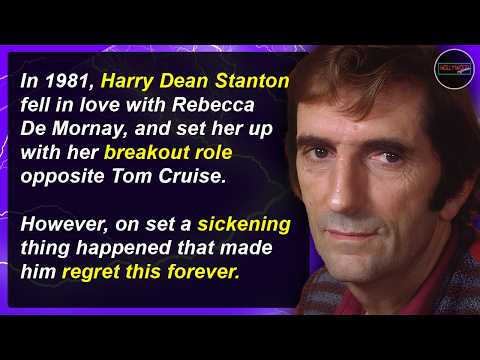
[19:16]That same year, Alex Cox cast him as Bud in Repo Man, a scabrous, hallucinatory comedy about Los Angeles car repossession and extraterrestrial conspiracies. Stanton played a grizzled speed snorting repo veteran who takes Emilio Estevez's punk kid under his wing, dispensing deranged wisdom about the repo code and the cosmic significance of their trade. When Cox first approached Stanton's agent about the role, the agent shocked him by suggesting Mick Jagger of the Rolling Stones instead. Cox was appalled. He wanted Stanton, and he got him, and the result was one of the most purely entertaining performances of the decade. Maniac, yet grounded, ridiculous, yet oddly noble. It was the photographic negative of Paris, Texas, wild, loud, profane, and yet Stanton brought the same quality of lived in authenticity to both. Together, the two films made 1984 the year Harry Dean Stanton finally arrived. He was 58 years old. His price doubled. His admirers now included not just old friends like Nicholson and Bob Dylan, but the Brat Pack generation, Sean Penn, Rob Lowe, Emilio Estevez, and a growing army of critics who recognized that something extraordinary had been hiding in their peripheral vision for decades. Harry Dean Stanton is a very late bloomer, interview magazine declared. 30 years and 60 films after making his screen debut, the 59-year-old actor is finally being offered top billing. His confidant, Lois Childes, called him the most in the moment man she'd ever met. The paradox, of course, was that the moment did not convert him into a conventional leading man. He did not want it to. I've had offers that could have made me much richer and much more famous than I am, he admitted. I've been rather like a cat. I'm finicky and I've done a lot of things and made career choices, missed meetings, and so forth that would have made me a much bigger actor. I think. But by the same token, that would have demanded more of my time too. There was an offer from John Carpenter for a lead role in a private investigator series that Stanton turned down simply because he didn't want that much work. It was professional self sabotage as philosophy, or perhaps philosophy as the highest form of self-preservation. There was, in the early 1980s, a love affair that would become the most publicly narrated episode of Stanton's private life. He met Rebecca Demorne in 1981 on the set of Francis Ford Coppola's One From the Heart. She was in her early 20s, more than 30 years his junior. He was 55 and magnetic in the way that only deeply weathered, deeply un sentimental men can be. Demorne later recalled that his first line to her was, do you believe in magic? They were together for over a year. Stanton used his industry connections to help further her career, including helping her land the female lead in Risky Business opposite a young actor named Tom Cruise. And then, as these things go, Cruz and Demorne began an affair during filming. Curtis Armstrong, who played Cruz's friend Miles Dalby in the movie, would later recount in his 2017 memoir, Revenge of the Nerd, the awkward spectacle of the triangle. Demorne at 23 maintained what Armstrong described as an air of inaccessible sexual mysteriousness. Stanton, meanwhile, visited the set and spent hours slowly swimming the length of the hotel pool, back and forth, literally for hours, while his girlfriend worked scenes with the man who would replace him. Armstrong noted that while Stanton was an affable man and a great actor, a prickly Cruz seemed to regard him as a guest overstaying his welcome. Demorne herself was initially unimpressed by Cruz. I will say that I thought he was very annoying when we first started, she later told celebrity page. But he grew on her. Stanton's own summary of the situation was characteristically blunt. I got her in the movie with Tom Cruise and she ends up with him. I was heartbroken. The heartbreak, though, did not destroy the relationship. It transformed it. Demorne and Cruz lasted about two and a half years. After they split Demorne and Stanton reconnected, not as lovers, but as something perhaps rarer. He became my closest friend, coincidentally, right after I broke up with Tom. She told Vanity Fair in 2017, Harry Dean and I are best friends, and Tom and I don't talk. She described Stanton as uniquely present, uniquely attentive. Most people ask questions but don't really care about the answers. Harry cared. Stanton never married, unresolved and unresolvable, like so much of his personal mythology. He was in his own description, a loner. Whether that word captured a choice or a condition was never entirely clear. Through the mid to late 1980s and into the 90s, Stanton worked at a pace that belied any notion of retirement or any expectation that the Paris, Texas breakthrough would produce conventional stardom. In 1985, he reunited with Sam Shepherd on Fool for Love, playing the mysterious old man. Shepherd's father figure, a ghost of the American West. He played Molly Ringwald's tender, boozy father in Pretty in Pink in 1986, a role that introduced him to the teen audience of the John Hughes era, in which he imbued with a defeated warmth that felt nothing like acting. He appeared for Martin Scorsese in The Last Temptation of Christ in 1988. He showed up in David Lynch's Wild at Heart in 1990, as a soft-hearted private investigator who doesn't survive the film's surreal violence. He was a trusty testing the electric chair in Frank Darabont's The Green Mile in 1999, bringing his morbid sense of humor to a scene that demanded it. He played the estranged stroke-filled brother in Lynch's The Straight Story the same year. A G-rated film, astonishingly, about a 73-year-old man who rides a John Deere mower across two states to be with his dying sibling. He surfaced in Terry Gilliam's Fear and Loathing in Las Vegas in 1998, as a Laconic judge. His friendship with Hunter S Thompson, a man who treated defiance as a lifestyle and self-destruction as a kind of art form, was a genuine bond. Rooted in shared nights at Thompson's Owl Farm compound and a mutual understanding that living hard was not the same as living carelessly. When Thompson killed himself in February 2005, Stanton performed Danny Boy in tribute. An emotional rendition that appeared in the subsequent Thompson documentary, Buy the Ticket, Take the Ride. Thompson's famously extravagant funeral, bankrolled by Johnny Depp to the tune of 3 million dollars, saw his ashes fired from a cannon shaped like his signature fist with peyote button emblem while Mr. Tambourine Man played. It was a kind of valediction Stanton understood, loud, absurd and hiding something desperately sad beneath the spectacle. Depp for his part, had this to say about Stanton, this is the finest gentleman that has ever survived. He also worked extensively on the small screen. He had a recurring role on the medical comedy drama, Getting On for HBO. But his most sustained television part was Roman Grant, the frightening yet measured fundamentalist patriarch on HBO's Big Love, which ran from 2006 to 2011. The part introduced him to a new generation of viewers who might not have known his film work, and it demonstrated that even in his 80s, Stanton could generate menace through pure stillness. A lifted eyebrow, a silence that lasted a B too long, the sense that behind those ancient eyes a calculation was always running. But if the professional life hum steadily along, the personal life held at least one genuinely harrowing chapter. On the evening of January 20th, 1996, three armed men appeared at Stanton's Mulholland Drive home above Sherman Oaks. When Stanton answered the door, they pulled out guns, forced their way inside, threw the 69-year-old actor to the floor and tied him up. One man pressed a pistol into his face, leaving bruises around both eyes. They ran sacked the house, loaded electronic goods and cash into his 1995 Lexus and fled into the night. Stanton freed himself and called the police. The car had been outfitted with a tracking device, and officers located it two hours later in North Hollywood. When another vehicle arrived and a man attempted to drive the Lexus away, police gave chase, the driver crashed into a park car and was arrested. Two suspects, Jose Rivera, 18, and Alberto Guerrero, 20, were charged with home invasion robbery, assault with a deadly weapon, and a litany of related counts. A third suspect remained at large. Stanton's response as reported in the Los Angeles Times was darkly typical. He acknowledged he'd been robbed and thought he was going to die. The Gallo's humor was Vint Stanton, the refusal to dramatize, the flat acknowledgement of mortality, delivered in the same register he brought to his least expressive screen role. You could have written a movie around the incident, Stanton simply lived through it and moved on. The later years brought something unexpected. Not decline, but a kind of secular canonization. Two documentaries were made about him. Harry Dean Stanton, Crossing Mulholland in 2011, a Kentucky Public television production directed by Tom Thurman that tracked his path from West Irvine through the Pasadena Playhouse to Mulholland Drive, featuring testimonials from Billy Bob Thornton, Richard Dryfus, Chris Christopherson, and Vim Venders, and Sophie Huber's Harry Dean Stanton, partly fiction in 2012. The latter became the primary text of his late life mythology. Hubert working with the celebrated cinematographer, Sheamus McGarvey, built the film around long structures of Stanton singing, folk standards, Mexican ballads, Blue Bayu, Cancion Mictica, Danny Boy, interspersed with fragments of philosophical talk that revealed a man who had read enough Buddhism and Daism, but refused to be pinned to any system. The documentary was not by design a biography. It was something more elusive, a portrait that used silence and song to get at a truth that chronology could not reach. The accompanying music released on Omnivore recordings, framed the project explicitly as an attempt to merge image, sound and persona into a coherent portrait. Stanton's singing treated not as an add-on but as the most direct channel to whatever lay beneath the mask of genial detachment. There's nothing, he told a film comment interviewer. There is no self. When the interviewer pressed him, he shrugged. It doesn't matter. Asked what he dreamed about, he said, nightmares. It was the kind of exchange that could be read as either devastatingly honest or performance art of the highest order, and the genius of Stanton was that you could never be entirely sure, which. David Lynch, his friend and recurring collaborator, described this world view with evident affection. This nothingness is an interesting thing. Lynch cast Stanton in film after film, Wild at Heart, The Straight Story, Inland Empire, Twin Peaks, Fire Walk with Me, and in 2017, brought him back one final time as Carl Rodd, the kindly trailer park manager in Twin Peaks, The Return, on Showtime. The scenes are quiet, observational, almost plotless. And they carry an emotional weight that has nothing to do with narrative and everything to do with the quality of the man in the frame. In one scene, Carl watches a boy and his mother from a park bench. Nothing happens. Then everything happens as a scene bleeds into the most horrifying of Lynch's entire career, as a child is killed by a runaway truck. A mother screams, but the emotional counterweight is Stanton's staggered disbelief, which seems more directed at the universe than the truck driver. By the 2010s, Stanton had settled into a nightly routine that became the stuff of Los Angeles legend. He held court most evenings at Dan Tan's, the old school Italian restaurant on Santa Monica Boulevard in West Hollywood, where a revolving cast of friends, actors, writers, musicians, ex-cops, screenwriters, would gather around his table for what amounted to a salon of metaphysical talk, off-color jokes, and spontaneous singing. The gatherings had the quality of the last supper that never ended. Every night was a potential farewell, and every farewell was deferred by another bottle of wine and another song. He was still performing with the Harry Dean Stanton band, playing their distinctive blend of Mariachi inflicted rock and country covers at small clubs around town. The band had toured internationally for well over a decade. Debbie Harry of Blondie had once sung, I want to dance with Harry Dean. In her hit, I Want That Man. It was no idol namedrop. Stanton moved through the music world with an ease that most actors couldn't fake. He had jammed with Dylan, Christopherson, Ry Cooder, Art Garfunkel, Carol King, and Linda Ronstadt. He played harmonica on the Calls 1989 album, let the day begin. He appeared in music videos for Dwight Yokum and Bob Dylan. Music for Stanton was never a second career. It was the first one, the one that predated the camera and would outlast it. I've never pursued my music career, he said with the resignation of a man who knew his own choices. I like to sing.
[33:16]His final starring role arrived just in time. Lucky directed by John Carroll Lynch and released in 2017, was written specifically around Stanton by two screenwriters from his own circle of friends, Logan Sparks and Drago Simonja. The film follows a 90-year-old atheist named Lucky, who smokes, does crossword puzzles, watches game shows, and walks to the same diner every morning in a small desert town. The title card reads, is lucky, as if the film were both introduction and epitaph. Stanton did not so much act the part as inhabit it. Lucky's routines were his routines. Lucky's philosophical provocations, blunt talk about nothingness, mortality, the absence of God, were his own conversational staples. David Lynch showed up in the film as a man grieving a lost tortoise, joining the project out of sheer devotion to Stanton. It was all Harry Dean, Lynch said. I do anything for that man. John Carroll Lynch, the director, described the production process with a clear eyed affection, one that bordered on eulogy, even before Stanton had died. He also made a point, after Stanton's death, of resisting sentimental language. People have been using the term passed on. Harry didn't pass on, he died. The film premiered at South by Southwest and was scheduled for theatrical release on September 29th, 2017. Stanton did not live to see it open. He died on September 15th, 2017 at Cedar Sinai Medical Center in Los Angeles. He was 91. The cause was reported as natural causes. In his final weeks, friends had gathered around him for what Vanity Fair described as a kind of living wake. Dinners at Dan Tan's, quiet evenings at the house on Mulholland, the circle closing around a man who had always insisted there was nothing at the center. And now, perhaps, was proving himself right. The tributes were immediate, and surprisingly emotional for a man who had spent his career at the margins. David Lynch released a statement. The great Harry Dean Stanton has left us. There went a great one. There's nobody like Harry Dean. John Carpenter, who had cast him in both Escape From New York and Christine, wrote, Harry Dean Stanton was a wonderful man, kind and full of humor. He was also a great actor. Angelica Houston called him, an amazing totem in my landscape, and a poet and an artist. The word that surfaced most often in the posthumous writing was truth, not performance, not technique, truth. The critical consensus converged on a simple proposition, that Stanton's genius lay in his refusal to explain. His face was the screen on which audiences projected their own grief, their own endurance, their own unresolvable questions about what it means to be alive, and then, eventually, not. He did not over explain because he did not believe there was anything to explain. The soul is an illusion, he had told a Denver journalist, not long before the end. It gets tiresome after a while. He left behind no confirmed family, no estate drama that made the papers, no conventional legacy of the kind Hollywood builds monuments to. What he left instead were 280 credits, a handful of songs that could make a grown man weep, and a way of being on camera that will endure as long as anyone cares about what it means to be honest in front of a lens. Roger Ebert's rule stands. Sam Shepherd's observation endures, the face was the story, it always was, and there was a little nothing and everything he ever did.
[37:06]That's about all for this week. I hope you enjoyed this one as much as I did. Harry Dean Stanton is one of my favorite actors of all time, and Paris, Texas ranks up among my favorite movies. Let me know which of his appearances is your own personal favorite down in the comments. And be sure to stop by the Hollywood Mystery store too. Spring is on the horizon, and what better time to stock up on some of my exclusively designed movie themed t-shirts.


