[0:00]When you press down on the trigger of a barbecue lighter, you'll notice it's quite hard work. Like, it's not like pressing the button on a remote control, you actually have to put some effort into it.
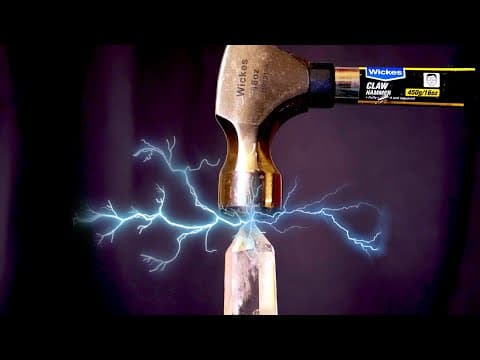
[0:15]And there's a reason for that. When you press down on the trigger, you're working against quite a stiff spring, so that all that work you do is stored as potential energy in the compressed spring. And in front of that spring is a tiny hammer, so that when the mechanism finally gives way and the spring is released, all that potential energy stored in the spring is turned into kinetic energy in the hammer. The hammer then strikes a special kind of crystal called a piezoelectric crystal. And when you hit one of these things, it generates a voltage across the crystal. This is the inside of a barbecue lighter. This is the mechanism that houses the spring and the hammer and the crystal. These two wires are coming off the crystal and they're drawing that voltage up to the top of the lighter here. There's still a gap between the two wires at the top here, but the voltage that you produce when you press down on the piezoelectric crystal is so high that electricity can actually jump across that gap, producing a spark. If you send a flammable gas up to the top as well, then the spark will ignite the gas. For a while now, I've wanted to understand how the piezoelectric effect works on the molecular level, and I finally do. And I've also built something to make it easy for anyone to understand how it works, so that's what this video is about. There's a few different types of piezoelectric crystal that you can buy, but I'm going to look at quartz in particular, which is the first piezoelectric crystal to ever be discovered. This is what a giant quartz crystal looks like. If you were to take a slice of quartz away from this crystal and compress it, you'd be able to measure a voltage across the slice, but you'd have to slice it at just the right angle like this. I don't know if this is the right angle, but it would be something like that, but it's got to be just right. And to see why you've got to get the angle just right, we need to look at the lattice structure of quartz. So, quartz is made of silicon dioxide, so silicon and oxygen, and this is what it looks like. At first, it looks like quite a complicated structure, but as you rotate the crystal, you find these symmetries, like this one. And here's another. But there's one particular angle that I'm interested in, which is this one. Notice this hexagonal shape here. It's actually a spiral going into the screen, but for simplicity, we're going to think of it as a ring. So, these three crunchy peanut butter lids represent silicon atoms, and these three smooth peanut butter lids represent oxygen. So when you compress a crystal of quartz, you're squishing these hexagons. But crucially, the bond between oxygen and silicon isn't quite even, like the oxygen is a bit more aggressive in the way it holds on to its electrons. So the oxygens are a little bit negatively charged and the silicons are a little bit positively charged. So think about where the average of all the positive charge is in this diagram. It's a bit like the center of mass, but it's the center of charge. So it's there in the middle between these three silicon atoms. But watch what happens when you compress the crystal. The two side silicons move outwards, but they don't move vertically. And the bottom silicon moves upwards, so the average position of these three positive charges moves upwards slightly. And similarly, think about the average position of the three negative charges. Look, the two side negative charges move outwards, but that top negative charge moves downwards, so the average of the three negative charges moves downwards. So when you compress a crystal of quartz in this exact orientation, you're slightly shifting all the negative charges in one direction and all the positive charges in the other direction. Suppose you've got a square slice of quartz crystal. Let's represent all the positive charge as gold and all the negative charge as red. And in an uncompressed crystal, those negative charges and positive charges overlap exactly, and so you've got this neutral greenish color. But when you compress the crystal, the negative charges shift in one direction and the positive charges shift in the other direction. In the bulk of the crystal, it's still neutral overall, but at the faces, you've got this buildup of positive and negative charge. If you then wire up these faces, well, the positively charged face will be trying to pull electrons towards it from inside the wire, and the negatively charged face will be repelling electrons. And if you bring the ends of those wires close enough together, the electricity will be able to jump the gap, producing a spark. So that's how quartz is piezoelectric, but in general any crystal can be piezoelectric, so long as it fulfills a couple of criteria. The first one is that the lattice needs to contain some polar bonds. That just means that some of the atoms end up with a slight positive charge, and some of the atoms end up with a slight negative charge, like silicon and oxygen in quartz. That's why diamond isn't piezoelectric. You can squeeze a diamond as much as you like, but all the carbon atoms inside are neutral, so there's no charge for you to move around. The second criteria is more subtle, it's to do with symmetry. The crystal needs to have a certain type of symmetry, or more accurately, a lack of a certain type of symmetry. Take a look again at this hexagonal arrangement of atoms from the quartz crystal. Look at this silicon atom, and then draw a line through the central point to the opposite side and see what's there. It's not another silicon atom, it's an oxygen atom. So there's something different on the opposite side when you go through the central point. That means it doesn't have point symmetry. To see why a lack of point symmetry is important, look at this arrangement of atoms that does have point symmetry. See how silicon atoms are opposite silicon atoms, oxygen atoms are opposite oxygen atoms. When you compress the crystal, you move the charges symmetrically, so the average position of those charges doesn't change, it stays in the middle. The piezoelectric effect has a lot of uses besides just a high voltage power source like a barbecue lighter. It can also be used as a sensor. This is a piezoelectric disc, it's probably not quartz, it'll be something else, and if I press down on the disc, I can get a bit of a voltage across it. It's sensitive enough to be used as a pickup for sound, so I can actually use it as a microphone.
[6:46]Interestingly, the piezoelectric effect is reversible. Actually, in a previous video, I mentioned how speakers can be used as microphones and microphones can be used as speakers. And it's true of this piezoelectric microphone, it can be used as a speaker. When you apply a voltage across a piezoelectric crystal, it will deform. It's the opposite of the piezoelectric effect. My absolute favorite example of the use of the piezoelectric effect is in the quartz watch. Inside one of these watches, there's a tiny crystal of quartz that vibrates exactly 32,768 times per second. If you know your powers of two, then that might sound familiar. But why? Well, this video is already getting too long, so my next video is going to be about the amazing mechanism inside a quartz watch. If you want to make sure you definitely see that video, then don't forget to subscribe. If you super want to make sure, then consider clicking the notification bell. This video was made possible by my patrons on Patreon and Curiosity Stream, a subscription streaming service of over 2,000 documentaries and non-fiction titles, including some exclusive originals. You can get unlimited access to all of that for as little as $2.99 a month, and for you fine people a 30-day free trial if you go to curiositystream.com/stevemould and use the promo code steve mould when you sign up, no spaces all lowercase. Look, you're the sort of people who like to learn through video, and, you know, sometimes you just want someone to curate the videos for you to just say, 'Look, these are the good ones.' Watch these ones. And Curiosity Stream is really good for that. It was founded by the person who founded the Discovery Channel, and it's just a great collection, like if you want to learn about gravity, there's a few really good documentaries hosted by Jim Al-Khalili that I recommend. If you don't know about Jim Al-Khalili, he's really good, like, he's really good at explaining things, so I recommend those when you first sign up for your 30-day free trial, and, you know, maybe do it today. Do it now. All right, that's it. Hope you enjoyed this video. If you did, don't forget to hit subscribe and I'll see you next time.