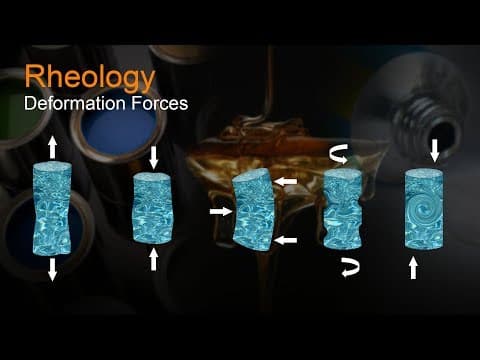
[0:26]In part one of our video series on rheology, I reviewed some background information including its definition, the essential elements that affect how materials flow and deform, the differences amongst materials and their rheological behavior, and an initial understanding of viscosity. Recall that rheology is the study of a material's flow behavior under applied deformation forces or stress. One of the essential elements to be considered is the impact of outside forces, since materials can be pulled apart, compressed, or sheared. In this video, part two, we'll examine deformation forces to understand how they affect a material's flow behavior, and as a result of that discussion, give a more in-depth understanding to the term viscosity. There are different forces that can act on any state of matter. They include tension, these are aligned forces pulling apart the material, compression, these are aligned forces pressing the substance, bending, unaligned forces are applied to opposite sides of a material, torsion, forces twisting the substance,
[2:00]and shear, unaligned forces pushing one part of a material in one direction, and another part in the opposite direction. For the sake of simplicity, particularly when we review flow profiles in part three, we'll focus our discussion on the flow behavior due to shear forces. But first, let's ensure we fully understand the meaning of some deformation terms by reviewing shear rate and shear stress. There is a relationship between the two terms, and that relationship is the foundation in arriving at a material's viscosity. Materials that flow are comprised of velocity gradients, which are layers that flow at different velocities. Imagine water flowing through a pipe. The liquid layers do not flow with even velocity throughout the bulk. There are frictional forces between the pipe wall and the interfacing liquid layer, as well as frictional forces between all the liquid layers themselves. The difference in velocity between the liquid layer closest to the pipe wall and the liquid layer in the middle, divided by their relative distance, is known as shear rate. Shear stress is a force applied over a given unit area.
[3:38]As I mentioned, there is a direct relationship between shear stress and shear rate. With higher shear stress, we can expect a higher shear rate given the same system. And the more viscous a liquid is, the more force is required for it to flow at the same rate as a less viscous liquid. So, water requires less force to flow through a pipe than, for example, honey. Now that we understand shear stress and shear rate, let's revisit viscosity once again so that we can define it more precisely. The viscosity of a material is the shear stress divided by the shear rate. Remember that shear stress is a force over a specified area. This can be in the form of pounds per square inch, or Newtons per square meter, whereby one Newton is equivalent to about 0.225 pounds of force, or even dynes per square centimeter, where one dyne is equivalent to about 0.225 x 10^-5 pounds of force. So, shear stress is defined as a force per square area. Now, let's examine shear rate. Shear rate is the difference in velocity of two layers within the bulk of the material divided by its relative distance. The units of velocity in this case is measured as distance in centimeters over time in seconds, divided by the distance between the two layers in centimeters. Let's simplify the units in this fraction. The distance units cancel each other out, and we end up with a reciprocal second measurement for shear rate. The reciprocal of any number multiplied by itself will always equal one. Further simplification of the units results in a viscosity measured as dynes seconds per square centimeter or more commonly known as poise or cP. Water, for example, has a viscosity of 0.01 poise or one centipoise. Let's use a golf stroke as another analogy to deformation forces. When we putt a golf ball, we exert a slight force or stress onto the ball, which travels at a slow rate. On the other hand, driving a golf ball exerts a tremendous force, which propels the ball at a much faster rate. And if we were in a sand trap, a more viscous medium, we would have to exert a relatively higher force to achieve a reasonable speed and distance to reach the flagpole. So, let's look at this intuitively. If we have to apply more shear stress to achieve the same shear rate, the numerator is larger and therefore the viscosity must be higher. Conversely, if we had to apply less shear stress to achieve the same shear rate, the numerator is smaller, and therefore the viscosity must be lower. Alternatively, if we achieve a higher shear rate from a given shear stress, the denominator is larger, and therefore the viscosity must be lower. Conversely, if we achieve a lower shear rate from a given shear stress, the denominator is smaller, and therefore the viscosity must be higher. I hope this gives you a better understanding of deformation forces, particularly when we examine flow profiles in part three of our video series. We'll review viscosity versus shear rate and give examples of systems that demonstrate Newtonian, pseudoplastic, dilatant, and fixotropic flow behavior. In the interim, you may want to check out the benefits provided by the rheological agent highlighted in this periodic news publication.


