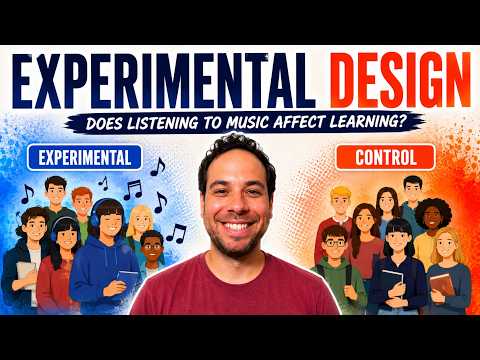
[0:09]All right guys, welcome to Psych Explained. In this video, we're going to break down the experimental method. Now, why are experiments so important to psychologists? Well, let's say you wanted to describe some phenomenon in the world, you'd probably do a case study or survey method. Or, if you wanted to find a relationship between two things, you'd probably do a correlational study. But what if you wanted to establish causality? That is to say, one variable caused a change in another variable. Well for that, you'd have to design an experiment. And in this video, we're going to go step-by-step how to design and analyze a psychological experiment from start to finish. So let's get started. Now, in order to design our experiment, we first have to know what our study is about. And here it is. A psychologist is interested in the effect of background music on learning. Think about how many times in your life you've been doing your homework, reading a textbook, and you had music in the background. In fact, I guarantee many of you right now have music playing as you're watching this video. Now, you might not realize it, but that music as subtle as it is might have an impact on your learning, whether it's good or bad. But the only way to really determine if it has an effect is to do a controlled experiment. Now, before we go over the flow of that experiment, let's first identify our variables. Specifically, our independent and dependent variables. Now, I do have a separate video on these variables. I highly recommend to go watch that first. But let's identify what these are. Now, our independent variable, there's a lot of terms for it, right? It's the treatment, it's the intervention, it's the variable that you manipulate. There's a lot of words for it. But to simplify it, the independent variable is what we're going to label as the cause. Okay? Which would make our dependent variable the effect. So we want to know which one of these variables has an effect on the data that we collect. So what would that be? Well, we are going to say the independent variable is our background music, okay? Our background music, okay? Because that is our cause to see if it has an effect on learning. And to say this in a sentence, what we would say is, learning is dependent on the background music, which is why we call it the dependent variable. Now, we can't stop there. When you do a study, you have to break down your variables in a way that you can measure them and collect data. And we call this operational definitions. So how do I operationally define these variables? Well, background music, I'm going to operationally define as listening to classical music. In other words, background music is so broad, I need to define it, break it down and be able to collect data from that. And I could break down learning, our operational definition is going to be memorizing, right? This is the task I'm going to have my participants do, memorizing 40 random words and I'm going to give it a little time frame in let's say 5 minutes, okay? So there's our study. They're going to be listening to background classical music, and the task that's going to be memorizing 40 random words in 5 minutes. Now, why do we operationally define our variables? So that somebody else could replicate it and recreate the assignment and recreate the study to see if they get the same results. So there's our variables, background music and its effect on learning. So let's get to our study. We're going to begin with eight participants in our study, and these eight participants are going to make up what? They are going to make up our sample. Okay? And we gather these participants using random sampling from the population. Now, is it possible I can have all eight participants listen to classical music and see how well they do on the memory test? I mean, I could, but here's the problem. If they do really well, how can I prove it was the music and the music alone, right? Our independent variable, is what affected their memorization? Couldn't it just be that these eight participants happen to be really smart, that they happen to have a really good memory, or maybe some of them are really good at blocking out background noise? So because of those individual differences, what I need to do is separate them into two different groups. These are our two groups. One is called the experimental group, and one is called the control group. Now, what is the difference between the groups? Our experimental group is the group that's exposed to the independent variable, which means they're going to be listening to the background classical music as they do the memory task. While the control group is not exposed to the independent variable, or you can say not exposed to the treatment or not exposed to the intervention. So we have the music and the non-music group. In fact, we can draw that together. Here's going to be our musical note, right? This will represent our independent variable. And this will be our, you know, our not musical group. We'll have a little circle, and for the not, we'll have a little X through it, okay? So we have our independent variable and our control group.
[5:27]And by the way, just on a side note, another name for the control group, is what we call the comparison group, because we are comparing the group that receives the independent variable to the group that does not receive the treatment or intervention. All right, so here's a big question. How do we get people into the experimental group and control group? Well, the way we do this is through a process called random assignment. And what is random assignment? Random assignment ensures that everybody in the study has an equal chance to be part of the experimental and control group. Now, how do we randomly assign them? Well, you could flip a coin, right? Heads, tails, heads experimental group, tails control group. You could put them in a computer and randomly randomize them to each group. Either way, as long as it's random, you're going to be eliminating confounding variables. And you're going to make sure that the independent variable, IE background music is what caused the change in learning and not any other variables that you're not accounting for, right? Specifically like individual differences. But let's say for our purposes, we're just going to do heads tails, right? Just something easy. So participant number one gets heads, participant number two gets tails, then heads, then heads, then tails, then heads, then tails, then tails, right? And then we put them in groups. So heads is going to be experimental group. So we have participant number one, uh, we have participant number three, we have participant number four and we have participant number six. And for our control group, this is our tails group. We have participant number two. We have participant number five. We have participant number, uh, seven and we have participant number eight, right? So now we have randomly assigned participants, we have the same conditions except for the independent variable, then we carry out the task.
[8:17]And participants in both groups are going to be looking at these 40 words, right? Random word, shoe, horse, cow, whatever it is, for 5 minutes. One group is going to have the background music, the classical music, and the other group is going to have nothing. Now, before we get to our results, is it possible you could have multiple experimental groups? Right, we have classical music being played, but could I have multiple experimental groups? Of course you can, right? For example, let's say instead of eight people, I have 500 people, right? And I want to make this even bigger. Let's think about how this could work. What if we have multiple groups, right? Experimental group one, uh, you're going to listen to rap music. And experimental group two, you're going to listen to jazz. And experimental group three, you're going to listen to rock. So this is just important to note that you can have more than one experimental group. But in this study, all we're focusing on is classical music because that's probably what a lot of people do listen to when they are studying for something. All right, so now that everybody's done their task, what do we have to do? We have to collect the data, and the data is our dependent variable. Which is how many terms out of 40 participants remembered in 5 minutes. So the last box represents our results, our outcome, what actually did we find? Right? What were the results? And can we actually graph this out? Of course. Here is how we would graph our data. Our X-axis is typically going to be our independent variable, right? That would be our experimental group. And on our Y-axis, that's going to be our dependent variable. So we have our independent and our dependent. And we could just hypothetically graph this out. We can imagine, for example, our experimental group, the group exposed to the music, possibly remembered, let's say an average of 25 terms out of 40. And hypothetically, let's say our control group remembered 35 out of 40, right? So maybe we can conclude that background music does have more of an impact in a negative way than what we normally thought. So when we're designing a really good, rigorous experiment, we have to think about our groups. We have to think about our variables, and we have to think about randomization to make sure that we account for all individual differences. All right, guys, thanks for watching. I really hope you learned something. Don't forget to like the video, subscribe, and I'll see you next time.


