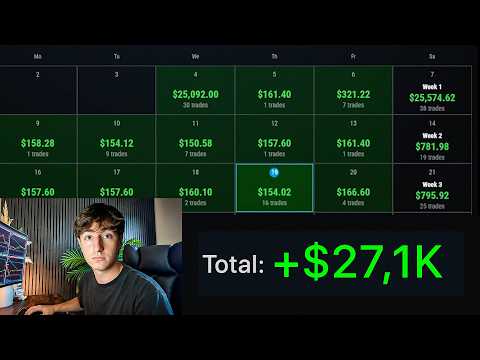
[0:00]In this video, I'm going to show you guys the one free indicator that I use that got me over an 83% win rate, six figures in payouts, and I can literally trade it at the exact same time every single day.
[0:09]Using this has my top step P&L over $50,000 this month alone and the month's not even over. This is $27,000 on just one account here.
[0:17]And yes, it is Express. Let me go ahead and refresh the page for all of you guys and go ahead and go to the other ones.
[0:25]Again, here's 10,500 and here's 10,700, and additionally I got another $10,000 account, took a 5K payout and blew that one. So that puts my top step PNL at $53,000 this month alone with this.
[0:38]Now, here's what no one tells you, okay? I almost completely missed out on having that kind of PNL because my charts literally looked like a fucking Christmas tree with like 15 different indicators is actually killing my win rate when I thought it would improve it.
[0:51]And the one indicator that I actually finally found that works for me, it's not RSI, it's not MACD, it's not any of that noise.
[0:56]I'm talking about the one indicator that replaced literally everything for me once I had finally cleared my charts.
[1:02]So in the next few minutes, I'll show you exactly what it is, why it's outperforming literally everything else and how you can set it up to start taking consistent payouts like my students are.
[1:10]But first, if you're actually going to use an indicator to trade and add to your strategy, you need to understand why most traders actually fail with traditional indicators.
[1:18]Most traders, especially at the beginning, end up thinking that, oh, the more indicators I have, the more confluenes I have, if I can just add a ton of indicators, I'm going to end up being profitable, right?
[1:28]That's actually legit just completely killing your win rate. Look, I had RSIs, MACDs, Bollinger bands, moving averages, literally everything you could possibly think of.
[1:38]And my chart honestly looked worse than this. I wish I had a screenshot that I could go back and find it's probably one of my phone from years ago.
[1:44]Anyways, that resulted in me spending about two years just trying to make all of my charts look like my favorite guru's charts, kind of combining everything and thinking that it would just magically turn me profitable.
[1:53]And look, it's not necessarily that indicators just don't work, it's more the fact that you're putting 10 different ones on your charts at a time and they actually all just end up contradicting each other.
[2:03]Here, you're getting a buy signal with a MACD buy or sell, but here you're touching the EMAs and you're also in a downtrend. As you can see, everything is just kind of mixing and matching and it just ends up leaving you more confused than you started.
[2:16]In reality, traders aren't failing because they don't know enough, they're actually failing because they know too much and they're trying to combine everything.
[2:23]So obviously, as a trader, I went down the list and started testing every single one of these indicators to really just find which one actually mattered.
[2:30]All in all, I finally found it. So let's go ahead and do a satisfying clearing of the charts and actually look at that indicator that turned me profitable and actually truly mattered for my strategy.
[2:40]So this indicator is called the High Time Frame Power of Three, otherwise known as HTF Power Three. And before you skip ahead and just look for examples, it's very important that you understand why this indicator works so well.
[2:54]So let me go ahead and explain that for you. And by the way, this isn't a promotion, this isn't my indicator, I'm not affiliated with it. I'm just dropping pure fucking game for you guys on a free indicator that has printed me hundreds of thousands of dollars.
[3:04]So the first thing that's going to happen when you actually click on that indicator is you're going to see a higher time frame candle pop up beside your lower time frame. You're just going to see this big ass candle pop up and you're probably thinking, okay, what the fuck does this actually do?
[3:19]Like this isn't telling me to buy or sell, it's not telling me where there's support or resistance. How do you use it? How does it work?
[3:24]Well, let's start off by going over here and clicking the settings on this indicator. Okay? You will see the time frame. Whatever time frame this indicator is, that's actually what this candlestick is.
[3:37]So you could be on the one minute, the five minute, the 15 minute or even the four hour and it would just hold this daily candlestick, the current daily candlestick beside your current time frame, okay?
[3:47]Likewise, if you flip this to the four-hour time frame, it would then make this the four-hour candle, which in this scenario is the same because the day literally opened.
[3:57]You can do the 30-minute candle as well. As you can see, just puts that time frame besides whatever time frame you're on.
[4:04]Okay, so why does that matter? Can I just like flip through the time frames and go and see what the daily looks like and just go right back?
[4:11]Okay, let's explain how to actually use this indicator and why it matters. This is actually one of the most important concepts and the fundamentals of trading, and it is a fractal concept, meaning this happens across all candlesticks and all time frames.
[4:28]So let's go ahead and get into it. First off, I'm going to put our high time frame candle over here. Just like the indicator would show.
[4:36]We're going to have a body, a top wick and a bottom wick here. Okay?
[4:43]So, every single candlestick moves in four steps. The first step of a candlestick is for it to simply just open, okay?
[4:54]Now, if you are expecting a bullish candlestick, the second step is for it to go and make the low. Okay? So if you're bullish, you're going to open, then make the low, and then three, you're going to push up to make the high of the candlestick, and then four, you're going to eventually form that wick and close.
[5:12]That is how literally every single high time frame candlestick uses. Now, the formation of that is actually displayed in somewhat of a pattern where you're grabbing liquidity on a lower time frame.
[5:24]That might sound complicated, but it's actually stupid simple and it only has three steps. So the lower time frame generic makeup of this higher time frame candlestick is going to show up as a Power of Three, meaning accumulation, manipulation, and then distribution higher.
[5:41]And then pushing down to close and accumulating. But again, it's just a power of three, okay?
[5:48]So the way this works is first step, the candlestick opens. First step, we accumulate. So we accumulate when that candlestick opens. We will then accumulate long enough to form a gap under here or just have some liquidity could just be the accumulation lows.
[6:03]Then we manipulate lower, okay? So step one, we accumulate. Step two, we manipulate. That manipulation is going to put in the bottom wick of that four-hour candle.
[6:17]Sounds simple enough. That's all we're waiting for. And we're just waiting for a reversal off of that, okay? Once we start to see price push back to the upside and we end up getting some sort of entry confirmation, then goes the distribution, okay?
[6:29]As this distribution is happening, this high time frame candlestick is actually pushing up. That is the distribution is the entire candlestick forming. So basically what the strategy does is it helps me catch the top and the bottom of high time frame candles.
[6:45]And as you know, if you took like literally any four-hour candle and we're able to catch all the points or all the ticks within that, you would absolutely be printing money. And that's my theory, that's all I do is I print money off high time frame candles off the low time frame entry here.
[7:03]And this works at the exact same time every single day. And when I say it works at the same time literally every single day, that's because we're trading it right exactly when one of these high time frame candles open.
[7:12]Now, I focus on the four-hour PO3 or the four-hour high time frame candlestick. So, if you want to follow along with me so you can set this up to actually start trading it, is you want to go on TradingView, click indicators like we said, look up HTF Power 3. I use the one by 2 degrees.
[7:31]Go ahead and click that. Over to the side here, you're going to see PO3. I want you to click settings and make sure it is on the four-hour time frame. Once it's on the four-hour time frame, go ahead and close out. You should see that four-hour candle.
[7:44]Now you're probably like, Jack, okay, what low time frame do you follow along with? Is that the 30 minute, the hourly, the 15 minute? What is it? You want to be on the one minute time frame primarily when you're looking for your entry.
[7:55]So go to the one minute time frame and make sure this is on the four-hour candle. And the next thing you're going to do is mark out 10:00 a.m. Eastern. If you're confused on when that is, it's literally just 30 minutes after the actual stock market opens in the morning.
[8:11]And the reason you're doing that is because using the indicator alone isn't going to turn you profitable, you have to actually know when to use it.
[8:19]This is that time. And like we talked about, high time frame candles are allowing you to catch a lot more ticks and a lot more points, harvest a lot more money out of the market.
[8:28]If you're just looking at the four-hour and thinking of what a candlestick is going to do, it's the same thing as a one minute. Could you tell what this one minute candle is going to do? No, you would have to drop to a lower and fractal time frame to figure out exactly when it's going to put in that top or bottom wick and how it's actually going to form.
[8:45]Again, we're catching the entire expansion of a high time frame candle and getting precise time-based low time frame entries.
[8:52]And what traders are still missing when they use this indicator is they're not trading it at this time because this indicator is literally 10 times more powerful when you trade it at 10:00 a.m. Eastern.
[9:02]Now, why specifically the one at 10:00 a.m. Eastern? That's because it is 30 minutes after the market open, which gives us the opportunity to let price give us extra confirmations and avoid the very commonly taken market open fake out right here, okay?
[9:17]I could have potentially been bullish on this. The market was quite high up. It was respecting high time frame gaps. Boom, liquidity sweep. Boom, inversion fair value gap.
[9:29]Okay, going to take long. But if you would have just waited for 10:00 a.m., would have realized that's not truly what's happening for the day and that's just the market open fake out, the market open sweep.
[9:40]Now that we are actually waiting for 10:00 a.m. to open, we can clearly see that the directional bias is actually bearish. We've inversed a couple of high time frame gaps. We're confirmed we can go short. Now we just have to wait for our setup. And now that new four-hour candle opens.
[9:54]So we're looking for our Power of 3 or PO3, which is going to be accumulation of price. So price just moving sideways in a range, not really going anywhere, which we can clearly see right here.
[10:06]And then we're waiting for our manipulation. But you're probably wondering, okay, but how do we know if like, oh, if it sweeps right here, is that our manipulation? How do we know when and where this manipulation is actually going to occur?
[10:20]And stop going up because we could just infinitely try and long what we think is the manipulation, but it ends up being a bias that and you get stopped out five times and still lose on the day. There is a specific time frame that we need to flip to to see this, okay?
[10:33]Price is typically going to consolidate long enough at around 10:00 a.m. for us to form a brand new 15-minute fair value gap on price, okay?
[10:46]So clearly, right here, we have consolidated for 15 minutes in this accumulation range. What I'm going to do is flip directly to the 15-minute time frame and see if I can spot a fair value gap. Boom.
[11:00]We have a 15-minute gap closest to price, directly above the accumulation range. We don't need price to go anywhere crazy. So, back to the one-minute time frame. We're going to wait for our manipulation to happen. Still accumulating.
[11:12]Okay, there we go. There is our manipulation into the 15-minute fair value gap. As we can see, we see a very instant reaction. Now, what are we going to do?
[11:23]Are we going to instantly trade this? No, that would be predicting. We're trying to react. We're waiting for an entry confirmation, okay? We want to make sure that we're actually going to enter the distribution leg instead of just continuing to push to the upside.
[11:36]But again, this manipulation into the 15-minute gap, putting in the high of that four-hour candle. That's why it's so important to have this indicator next to you, okay?
[11:46]Now what we're going to do is we're going to wait for an entry confirmation. For me, I typically like to take inversion fair value gaps or changes in the state of delivery.
[11:58]Obviously, you guys may know this, you may not know this, but an inversion gap is a fair value gap that gets closed below.
[12:04]So in this scenario, this fair value gap right here, the candle body closes below it, that would be an inversion fair value gap or an entry confirmation for us.
[12:15]The other entry confirmation that I like to take if I don't see any fair value gaps, which can happen, because we don't have any right here, right?
[12:23]There was one, but it already got inverse, so we don't care about that. Change in the state of delivery is going to be a candle closure below the most recent leg to the upside of multiple candles, okay?
[12:37]So what I would want to do is wait for that most recent leg to the upside. I would take the opening price of that first up candle, okay?
[12:49]Same thing if I was bearish. I'd take the opening price of the first down candle that created that leg, okay?
[12:55]So, I'm going to do is I am going to go short right here and I have my stop-loss placement all the way at that manipulation high. Okay? That is where our stop loss is safe.
[13:07]For this, I typically like to target any near points of liquidity, previous session high, previous session low, previous day high, previous day low, anything like that.
[13:17]I don't like to keep it too complicated. So here we have a two risk reward and we can leave some runners all the way to a four risk reward.
[13:26]And again, this entry confirmation right here is how I have that over 83% win rate. It's because I am waiting for the market to actually tell us what it's going to do. I'm not just trying to predict or set limit orders. So, we can see this trade play out and you're going to see.
[13:40]This creates the expansion of the entire four-hour candle here and just continues to bleed on this setup. You could have literally harvested 1300 ticks on this because you're really trading a high time frame candle.
[13:54]You're just getting a extremely, extremely simple and time-based low time frame entry that's repeatable the same time every single day. Get why this is so powerful now?
[14:04]Now look, if you do want to go deeper into this exact strategy and watch how I executed it to become profitable for the last two and a half years every single morning, I put together a completely free Power of Three Bible.
[14:15]It's 30 pages of literally everything I learned over the last two and a half years using this specific indicator with this entry model. Go ahead and grab it for free at the first link in the description while it's still available.
[14:26]All right, now let me walk you through a real trade that I took last week using this indicator. So again, go ahead and mark out 30 minutes after the market opens, which is going to be 10:00 a.m. Eastern.
[14:35]Now currently, I'm on the 15-minute time frame and I can already see that price has formed a brand new 15-minute fair value gap closest to me. So that's going to be my area of interest for this manipulation to happen here.
[14:49]Okay, so what we're going to do is we're going to mark out 10:00 a.m. Eastern and I'm on the 15-minute time frame. I can already see that before this candlestick opens, that there has been a brand new 15-minute fair value gap formed. So that's probably what we're going to be using to where we think price is going to manipulate to.
[15:09]Now, the accumulation can happen just during your a little bit just after. You don't want it for too long, but the accumulation basically right around the opening here. So, we can already see, okay, cool. Price has already started to accumulate, right?
[15:25]Now we wait for that new four-hour candle to open here. Okay, so our four-hour candle has opened and pretty much instantly given us that manipulation to put in the bottom wick of this new four-hour candlestick into the 15-minute gap. We were expecting price to tap into.
[15:40]Now, all we're doing is waiting for entry confirmation. As we can see, there are no fair value gaps here, so we're going to have to wait for a change in the state of delivery.
[15:48]Which is going to be right here because that is the opening price of the last or the first candlestick that forms that new leg to the downside. So let's go ahead and see what happens.
[16:03]All right, we're waiting for an entry confirmation and we actually do end up seeing a deeper manipulation here. Okay? That's why it is so important within this strategy to not just react and the second price taps in, we're enter, but to actually wait for entry confirmation, okay?
[16:22]Now, we got a deeper manipulation, a very clear low of the four-hour put in. And we can go ahead and see that we have a very clean entry confirmation. We have an inversion fair value gap right here, okay?
[16:36]So, what I'm going to do is I'm going to enter long right here, which was the break that. Same thing as I always do, keep my stop loss at the low of that brand new four-hour candle. For this trade, I have liquidity just up here at a two risk reward.
[16:50]So that's all I'm going to take this one. Let's see how it plays here. Pretty quick delivery straight up there. As you can see, this trade hit in literally under 10 minutes for a one-to-one base it.
[17:11]No guessing, no hoping, no more staring at 10 different fucking indicators all day on the charts, literally just one clean setup at one specific time is all it took to completely change my life and make me over six figures in trading.
[17:24]This is exactly why my student Dobrin took a $50,000 account with Apex to over a $75,000 account balance, harvesting, again, well over an 83% win rate, with his win rate sitting at a 94% for this month of track data.
[17:39]And as you can see, this is repeatable. You can do this practically every single day at 10:00 a.m. So, here's what you actually need to remember, you don't need 10 different indicators just completely cluttering your charts, you just need one indicator, one setup at one specific time.
[17:53]The high time frame power of three indicator gives you high time frame context without all the noise, and the Power of 3 provides you that mechanical and easy to follow entry model that you can execute time and time again with discipline.
[18:05]If you've been overcomplicating your trading, this is definitely your way out. I sure know it was for me. So, clear your charts, set up this one indicator and just start trading at 10:00 a.m. Eastern. That is how you go from losing to consistent payouts.
[18:16]All right, so if you're serious about mastering this strategy and you want one-on-one help to get funded and actually stay profitable with it, I work with traders inside my mentorship program where I'll build you an exact road map to passing challenges consistently and ripping five-figure payouts every single month.
[18:31]And unlike pretty much everyone else in this entire space, I print it for myself, so I can guarantee results for my students. I put my money where my mouth is. So, click the second link below in the description and apply to see if you're a good fit.
[18:42]And if you got value from this video, make sure to subscribe and go ahead and check out this video right here where I break down the right way to actually use prop firms. It's the exact method me and my students use to pull six-figure payouts.