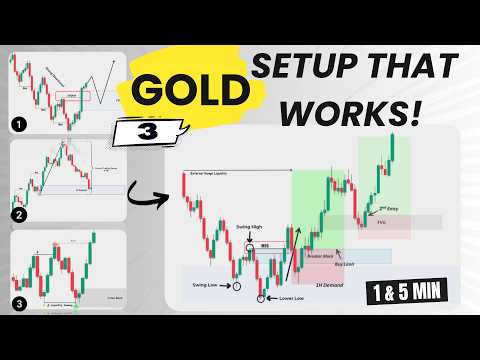
[0:00]Hey traders and welcome back to Smart Risk. If you've ever tried scalping gold, you already know. It's fast, aggressive, and extremely unforgiving.
[0:10]One wrong entry and you're out instantly. In today's video, I'm going to show you my three most powerful gold scalping strategies that work perfectly on the one-minute and five-minute charts.
[0:21]These are the exact setups I would rely on if I had to trade gold every single day. Each one is built on clear mechanical rules, and I'll break them down step-by-step.
[0:33]So by the end of this video, you'll have a complete roadmap to scalp gold with ease. Let's get into it.
[0:49]Welcome back, traders. So let's get started.
[0:53]Before jumping into the scalping strategy, we first need to understand the gold pair.
[0:58]In forex, gold is traded as XAUUSD, which represents the price of gold quoted in US dollars.
[1:05]In the crypto market, gold exposure is available through tokenized assets like PAXG Gold (PAXG), or Tether Gold, which are backed by physical gold and traded against cryptocurrencies like Bitcoin or stable coins such as Tether.
[1:18]Because of its strong volatility, deep liquidity, and frequent price movements, Gold has become one of the most popular assets for traders, especially for short-term strategies like scalping.
[1:30]Despite the forex pairs like euro dollar or US stock indices such as S&P or Nasdaq, that I prefer using strategies based on liquidity sweeps, the gold pair is most likely to react and respect the major areas such as key higher time frames supply and demands,
[1:46]order blocks and fair value gaps. And it usually swings between these areas.
[1:52]Hence, for having the A+ scalping strategy, we need to take advantage of that by only focusing on scalping strategies that use higher time frame delivery as the main confirmation criteria.
[2:04]Now, let's start with the first scalping strategy.
[2:08]To apply this strategy correctly, you'll need to work with two time frames. First, a higher time frame to analyze the overall market condition.
[2:18]On this time frame, you want to identify a liquidity sweep, a break of structure, and the order block connected to them.
[2:25]Then, you'll zoom into a lower time frame to track the higher time frame delivery and look for reversal or confirmation signals.
[2:33]This is where you'll wait for your entry model to appear before opening a position.
[2:38]Now let's go step-by-step and see exactly how this setup plays out.
[2:44]In the first step, you need to identify a key liquidity sweep or liquidity grab, along with a break of structure on the higher time frame.
[2:53]Of course, you can do all of this manually. But for this video, we're going to use the price action toolkit indicator to do it automatically.
[3:00]If you're interested in using this indicator, check out the link in the description.
[3:07]It also comes with a 30-day money-back guarantee in case you decide it's not for you.
[3:12]Now, in this bullish example on the higher time frame, the very first thing you want to identify is a bullish liquidity sweep or liquidity grab.
[3:20]In simple terms, you're looking for price to take out a key level, reverse immediately, and then confirm that reversal with a break of structure.
[3:30]To set this up, after applying the price action toolkit, go to the settings tab and enable the liquidity grab option.
[3:38]Once that's activated, bullish liquidity grabs will appear on the chart as small green circles, while bearish liquidity grabs will appear as red circles.
[3:49]Next, go to the indicator settings and activate the BOS and shock checkboxes.
[3:55]Here in this example, we can see a bullish liquidity grab, where price sweeps below a recent key swing low, immediately shows a strong rejection to the upside, and finally leads to a bullish break of structure.
[4:09]In the next step, you need to mark out the order block that initiated both the liquidity grab and the break of structure.
[4:17]This becomes your higher time frame point of interest. More often than not, price tends to revisit this block, where it acts as a demand zone and smart money steps back into the market.
[4:27]Now, for those who are wondering what an order block is.
[4:31]Order blocks are decisional zones where large volumes are placed right before a major expansion.
[4:37]Because of this, price often reacts or reverses when it returns to these areas.
[4:42]In a bearish scenario, a bearish order block is the last up close candle or a series of up close candles formed right before a strong bearish move that causes a break of structure.
[4:52]On the other hand, in a bullish scenario, a bullish order block is the last down close candle or a series of down close candles formed just before a strong bullish move that leads to a break of structure.
[5:07]After marking the order block, the next step is simply to wait for the price to return to that zone.
[5:13]This is where your potential trading opportunity begins to form.
[5:16]Once price reaches the order block, the next step is to zoom into the lower time frame and closely monitor the price action for signs of reversal.
[5:26]These signs could include a market structure shift, a change of character, or other reversal signals such as IFVGs or VSR patterns.
[5:35]Now in the next step, we're looking for a violated fair value gap that transforms into an inverse fair value gap.
[5:43]This serves as our first confirmation.
[5:46]Once the IFVG forms, it often acts as a new support level, providing a strong area for a potential buy entry.
[5:54]And if a market structure shift occurs at the same time, it adds another powerful layer of confluence, making the setup even more reliable.
[6:02]With these confirmations in place, we can expect price to retrace back into the inverse fair value gap, now acting as support, before continuing upward toward the next pool of buy-side liquidity.
[6:16]For placing an entry using this model, you have two options.
[6:19]But before we go into the details, keep in mind that you can always add additional confluence or confirmation factors to this setup before placing your entry.
[6:28]Such as a V-shaped recovery, or a change in the state of delivery.
[6:33]However, this is completely up to you, because adding extra confirmations can be a double-edged sword.
[6:39]While it can increase the reliability of the setup, it may also cause you to miss the trade entirely if the market moves quickly.
[6:47]Now let's see exactly how to place our entry.
[6:51]As mentioned earlier, when using this scalping setup, you have two main entry options.
[6:56]The first option is to enter immediately after the inverse fair value gap, IFVG forms.
[7:04]In this case, you open your position at the opening of the next candle with your stop loss placed below the most recent swing low.
[7:12]The second option is to place a buy limit order at the highest point of the newly formed IFVG and wait for price to retrace back into the zone and activate your position.
[7:24]For your take profit, you can target the nearest buy-side liquidity on the current time frame.
[7:30]Or, if you're aiming for a larger move, you can target a key level on the higher time frame.
[7:35]This entry approach often provides a better risk to reward ratio, since it is slightly more conservative.
[7:42]Now, in cases where price has already started moving in my expected direction, and my first position is already running in profit, and there is still enough room for price to continue higher,
[7:53]I often look for an opportunity to add another position as a continuation setup.
[7:59]This happens when price forms a new bullish fair value gap during the next bullish leg that follows the new break of structure.
[8:07]In that case, the next unmitigated bullish fair value gap becomes our second entry point.
[8:14]We can place a buy limit order at the highest point of that fair value gap with the stop loss placed a few pips below the most recent swing low.
[8:28]As mentioned earlier, to get the best results with this trading plan, especially when trading gold, you'll need to work across two different time frames.
[8:37]The most effective higher time frames for identifying this setup are the 30-minute and 15-minute charts.
[8:43]Once a potential setup is identified on the higher time frame, you can then move to lower time frames, such as the 5-minute or even the 1-minute chart, to execute your entries.
[8:55]So let's continue with the second scalping strategy.
[8:59]This setup works with two time frames, the 1-hour and the 5-minute charts.
[9:04]On the higher time frame, we analyze the overall market condition.
[9:09]Here, we're looking for unmitigated, high-quality supply and demand zones.
[9:13]Then, we zoom into the lower time frame to track the higher time frame delivery and look for reversal or confirmation signals.
[9:21]This is where your entry model needs to appear before opening a position. Now let's go step-by-step on the chart and see exactly how to apply it.
[9:30]In a bullish scenario, the first step is to confirm that the price is in an uptrend and that buyers are in control of the market.
[9:37]To do this, you need to identify at least two consecutive bullish breaks of structure.
[9:41]So first, let's enable the BOS option from the indicator settings.
[9:45]Once price forms two successful bullish BOS, shift your attention to the most recent bullish break of structure.
[9:53]From there, trace back to the origin of the bullish expansion move, the move that caused the break.
[9:59]That origin point is what forms the demand zone.
[10:02]The next step is to highlight the most recent unmitigated demand zone on the higher time frame, and then wait for the price to return to it.
[10:10]Once price taps back into that zone, zoom into the 5-minute chart and closely monitor the price action for signs of reversal.
[10:17]This will serve as your first confirmation before you start looking for an entry.
[10:21]This could be a market structure shift or a clear change of character.
[10:26]Either way, that serves as your first layer of confirmation.
[10:30]A market structure shift indicates that the temporary bearish move is coming to an end, and that bullish momentum is likely returning.
[10:38]At this point, price is expected to realign with the higher time frame trend.
[10:43]Once the bullish market structure is confirmed and we expect the price to move higher, the next step is to look for a buying opportunity.
[10:50]At this stage, we need an entry model to form.
[10:54]For my first entry, I usually prefer to look for a bullish breaker block forming inside the higher time frame supply or demand zone.
[11:02]For a valid bullish breaker block, price should first create a swing low, then a swing high, followed by a lower low.
[11:10]After that, we need to see an immediate expansion move to the upside that breaks structure and confirms the shift.
[11:16]In this case, the up close candle or series of up close candles formed between the first swing low and the swing high, becomes your breaker block zone.
[11:26]This is the area where you plan your long entry.
[11:29]You can mark the breaker block manually step-by-step, exactly as I showed earlier.
[11:35]Or you can highlight it automatically by simply enabling the breaker block option in the indicators settings.
[11:42]The next step is to set a buy limit order at the highest point of that breaker block and wait for the price to retrace into the zone.
[11:49]For your take profit, you can target the nearest liquidity on the current time frame, or aim for a higher time frame key level if you're expecting a larger move.
[11:57]Now, in cases where price has already moved in my expected direction, respected the demand zone, and my first trade is already running in profit,
[12:06]I often look to add a second position as a continuation entry when price creates a new break of structure.
[12:12]This usually occurs when price forms a new bullish fair value gap within the expansion leg of the new BOS.
[12:19]In that case, the next unmitigated bullish fair value gap becomes our second entry zone.
[12:25]We place a buy limit order at the highest point of the fair value gap with the stop loss set a few pips below the most recent swing low.
[12:33]The bearish scenario follows the exact opposite logic.
[12:38]Now let's move on to the third scalping strategy.
[12:41]Just like the previous two strategies, to apply this setup correctly, you need to work with two time frames.
[12:48]First, a higher time frame, such as the 4-hour or 1-hour chart, to analyze market structure and look for a clear higher time frame change of character, along with the formation of an unmitigated fair value gap tied to it.
[13:02]Then, we zoom into a lower time frame, such as the 15-minute or 5-minute chart depending on the combination you prefer, to look for reversal signs, confirmation signals, and eventually a proper entry model.
[13:17]Now, let's go step-by-step and see exactly how to apply it on the chart.
[13:21]The very first step is to analyze the higher time frame market structure and determine whether the price is currently in a strong uptrend or a strong downtrend.
[13:30]So, in a bullish scenario, the first thing you want to identify is a strong downtrend.
[13:36]To confirm a strong downtrend, price should form at least three consecutive bearish breaks of structure.
[13:43]On the other hand, to confirm a strong uptrend, price needs to form three consecutive bullish breaks of structure.
[13:50]Once that is confirmed, the next thing you need to look for is a higher time frame change of character.
[13:56]So, if price breaks and closes above the most recent break of structure high of a strong downtrend, it signals a bullish change of character.
[14:06]Suggesting that sellers are losing control and the market may be preparing to shift direction.
[14:10]Now, once this market structure shift is confirmed and we expect the price to move higher, the next step is to look for a buying opportunity.
[14:19]At this stage, we focus on identifying a bullish fair value gap that forms within the change of character leg.
[14:26]So after identifying the higher time frame chalk and its fair value gap,
[14:31]the next step is to zoom into the lower time frame and wait for the price to return to that higher time frame fair value gap.
[14:38]Once price enters the zone, closely monitor the price action inside the gap and look for any sign of rejection.
[14:45]This confirms that price is respecting the higher time frame imbalance and it serves as your first layer of confirmation.
[14:52]After that, the next step is to look for a violated fair value gap that flips into an inversion fair value gap.
[14:59]Either inside the higher time frame FVG, or just outside it after the rejection.
[15:05]This becomes your second layer of confirmation.
[15:09]When this inversion fair value gap forms, it often acts as a new support level and this is the area where you start looking to open your long position.
[15:18]Now the next step is executing your position. To do that you have two options.
[15:23]The first option is to enter immediately after the inversion fair value gap forms, inside the higher time frame fair value gap.
[15:31]In this case, you open your position at the opening of the next candle with your stop loss placed below the most recent swing low.
[15:39]The second option is to place a buy limit order at the highest point of the newly formed IFVG and wait for the price to retrace back into the zone and activate your position.
[15:50]For your target, you can aim for the nearest buy-side liquidity on the current time frame.
[15:55]Or if you are expecting a larger move, you can target a key level on the higher time frame.
[16:00]Keep in mind that you can always add additional confluence or confirmation factors to this setup to improve its win rate, depending on your trading style.
[16:09]For example, you might require price to fill at least 50% of the higher time frame fair value gap, or wait for additional confirmation signals such as a CISD formation before entering the trade and other similar factors.
[16:23]That's it, traders. Thanks for watching. I hope you found this video valuable.
[16:27]If you did, hit subscribe and turn on notifications so you never miss an update.
[16:32]Drop a comment below with your thoughts or topics you'd like to see next.
[16:36]Your support means the world to us. See you in the next video.


