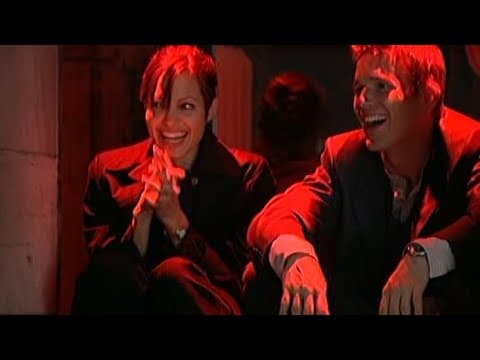
[0:20]Part of my philosophy as a director is to sort of get everyone together 10 days or at least a week before and during the rehearsal process. You become friends, you become partners, you become collaborators. And for me, it's important that everyone feels involved. There are very few films you have this amazing experience where the director is really nice and everybody's doing so much character study and research into psychopaths and I thought, It's that great thriller that comes along every once in a while and you're halfway through it and you think you know exactly what's going to happen and then it just makes all these turns and surprises you.
[0:56]I always say it's less of a who done it, but it's also a why done it, you know, so it's a combination of trying to figure out why a killer's done it and and how he's behaving and why he's behaving that way. It's been a quest. All right, stand by. Here we go. I think you're always looking for things within this genre to make it unique. Frankly, every now and then you find a piece of material that you think you can raise the bar. I think you have to set out with very lofty goals and you have to set out believing that you have the potential to make something really special. Uh and this is no exception. Dock on action, ready and action! We have a great script that originally was written by John Boken Camp, who's a fine young writer, and then Hillary sites who wrote Insomnia came in. And when Warner Brothers approached me about the script and before I even read it, I said, well, is anybody interested in Lisa Angelina Jolie is. And so having read it knowing that they can potentially make this movie with her, it was very exciting. I loved the script and thought I didn't know what kind of a movie it was going to be, I just wanted to be a part of it and explore it and now it's actually become this many layered, very in depth, very interesting character-driven film. This had a lot of things going for it. Mark Canton producing the show, Angelina Jolie and Ethan Hawker, two fantastic actors, and so all of those things combined with the script make you start to get excited about oh, where the where is this really going to really go?
[2:25]Ethan expressed an interest in in making the movie. It seemed like such a great opportunity and such a great chemistry. You know, it's kind of a classic thriller structure. Well, I was really interested in doing the movie. I kind of like the genre. I saw this man. We seem to make him very nervous. Things are not always like they look like in a movie or in life. That's all about the subject of this movie also. Who is who really? The wonderful thing about a thriller is that nothing should be as it seems. The one thing that I've I really admire about this piece is that it doesn't just have a twist that is thrown in there because it confuses everybody. It's a very honest movie in that way. So, you know, you do have the thrills, you do have the twist, and at the same time as you try to figure it out, if you go home and you think back about the movie, it does all make sense. You want the logic of a movie to make sense and to have it have its own continuity. Because it's important if you're teasing people that it has the right payoff. Because the movie that we wanted to make was a movie that had no holes, no logic gaps.
[3:36]It's a very frustrating experience as an audience member and you go, well that doesn't make sense. It takes you out of the movie. We didn't want anybody to have that experience. We did a huge amount of research with both the FBI and with the profilers and with the people that spend their careers and lives cracking and hunting serial killers. We're looking for some expertise because they want to do it uh the way we do it at the security back. Francois has been incredible, you know, he's helped us with the research, he's helped us do things right. We've been able to portray the the SQ as as accurately as possible for film. I'm more at ease with murderers, drug dealers, thieves, and now I'm doing I'm dealing with a movie. Quite a difference in my life. All right, first position. Basically, our set to identical copy of the circuit Quebec, which is sort of like the prevention police department that they have there. And so if we're dramatically interpreting it, but I want to be as accurate as I can. I don't understand why he needs to bring in someone else. I mean, we we've got everything under control. Key to this movie, like any good movie is, you know, a good story well told. And there's not that many tricks here, you know, it's performance and storytelling. I think it's sort of a crime thriller love story, which is which is very unique when you start to combine all these genres. And I just want to make sure the actors feel like it's a completely collaborative process. So that when we go off make the movie, we know exactly where we're going.
[5:23]The hardest part of directing, I think, is to know walking each day and know where you've been and know where you're going in terms of the scene. And DJ is a hard worker. He studies and he comes in prepared. And then they go like this and then you can just hold. I like to work on, you know, work out a couple things, and so I had those animatics, and I'd show the studio, particularly one of the intense sequences and just kind of show them just to make them comfortable. This is the style of the movie that I want to make and and it becomes incredibly helpful. She focuses on a box that she sees up in the ceiling. slides the tile back.
[6:02]The body falls. These animatics are these storyboards, help you understand your movie and the scene so much better.
[6:17]Why?
[6:31]I think a good thriller always has mystery and intrigue. But at the same time, you need that anchor of a character and I believe Angie's character is that anchor. That's someone who's going to take you through, someone that you like, someone that you trust, someone that you want to grab on to.
[6:49]Some directors don't get inside your character as much, they're very focused on the whole plot and where everybody needs to be, but they don't really think, you know, this is where she's nervous or this is what makes him like her.
[7:03]DJ really understands our character. It was important for me to always stay on top of why a certain character was doing what they were doing and so that you can explain it to the actor. If you don't have that foundation, how can you possibly tell the actor what to do or how to react? I have confidence because every time I feel something is not there, he's he's there to, you know, put us back on track or give us an idea just to get away from what we did before to find something new, you know. He's really a good, good director.
[7:35]He is real passion and real integrity as a person and I don't know, you know, you can tell when somebody really wants to make a good movie, you know, they're really willing to put the thought and time into it and he certainly is. DJ has a very strong, very strong sense of of where he wants to go with the picture, and a very strong point of view about each individual character and how they're going to interact and and ultimately that vision is what becomes the film.
[8:09]There's a really vital scene that takes place on the elevator between Gena Rowlands and Glenn Beck, the characters, and to me that was a really, really tough scene. Because this transformation has to happen with Jenna, and she has to realize that her son has now maybe confronted her on this elevator, and and just the performance elements of that were very interesting. Because seeing your son have to, if you've not seen him in 20 years and believe that he's dead, it presents a lot of challenges. There are a lot of things you do with cameras in lingering things or cameras back in the corner looking through some foreground and just getting the sense that someone might be in that room. Or even leading the audience to of sort of a false focus. Like, Angelina might be focusing on something up there when really she should be focusing on something that's behind her. There's nothing more effective than just a nice close-up of an actor whose eyes shift. If you have the audience, the movie's working, a look or a shift or something could mean something that might necessarily, you know, something that might go by in a normal movie and a thriller can mean something. Something scary is about to happen. Particularly with Angelina's character, I did a lot of extreme close-ups of one eye or two eyes. It was just a way that I found it helped me kind of get inside her head. And so those are I mean, they're not any new tricks, but those are sort of the tried and true tricks of the of the genre. Special Agent Scott. Yes.
[9:32]I think what I what I try to do is let the emotion of what the actor and and the scene is about help dictate the shot. There's a sequence where Angelina is in the hospital and um she sees Mrs. Asher, and Mrs. Asher has just identified the body. And sort of sends Zilleana spinning. And you'll see there's a shot that we do a 360 spin coming down the stairwell with Illeana that's, you know, emotionally representing where she is at that time. And I think that DJ's really tapped into that into finding these locations that represent, you know, where the character is at the time.
[10:20]Our final sort of showdown is about four and a half minutes. And about three and a half minutes of it's like it's completely quiet with no music and two people talking.
[10:37]And if your movie's not working, it would be probably incredibly frightening to have to sit there for three and a half minutes. But when we get to this final scene, you realize that you cannot hear a thing. Not one ounce, not one word, not one cough. It's just completely quiet because you've gotten the audience to a place where they're captivated and they want to see what's going to happen. That's really exciting as a filmmaker. You know, to scare the shit out of the audience, it's it's fantastic. The thing about making a movie, it's a marathon. You wake up every day and you shoot the movie, you go to dailies, you know, after dinner. And next thing you know, it's midnight and you got to call at 7:00. It's just a cycle that never ends, so you really have to pace yourself, you know, you really have to keep focus. You don't have a lot of time to look back. It's all about being going forward and what's next and what's next. Everything you saw. I wanted you to see.
[11:53]Our house is under the department's protection, that doesn't mean we can just go in and search it. What about a a headstrong FBI agent who's just not familiar with these rules. Yeah, I was lucky. I was very lucky. I was blessed. It's a really, really good cast. I just wanted to make sure it was still an actor's piece even though it was in this sort of thriller genre.
[13:12]I didn't want to play a just really confident, perfect, smart woman who came in and just had the answers to everything. I wanted to play somebody who was very flawed. Angelina's character is a character who by the nature of being a profile is very shut down. And that's what's interesting about Illeana is that for Illeana to be great at what she does, she has to cut herself off from the rest of her life to enable her to do her job. She's one of the few actors that I've watched that can be incredibly quiet and have a thousand things going on at the same time. So this role was perfect.
[13:51]I've always joked that she plays the, you know, leading man and I play the femme fatale. And he is a very good film fatale. In a way he is. He's a little bit dangerous, he's a little bit mysterious, he's very vulnerable. There's a depth and there's a darkness and there's a certain kind of mystery about this character that I haven't seen him play that I really am enjoying and I think he's great in it. I think it suits him. You looked at him and you saw me. My kind of take on performance has always been one kind of rooted in a first person kind of narrative where I relate to this guy. I'm going to play him and I don't get this character at all and I don't relate to him at all. And that's that's really interesting for me. I thought it would be great to put him in this role because this character had to be everything. He had to be incredibly intelligent. He witnessed something that's so horrific that he tries to overcome. And at the same time, he has this physical attraction to Angelina's character and I just thought Ethan has the depth to kind of put all that together. You've been great. You're making me sound nicer than I am. Kiefer's role is not in as much of the movie, but I knew that if we didn't get somebody good to play the that part, the movie would never work. It kind of pivots on that role. With Kiefer, there's a sense of menace. He doesn't have to raise his voice. He seems on screen so much bigger, so much more physical than he is because there's so much going on inside of him. When you get into playing a character based on ambiguity, it can be a lot of fun, especially if you get to steer them away from the truth here and a bit there. That's fun, yeah. Setting the movie in Montreal gave me an opportunity to get really good French actors and and the real thing. So I got Olivier Martinez and Jean-Hugues Anglade and Tchéky Karyo, who are three of my favorite French actors. In a way we are discovering the story uh day after day, you know. I didn't want to uh to play too much a stereotype of a cop. So, DJ's uh very open to our suggestions. The character of John Anglad Duval has been the opposite of my character, and I think we're like a couple. He's more phlegmatic and I'm more nervous. So Duval is uh based on the only friend because this is the only guy who's able to support him. It's a good team, you know. They uh they energy has very different. There is one discreet, the other one is a bit more outside. It's interesting, you know, they can play bad and good, they can have a good interaction. She's just going to be advising, right? This isn't about territory, Paquette. There hasn't been a murder like this in years. Okay, and the first thing you're going to do is bring in someone else. Come on. I have a strange feeling about this murder. And then of course, the icing on the cake is Gina Rowlands. I mean, she's a legend for the right reason, you know. She was really the most surprising actor. The way that she stepped up and took the darkness of her part and carried it underneath the sweetness that she portrays, I thought was really intriguing and interesting. Well, we just talked generally what we thought and we agreed so much that there really wasn't any place to uh to argue about. It just it's a very well-written script, and your duties towards it are are very specific. I think what was important for me was that we maintained a a level of what I sort of call character integrity. The reason I I choose or do a project is because I love the story and the actors that I choose to be in the story are are people that I admire. And in this film, we had this incredible, incredible cast lined up and there's interesting roles.
[17:51]I know you've seen this picture on the news, Mrs. Asher, but if you could just take a closer look at him please. This was a female character and and this was a female's movie and I thought also important to have a female editor, you know, to help with that voice. This was a very character-driven film. It's about a killer's mind and the FBI agent's mind and it's about interesting characters. And I would say that my work is somewhat character-driven or acted-driven in that way. Depending on the scene, there might be a moment where the actor is incredibly compelling and good, but at the same time it's not propelling your story forward. So how long do you hang on this moment? Is this moment vital? And you'd usually cut the scene for what it's worth when you first cut it, you know, not allowing necessarily for where that performance is going to go. So you know you're going to have to go back in and delete, edit, and change it a little bit. Then later on when you get it all together and you see where her performance went, you go back into the earlier scenes and you alter things to suit where the performance is going later on. Even the simplest scene maybe should be shot or played two or three different ways because you want to be able to have control over how they behave in the editing room so that you can have this option or this option. Only Martin reached the shore. That must have been devastating for you. It was.
[19:10]The first thing that you think about is what story are you telling and then you start thinking about the suspense and the thrills and you know, putting in the excitement.
[20:03]When you saw the Kiefer character, give that wave, you used to drop a glass with a crash and then they would all start running around. But it had a lot more that suspense tension of longer shots. Now, we've cut it quite quickly and you get there very quickly and it seems to make sense because once she sees the Kiefer character, it obviously looks like a suspect. So how long can you hold her before she would react? So, you know, there were two ways of looking at that, and that was quite interesting. I thought he could kind of hold it, and it's only because we know it's Kiefer Sutherland that we think she should react. But to my mind, she could have held back a little bit and been suspicious of him but not moving on him immediately. It's exciting. That's why I love cutting. Which is interesting because we have different styles, which is good, you know, she might like something that I hate, or I might hate something that she likes, but ultimately at the end of the day, there has to be one decision that's been, you know, if you're empowered and I was, thank God, in this movie that it's ultimately going to be your decision, so you're either going to sink or swim with it, you know.


