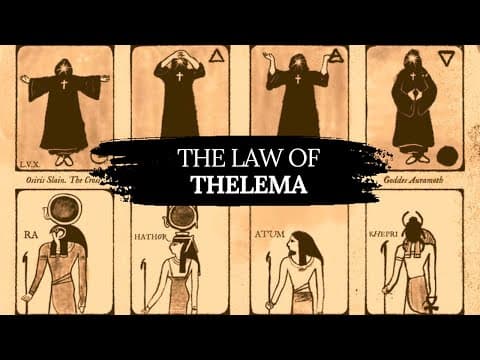
[0:02]What if there were a universal law capable of guiding your entire life, a mystical principle that promises to illuminate the path to true spiritual freedom? Today we will delve into the Law of Thelema, the doctrine created by Aleister Crowley, that has influenced occultists, artists, and seekers of truth for over a century. Prepare yourself for a journey that may change the way you perceive reality. The Origin Of The Law Of Thelema To understand the Law of Thelema, it is essential to know Aleister Crowley, one of the most controversial and influential figures in modern occultism. I will make a separate video about him in the future. But for now, what matters is that in 1904, during a stay in Egypt, Crowley claimed to have received a revelation from an entity called Aiwass. This message was recorded in The Book of the Law, Liber AL Vel Legis, becoming one of the most enigmatic and important texts in contemporary esotericism. The story begins in Cairo, where Crowley and his wife, Rose Edith Kelly, were conducting mystical experiments. Unexpectedly, Rose entered a trance state and began proclaiming that an entity was waiting for them, insisting that "the god Horus wishes to speak." Initially skeptical, Crowley tested his wife to verify the authenticity of her words. To his surprise, Rose accurately described details of Horus' iconography, information she could not have known without extensive study. On April 8th, 1904, Crowley sat in a room in Cairo and for three consecutive days received dictations from a mysterious voice that identified itself as Aiwass, the messenger of the gods. The content of these revelations would form the three chapters of Liber AL Vel Legis, a text that Crowley himself would take years to fully interpret. The Book of the Law introduced revolutionary concepts to Western spirituality, proclaiming that humanity was entering a new era, the Aeon of Horus. In this new cycle, true will and individual freedom would become the fundamental pillars of spiritual evolution. The Law of Thelema was born from this revelation, marking a break with religious dogmas and encouraging the pursuit of self-knowledge and personal fulfillment. Crowley's revelation did not go without controversy. While some saw him as a prophet of a new era, others accused him of fraud and madness. However, Thelema spread through esoteric orders and influenced occultists, writers, and philosophers throughout the 20th century. Its impact transcended borders and became one of the pillars of modern occultism. "Do What Thou Wilt Shall Be The Whole Of The Law" At the core of the Law of Thelema lies the enigmatic and powerful statement: "Do what thou wilt shall be the whole of the Law." These words, dictated by Aiwass to Aleister Crowley, became the fundamental principle of Thelemic philosophy. However, its true meaning is often misunderstood. To many, this phrase may seem like a call to unchecked hedonism or anarchy, but its correct interpretation goes far beyond that. In the context of Thelema, "doing what thou wilt" does not mean acting according to momentary impulses or selfish desires. Instead, it refers to the concept of true will. This is not a fleeting whim but the essential mission of each individual, their reason for existing in the cosmos. Thelema teaches that every human being has a unique purpose, and that fulfilling this purpose is the key to freedom and universal harmony. To discover one's true will, the adept must delve into themselves, freeing themselves from external conditioning and social illusions. Meditation, magical practices, and deep occult study are tools used by Thelemites in this quest. When an individual finds their true will and acts in accordance with it, there is no need for artificial moral restrictions or religious dogmas. Their very essence will guide their actions in perfect harmony with the universe. Crowley often compared this idea to the way celestial bodies move in their orbits. Each planet follows its path without interfering with the movement of others. When each individual follows their true will, there are no conflicts, as everyone occupies the place that corresponds to them in the natural order of things. The apparent chaos of the universe hides a deep harmony, and Thelema proposes that human life should reflect this cosmic order. This idea also carries a profound responsibility. Following true will is not a free pass for irresponsible indulgence, but a call for self-discovery and discipline. True will cannot be determined by superficial desires, but only through a sincere commitment to self-knowledge. Thus, "doing what thou wilt" is, in reality, an invitation to live with authenticity and purpose, free from the shackles of guilt or repression. Since its formulation, this maxim has been the target of misinterpretations and criticism. If each person's true will is followed without fear and without doubt, then humanity may reach a new era of harmony and evolution. It is up to each individual to heed this call and decide whether they are ready to follow the path of their own truth. But I warn you, this is the only real path that exists. Everything else is a waste of time. "Love Is The Law, Love Under Will" The second fundamental maxim of the Law of Thelema, "Love is the Law, Love Under Will", is often cited alongside the phrase "Do what thou wilt shall be the whole of the Law". However, its meaning goes far beyond a simple exaltation of romantic love or interpersonal affection. Within the Thelemic perspective, love is a cosmic force, the energy that permeates and connects all existence. But it must be understood and directed in light of true will. For Aleister Crowley, love was not merely a fleeting emotion or feeling, but a universal principle. In his works, he argued that true love occurs when two forces interact harmoniously without conflict and without external impositions. In this way, authentic love arises when each individual is aligned with their own true will and allows others to follow theirs, without coercion or artificial restrictions. The expression "Love Under Will" indicates that love should not be blind, impulsive, or chaotic. It must be a conscious love, guided by understanding and each person's individual purpose. This means that human relationships, whether romantic, social, or spiritual, should be based on freedom and mutual respect, without one party trying to dominate or subjugate the other. When someone acts in accordance with their true will, their love also manifests in a purer and more sincere way. In the esoteric context, love is the force that unites opposites and maintains the balance of the universe. Crowley often associated this idea with the figure of Nuit, the cosmic goddess of Liber AL Vel Legis, who represents infinity and divine love. Nuit proclaims that her followers should lose themselves in her love and find wholeness by uniting with the cosmos. This transcendent love is not attachment, but rather a state of fusion with the whole, a deep spiritual union. Thus, "Love is the Law, Love Under Will" teaches that all our interactions and relationships should be guided by an understanding of our own nature and the nature of those around us. True love does not impose itself nor imprison. On the contrary, it liberates and strengthens.
[8:59]When an individual lives in accordance with their true will, they love naturally, without fear and without unnecessary restrictions. This concept also reflects an ethical vision within Thelemic philosophy. For Thelemites, morality is not imposed by external rules but arises from an understanding of each person's true will. In this way, loving under will means acting responsibly, allowing love to flow freely, but always in accordance with universal harmony. Therefore, Thelema teaches us that true love cannot be separated from will. It is the purest manifestation of spiritual freedom and the connection between all things. When an individual finds their true will and acts accordingly, love becomes a natural reflection of this realization. Thus, love is not just an emotion, but the very force that drives the evolution of humanity and the universe. The Three Chapters Of The Book Of The Law Liber AL Vel Legis, or The Book of the Law, is divided into three chapters, each supposedly dictated by a different entity, representing fundamental principles of Thelemic thought. Each chapter reveals distinct aspects of the nature of existence, the cosmos, and the relationship between human beings and their true will. The first chapter is attributed to Nuit, the goddess of infinity and the starry sky. Nuit represents the totality of existence and the cosmic love that connects all things. Her words exalt freedom, the expansion of consciousness, and the ecstasy of union with the universe. Nuit proclaims: "Every man and every woman is a star," emphasizing the uniqueness and essential role of each individual in the grand cosmic scheme. This chapter invites the dissolution of the ego into something greater, a call to transcendence, and the discovery of the true divine nature within each person. The second chapter is dictated by Hadit, the individual principle of consciousness and experience. While Nuit represents infinite vastness, Hadit symbolizes the central point, movement, and the fire of existence. Hadit declares: "I am the flame that burns in every human heart," emphasizing the inner journey and the search for true will. Hadit teaches that spiritual fulfillment does not lie in submission to dogmas or external rules, but in the direct and individual experience of truth. This chapter speaks of dynamism, self-expression, and the necessity of living fully, without fear or repression. The third and final chapter is attributed to Ra-Hoor-Khuit, the warrior manifestation of the god Horus. Unlike the previous chapters, this one has a more intense and combative tone as it announces the arrival of the Aeon of Horus, a new era of spiritual freedom and power. Ra-Hoor-Khuit represents strength, courage, and the overcoming of old paradigms. The chapter contains challenging passages, often interpreted as metaphors for the destruction of oppressive systems and the reconstruction of humanity on more authentic foundations. Here, the individual is called to take responsibility for their own destiny and to act according to their true will without hesitation. Each of the three chapters of Liber AL Vel Legis plays an essential role within the Law of Thelema. Nuit teaches cosmic love and union, Hadit reveals the inner spark and the pursuit of individual truth, and Ra-Hoor-Khuit brings the necessary strength to manifest this truth in the world. Together, they form the foundation of Thelemic philosophy, guiding those who seek spiritual awakening and the full realization of their existence. Thelema In Practice: How To Apply It In Life
[13:22]The philosophy of Thelema is not just a set of esoteric ideas, it is a living system that can be practically applied in daily life. For those who wish to live according to the Law of Thelema, understanding and following their own true will is essential. But how can this philosophy be translated into concrete actions? The first step in applying Thelema is self-knowledge. The search for true will requires deep introspection, which can be facilitated by practices such as meditation, reflective writing, and self-analysis. Methods like The Magical Diary, encouraged by Aleister Crowley, help practitioners record their experiences and identify patterns that bring them closer to their true essence. Beyond self-knowledge, study is a fundamental tool for those who want to live according to Thelema. Delving into texts such as Liber AL Vel Legis, Crowley's works, and writings from other occultists provides the theoretical foundation necessary to understand the philosophy's principles. Initiatory orders like the Ordo Templi Orientis, OTO, and the A::A:: offer structured guidance and methods for those seeking a more formal path within Thelema. Another way to incorporate Thelema into practical life is through magical rituals and spiritual practices. The Lesser Ritual of the Pentagram, for example, is a daily exercise that aids in purification and the energetic structuring of the practitioner. Practices such as the invocation of the Holy Guardian Angel, inspired by Liber Samekh, help in connecting with one's inner divinity and aligning with true will. Living Thelema also involves personal responsibility and conscious action in the world. Thelema teaches that each individual is responsible for their choices and that every action has consequences. This means acting with integrity, respecting the freedom of others while living according to one's own will. Autonomy and self-discipline are fundamental qualities for a Thelemite, as without them, freedom becomes just an empty desire. Another practical aspect of applying Thelema is the pursuit of excellence in all areas of life. True will is not limited to the spiritual realm. It permeates all aspects of existence, including profession, interpersonal relationships, and personal development. A Thelemite always seeks to express their essence in an authentic and full way, whether in art, science, work, or any other field. Finally, Thelema proposes a dynamic worldview in which each individual must be in constant evolution. Following true will is a continuous process that requires courage to abandon limiting beliefs and embrace new possibilities. The practice of Thelema is not static. It adapts to the growth and transformations of the practitioner, allowing for an ever-deepening and meaningful spiritual journey. By applying Thelema to daily life, the individual becomes more than just a follower of a philosophy. They become the very creator of their reality, guided by the light of true will and the freedom that this discovery provides. Controversies And Misunderstandings One of the main misconceptions about Thelema is the belief that its philosophy promotes uncontrolled hedonism. For those who have not studied Crowley's teachings in depth, it may seem that the Thelemic maxim justifies any action based on immediate desire. However, true will is not about momentary impulses, but a deep and spiritual purpose. The freedom promoted by Thelema is not libertinism but the disciplined pursuit of fulfilling one's destiny in harmony with the universe. Another controversial point is the figure of Aleister Crowley, dubbed "the most wicked man in the world" by sensationalist tabloids. Crowley cultivated a transgressive image that served both to attract followers and to generate repulsion. His writings often adopted a provocative and challenging tone, which contributed to the misinterpretation of his work. Although he explored topics considered taboo in his time, his goal was to break with moral hypocrisy and encourage a new approach to spirituality and individual freedom. Thelema has also been erroneously associated with Satanism, especially due to the use of esoteric symbols and the rejection of traditional religious dogmas. However, Thelemic philosophy does not ignore ethics. It proposes an ethics based on self-knowledge and responsibility. Each individual must understand their true will and act in accordance with it, respecting the freedom of others.
[19:22]Instead of a rigid moral code, Thelema suggests a conscious and balanced approach to life. Over the years, these controversies and misunderstandings have been fueled both by misinformation and by the distorted use of Thelemic philosophy by some groups or individuals. Like any profound system of thought, Thelema requires study and practice to be truly understood. Its essence is not in rebellion without cause, but in the pursuit of personal enlightenment and the full experience of spiritual freedom. By demystifying these false interpretations, it becomes possible to see Thelema as a powerful and transformative philosophy. The freedom it preaches is not an excuse for irresponsibility, but a call for each person to discover and follow their unique path in the universe in harmony with their true will. Now that you know the Law of Thelema, what will you do with this knowledge? Your true will is already calling. The next step is yours. If you liked this video, like, comment, and share, so that more people can discover this path of freedom and self-knowledge. Thank you for watching.


