[0:00]One question. Just one. What makes India? Is it the mountains, the rivers, the ancient wisdom? Or something deeper that no one can quite name? A poet named Subramania Bharati answered that question over a hundred years ago. In a poem so powerful it still gives goosebumps today. Class 9, let's break down Bharat our land. Themes, symbols, devices, vocabulary, everything. Right now, let's go. The poem is an ode, a formal, passionate tribute to something deeply loved. Stanza one opens with the Himalayas, called Himavant. Bharati ji used the ancient Sanskrit name and says they are without equal anywhere on Earth. Now, why does he start with mountains? Because mountains don't move, mountains don't bow, mountains protect. And that is exactly the image he wants you to carry about India, strong, permanent, unshakeable. Then comes the Ganga. He calls her generous. Think about that word choice. Not mighty, not holy, generous. Because the Ganga doesn't just exist, she gives. She gives water, she gives life, she gives spiritual cleansing to millions of people across centuries. And then he calls India a sunny golden land. What does gold make you think of? Wealth, warmth, brilliance. In just three words, Bharati ji has painted an entire country. This is not geography, students. This is identity. In the second stanza, Bharati ji talks about gallant warriors, brave, noble fighters who stood between this land and anyone who tried to take it. And in the same breath, he talks about wise sages who sanctified this land, made it holy through their presence, their teachings, their sacrifices. And then, divinest music. This is a masterstroke. Think about it. Warriors protect the body, sages nourish the soul. And music, music keeps both the body and the soul alive. Bharati ji is telling us that India is not a one-dimensional country. It is a full civilization, fierce when it needs to be, gentle when it needs to be, and always, always beautiful. The next stanza is where the poem goes deepest. Bharati ji speaks of Brahma knowledge, the highest form of spiritual wisdom, found in the Upanishads, taking root in this soil. He speaks of Lord Buddha preaching his dhamma here, his teachings of peace, compassion, and truth. And then comes this phrase, Hoary Antiquity. Hoary means ancient beyond memory. Antiquity means the distant past. Put them together and Bharati ji is saying India doesn't just have history, India is history, one of the oldest living civilizations on this planet. While other empires rose and fell, India kept teaching, kept creating, kept remembering who she was. Let's lock down the three core themes because exam questions love to ask about these. The first theme is patriotism and national pride. Bharati wrote this during British rule. Saying the Himalayas are ours was an act of courage. Every line is a reclamation of identity. The second one is the greatness of civilization. Notice how the poem moves. It starts with nature, the Himalayas, the Ganga. Then it moves to people, warriors, sages. Then it moves to ideas, the Upanishads, the Buddha's Dhamma. Bharati is building a case. He's showing us that India is not just a beautiful place. It is a place that has contributed something irreplaceable to the entire world's thinking. That is civilizational greatness. Not just old, but meaningfully old, wisely old. And the last one is nature as sacred. In this poem, mountains don't just stand, they protect. Rivers don't just flow, they bless. The golden land nourishes. Bharati collapses the distance between the physical world and the sacred world. In his poem, they are the same thing. Now let's talk about symbols. Because Bharati is a master of loading one word with a hundred meanings. First, Himavant, the Himalayas, symbol of physical might, protection and permanence. The Himalayas have stood for millions of years. They represent something that cannot be conquered. Then, the generous Ganga, symbol of life giving purity and grace. She doesn't demand, she only gives. She's the ultimate image of a nurturing mother. Third, the sacred Upanishads, symbol of India's greatest intellectual gift to the world. Philosophical texts that ask the biggest questions. Who am I? What is this world? What is truth? And attempt to answer them. The next one is the sunny golden land, symbol of prosperity, warmth, and radiance. Not just rich in resources, rich in spirit. And warriors and sages together. This pairing is deliberate. Warriors represent courage and protection. Sages represent wisdom, morality. Bharati is saying a great civilization needs both. Power without wisdom is dangerous. Wisdom without courage is helpless. Brahma knowledge, the highest spiritual truth. The kind of knowing that doesn't come from books alone, it comes from inner realization. And Bharati says this kind of knowledge belongs to India. Literary devices. This is your mark scoring section, pay attention. Refrain, she's peerless, let's praise her, repeats like a chorus. Repetition creates rhythm, emphasis, and a chant like energy that makes you feel the pride, not just read it. Personification, India is she. The Ganga is generous. By giving human qualities to the land, Bharati turns India into a living, breathing mother figure. Hyperbole, no equal anywhere on Earth. Extreme exaggeration, not to mislead, but to show the intensity of Bharati's love for his country. Allusion, references to the Upanishads, the Buddha, Brahma knowledge, without explaining them fully. He borrows the weight of thousands of years of history in just a few words. Rhetorical question, which other river can match her grace? He's not asking for an answer, the question is the answer. It makes you feel the truth rather than just read it. Imagery, sunny golden land is visual, divinest music is auditory. Bharati pulls you inside the poem through your senses. Now, your vocabulary power up. These words will appear in your exams, learn them like your own name. Peerless, without equal, matchless, nothing comes close. Use it in a sentence, Sachin Tendulkar's cover drive was peerless. Sanctified, made holy or pure through a sacred presence. Use it in a sentence, the temple was sanctified by the prayers of generations. Auspicious, favorable, promising success, carrying a good omen. Use it in a sentence, they chose an auspicious day to begin their journey. Hoary, extremely ancient, so old that it commands reverence. Use it in a sentence, India's hoary traditions continue to shape its present. Antiquity, the distant past, particularly before the modern era. Use it in a sentence, the ruins were evidence of a civilization of great antiquity. Gallant, brave, noble and heroic in conduct. Use it in a sentence, the gallant soldiers never retreated from the border. Dhamma, the Buddha's teachings of truth, compassion, and the right way of living. Use it in a sentence, the Buddha's Dhamma spread from India to the farthest corners of Asia. So here is what I want you to carry with you from this video. Bharati ji wrote this when India had no political freedom, and yet it is one of the freest things ever written. Because no empire can colonize a people he still know who they are. That is his message, know who you are and celebrate it. If this video helped you, smash that like button and subscribe so you never miss a Kaveri breakdown. Drop in the comments, which symbol from this poem hit you the hardest. The Himalayas, the Ganga, or the image of warriors and sages standing side by side. See you in the next video, class 9. Keep reading, keep thinking, keep asking questions.
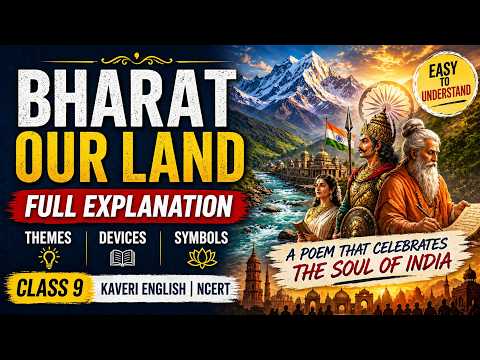
Bharat Our Land | Subramania Bharati | Full Explanation | Class 9 English | Kaveri | NCERT
Ramnik
9m 14s1,256 words~7 min read
YouTube auto captions
Transcript source
YouTube auto captions
This transcript was extracted from YouTube's auto-generated caption track. The transcript below is server-rendered so it can be read, searched, cited, and shared without opening the original YouTube player.
Pull quotes
[0:00]A poet named Subramania Bharati answered that question over a hundred years ago.
[0:00]Bharati ji used the ancient Sanskrit name and says they are without equal anywhere on Earth.
[0:00]And that is exactly the image he wants you to carry about India, strong, permanent, unshakeable.
[0:00]She gives water, she gives life, she gives spiritual cleansing to millions of people across centuries.
Use this transcript
Related transcript hubs
Watch on YouTube
Share
MORE TRANSCRIPTS