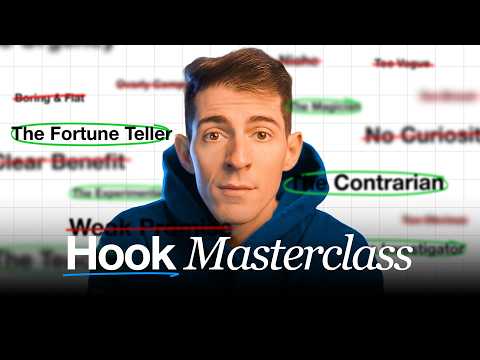
[0:00]The biggest difference between winning and losing on social media is the hook. This is the 80/20 of video. If you want your videos to perform better, you need to focus on leveling up your hooks. Now, I've studied thousands of videos, and it turns out all of the best performers only use six different hook formats. If you know these six, you're set. So in this video, I'm going to break all that down. First, we're going to walk through all six hook formats with examples, and then I'm going to give you a full playbook for how to actually write winning hooks on your own. I guarantee this will be the best video on hooks you ever watch. And I know this works because I've done billions of views myself using these exact same methods. All right, now first, before anything else, we need to understand the psychology behind how hooks work. This is super important. Hooks are designed for one reason: to create a curiosity loop. Think of it like a rabbit hole in the viewer's brain. We need to get them curious enough about the topic that they couldn't dream of doing anything else other than watching our video. Now, the best way to create that curiosity loop is with contrast. The viewer starts the video believing one thing, and then we introduce an alternative in the hook. They believe A, we show them B, and the distance between A and B is contrast. The bigger the contrast, the more the curiosity, and the deeper, the hook. It really is as simple as that. But the hard part is, you only have five seconds to make it stick. So each of these six hook formats are specifically designed to create that contrast and build the curiosity loop. All right, now the first hook format is called the Fortune Teller, and it's all about positioning the present against the future. The creator is using some scenario or question to build curiosity about how the future might change. So this could mean saying something like, that new microwave is going to change cooking forever, or that little blue light is going to impact traffic moving forward. Here are a couple other examples of the Fortune Teller hook in action. We're witnessing one of the largest breakthroughs in marketing. This is the future of animation. And this Fortune Teller hook format works super well because the human brain is designed to constantly think about the future. So it's playing into that. So the tactical steps for using this hook format would be, A. Establish what the current reality is. B. Figure out how the future might change based on whatever the video subject is. And C. Frame a question or statement teasing or suggesting that new future as a possibility. And this format is great for breaking news, product innovations, really anybody that's trying to build authority or interest around knowing the future of some topic. And again, I'm going through all six of these base formats first so we can build that baseline before going deeper tactically into how to actually write the hooks. And I'll go through that in a minute. Okay, now the second hook format is called the Experimenter, and this one is all about the creator showcasing how something works by using a demo or experiment. And specifically, this is angled as peer-to-peer. It's one friend showing another what they learned or came across. So the contrast that's being built is coming from, I used to do something this way, I figured out some method or format. Let me show you how now I'm doing this thing this way. And here are a couple examples of the Experimenter format in action. Does anything look weird about this shot to you? I actually don't have a camera in my hands. I'm recording with these glasses on my face. These are the Ray-Ban Meta Smart Glasses, and they're about to change the way that we create. This right here is the brand new chat GPT agent that literally controls your browser and does tasks for you. And this is an 11-step process, and we're going to see if it does it. I especially love the Colin and Samir one because Samir is actually showing how the glasses work in the hook as well. He doesn't have to use the hook to tea it up in the future because the glasses camera is the subject itself. And that video did 50 million views for a reason. And a lot of Mr. Beast videos fall into this hook category as well. He doesn't always explicitly explain them as experiments, but he's basically doing human experiments and then letting you watch in real time to see what happens. So the tactical steps for using the Experimenter hook framework are to: A. Establish the base pain point. B. Show that you solved that pain point with some new method or tool, and then C. Walk through why that new experiment or solve is different and helps solve the pain point. And this format is great for product demos, new frameworks. It's also great for B2B trying to showcase how your tool or product works. This is also the same hook framework where those people that make the elaborate outdoor structures, camping or building a log cabin by hand, the same format they're using as well. And before we keep going, if you like the way I break this content stuff down, using the metaphors and the names to make it a little bit easier, I actually did the exact same thing around virality. How does virality work, breaking it into a formula? You can actually grab that, that's a free five-day email course called the Virality Blueprint, explains concepts like this, but in way more depth. You can grab that, there's a link below, or go to viralityblueprint.com and you can sign up. All right, let's keep going. Now, the third hook format is called the Teacher. And this one is similar to the Experimenter, except that instead of peer-to-peer, it's teacher to student. And instead of showing things with a live experiment, it's more showing them by framing a lesson. So it's kind of like, I'm the teacher of this topic. I just saw somebody who solved X with Y method. Let me break that down and explain to you how they did it. Again, the contrast is coming from, you're failing at this thing, I found a new way to do it. Let me explain how to do it so that you can start winning. And here are a few examples of the Teacher format in action. Three things you can learn from Aritzia. Here is how I got this shot. I made this e-com brand a million dollars in 12 hours using something called the product drop method. And again, these are all teaching setups. So it's either the creator tried something and extracted the lessons and is now teaching it, not live experiment but teaching the methods, or they studied someone else who solved that thing and then it's now teaching those lessons back. Either way, it's show by teaching. And so the tactical steps for using this one would be: A. Establish the base pain point. B. Show that you have a solve through some set of learnings or method, and then C. Walk through why the process or steps worked because of your solve. And this format is super good for anybody who's trying to build authority in the category or become an expert to then sell that expertise. Okay, now the fourth hook framework is a little bit different than the other five. It's called the Magician, and it can be used as a precursor or in combination with the rest of them. Now, the Magician is basically a stun gun. It's strategically using visuals and or language like, hey, look at that, to visually force the viewer's attention to a specific thing in the visual. And it's usually something outlandish or just rhythmic and visually pops to stop the scroll. Now, there are a ton of amazing examples of people who do this. China China China. What's up, MTV Cribs? Yo, check this out. President Trump just ordered the resurgence of a 1980s plan for nuclear war in space. Let me explain. So this can either be executed with some visual stun tactic like what Carl uses, the kind of snap click, or it could be the spoken words themselves, like, look at that crazy thing and really forcing the attention. My favorite example of this is the Neon Sign guy who starts out as Trump with the wig, makes a joke in the voice and then throws the wig off and immediately starts talking about the neon signs. I've been using this on my own videos for the last 30 or so, where I start all the videos saying, check this out really quick, and I roll into the first line with it. Check this out. Check this out. Check this out. It just gives that kind of unique signature pattern that people recognize audibly when they hear it. Another great way to achieve the Magician is with something called a visual pacifier. Now, this is an activity that the subject is doing passively, which holds just enough of your subconscious attention to let you focus on the thing. This could either be like Alex Earl doing her makeup, or this guy in this example stacking the cups. It's the same psychological reason why people make those GTA gameplay videos, the split screen, and you see the car driving through the course on one end, and then the clip on the other. It holds just enough subconscious attention to get you to focus and not churn on the main thing. And I say this format is different because you can combine the Magician with any of the other five. A lot of people stack them so they use the Magician immediately as a visual stun gun, and then layer on one of the other five below. So tactically to do this, you either want to find some visual, some sound, or some signature thing that you can tie to your videos to kind of stun that's atypical and stops that scroll. All right, now the fifth hook format is called the Investigator, and this one is super common. With this format, you're basically trying to create contrast against some unknown secret or some finding that you found in your research that nobody knows about. So the contrast is today you don't know the thing. I show you the thing. Now you know the thing. Very simple. Almost all of my personal short-form videos fall into this category. It's kind of unearthing some tech or AI thing about the future potentially that people don't know about. And there's a ton of amazing examples showcasing this format as well. So this is one of the sneakier marketing campaigns I've seen. Central C's brand sells out in seconds and what's crazy is that it's not just because he's a rapper. Check this out. This is a secret Japanese city built at the base of Mount Fuji, but it's not just any city. So the tactical steps if you want to use the Investigator would be to tee up the fact that there is some secret that they don't know, and then frame it against their current reality, which is not knowing. And the communicated contrast in this one is pretty straightforward because the base case is they don't know, and then you tell them something they know. Some of these don't have to be super cheeky, they could be pretty straightforward, but inherently, they'll still grab and create that interest. This format is great for people to use who are trying to be at the leading edge of their field or showcase that in a research capacity, they're finding the deep insights that most people don't know. Okay, and the sixth and final hook format is called the Contrarian. And this one is actually the easiest to understand where exactly the contrast sits. The Contrarian hook literally has the creator come out specifically and say what they believe about the topic that is different than the conventional wisdom. And the difference between this one and some of the others is that a few of the others kind of slily try to hide that contrast in the framing. Whereas this one, immediately you come straight out and just say, you're doing your branding wrong, you should be doing it this way. It's very direct. Here are a few examples of the Contrarian in practice. So I think this is probably the most important thing that you need to be doing if you run a brand that you are probably not doing, and this is having one-on-one conversations with your customers. You have no creative ideas because your space sucks to live in. This guy is a multi-millionaire from his clothing brand, and the weird thing is their best sellers are almost never in stock. Now, of the six hook formats, this one is the most direct at creating that contrast. And it's really easy. The tactical steps would be, figure out what you believe that most people don't believe, and then say it explicitly. This is great for the smarty pants expert use case, or somebody that's trying to frame themselves as a contrarian in a crowded space. Okay, so there we have it. Those are the six hook archetypes: the Fortune Teller, the Experimenter, the Teacher, the Magician, the Investigator, and the Contrarian. Now, I'm going to tell you a secret: you don't actually have to figure out which one of the six works for your video. Because the truth is, every single video idea could be manipulated to use any of the six hook formats. For example, let's say I made videos reviewing backpacks, and this new interesting backpack just came out that I wanted to make a video about. How would I go about using all six of these in different ways? So for the Fortune Teller, I may say something like, this backpack is going to completely change the way millennials travel. For the Experimenter, I might say, I just took this backpack 7,000 miles across the world, but it has three major design flaws. For the Teacher, I may say something like, if you're traveling internationally this summer, this is the best way to pack your backpack. For the Magician, I may do a rapid match cut with a bunch of different backpacks to visually stun them, and then with the voiceover saying, which of these backpacks is the best for a guy in their 20s? For the Investigator, I may say something like, I can't believe this company isn't marketing this one flaw in their bag. And then for the Contrarian, I may say something like, everybody loves this bag, but if you use it every day, it is so overhyped. And see, so you can pick any of those hook directions with every single video topic. And so the real question is, how do you decide? If you're staring at the blank page and you're trying to write a hook, which of these is the best one for you in any given scenario? And this really gets into the second part of the video, which is tactically, how do you actually write a banger hook that crushes every single time? Cuz that's where the sauce really lies. So let's walk through that. I'm going to break the whole thing down right now. All hooks are made up of four components. The spoken hook, which is what you say, the visual hook, which is what you show on the screen, the text hook, which is what you write in text on the screen, and then the audio hook, which is the sound and sound effects that you play in the background. And this is the big secret right here. The difference between 500 and 500,000 views is unlocking max alignment between those four things. So if you say one thing verbally, but then the visual even slightly different, that creates misalignment, and then the hook is not as effective. To nail the hook, you need all four of these things to line up perfectly. And the reason this matters is because of comprehension. Comprehension is the degree to which the viewer actually understands what they're seeing and hearing. You can't hook them unless they fully understand and are interested in what they're watching. If your verbal spoken hook is different from your visual hook, which is different from the music in your audio hook, well, that leads to confusion. And confusion leads to comprehension loss, which just makes it harder for the viewer to stick with the hook. The way to drive max comprehension is to make sure the visual and audio hooks are aligned. And so how do you do this? The way you do this is to understand exactly how the viewer takes in the video when they're watching. And this gets to the deep psychology, which is my favorite thing to do. Imagine a subconscious heat map when somebody's watching the video. Where are they actually focusing their attention? I'm going to tell you. This is what all viewers do. The first thing they do is they take in the visual and text hook. They see the visual, they may read the text hook if it's obvious enough in the right place, and then their ears catch up and they hear the spoken hook after. And after they hear what you're saying, they look back at the visual and they're seeking visual confirmation with what they heard. So it's visual, audio, visual. That sandwich is how people actually take in videos at the subconscious level. Now, why is this the case? Well, the reason is our eyes process 10 to 100 times more information per second than our ears. And this is essentially the speed of light versus speed of sound phenomenon. So the viewer is seeing first, then hearing, and then looking back at the visual to match what they heard. Okay, so tactically tying all this together, what does this actually mean, and why did I spend so much time going through those six hook archetypes? What this means is that the most important part of getting the hook to actually perform well is the visual. It's not what you say, it's the visual. I call this the key visual. So when you first have your video idea, the very first thing you should do is figure out what visual or visuals you have your disposal that you could actually slot into the first three to five seconds. And based on that key visual, you then need to decide which of the six hook archetypes will create the most contrast and perfectly align with what that visual shows. Knowing the visual lets you set up the speech to then set back up to the visual. This is the golden approach to hooks that nobody talks about at this level.
[16:00]All right, now really quick, I just want to walk through a couple examples of my own content to illustrate what I mean by good and bad hooks. So we're going to show one of each. The first one is an example of a perfect hook. This video is about life-sized floor plans, which is this really cool projected home floor plans in a warehouse. This video did 15 million views. So the first thing I want you to do is watch this video with no sound. We're going to turn the sound off, just watch the hook visually, and I want you to think, where do your eyes go, what do you notice, and what do you see? So we're going to play that right now. All right, now the first place your eyes probably go is that sliding text that comes across that says the future of home design. This first clip with the split screen, you don't actually see that well, the girl with the arms going up, that was more just a visual stun gun. The actual hero visual, the key visual that I saw in the idea that I knew I was going to build the whole video around was the next visual in the full screen with the people walking on top of the floor plans. What I did is I put text that said, life-sized floor plans with an arrow, enhancing the fact that your visual eye line went directly to that thing. I wanted to make sure you saw that. And so this was the visual shocker, right? There's embedded contrast here. Most people have never seen this before. So the fact that it existed on its own created a large contrast. I knew that visual was a great key visual to build off of. Okay, so the next thing is I'd actually pick which of the hook formats that I want to go with, and then how would I actually write the hook itself? So when I looked at the formats, there were two that made sense. One was the Fortune Teller, this is the future of home design, and the second one was the Secret Keeper. I found this secret about how people are designing homes that nobody knew. They're close to the same but slightly different. I went with the Fortune Teller one because it was just easier to explain and creates more of a shock. This is what the future of home design will look like, right? So that's what I picked. And then step three was I had to actually write the hook. So, context lean, contrast, contrarian take. So I literally said, check this out. That was my Magician scroll stop thing, and then I said, these are life-sized floor plans. You can literally walk through your exact home design before you build it, right? So that's context lean, that is me literally describing exactly what you're seeing. That is perfect alignment with showing the visual and saying the thing. Then for this one, I didn't actually need a contrasting word. I didn't need to say, but here's what's crazy, because the fact that it existed on its own was already contrast enough. So my Contrarian take, which maps to the future hook Fortune Teller was, I think this is the future of how people are going to design their homes, right? So it's exactly what I'm saying. I picked the Fortune Teller, I talked about the future, I set up the context lean, what you're seeing with pure alignment, and then I framed this is the future of how people are going to design their homes. That is tailor-made how you build the hook with pure alignment. And this one worked, 15 million views. Now, before we end the video, let's quickly go through one bad example where I made a video, but it didn't work out that well. It got maybe 100,000 views or less, and the hook was just executed super poorly. So I want to explain what went wrong and what I should have done looking back. Okay, so the same thing here, I want you to watch this video without sound, just watch the first 15 seconds and tell me where you focus your attention.
[19:06]Right away, you see the text sliding across again, future of storytelling, and then you see a bunch of these rooms kind of like magically appearing out of nowhere. Just that alone is kind of misaligned. Future of storytelling, it's a bit of an abstract concept, and so visualizing that with those rooms, does that really mean future of storytelling? Not really. So already just in the visual and with the text, there is comprehension loss. Then when you turn the sound on, it gets even more confusing. So I say, this is the future of storytelling. It's called a Generative World Model. It lets you turn a single image into a photo realistic cinematic world. Okay, so if you really take that down, future of storytelling, it's so abstract, it's like what do you even show for that? Maybe it's a book with a video or a robot coming out of it. Maybe I could have used that. The problem is, nobody knows what Generative World Model is. Nobody knows what photo realistic world, so I use these crazy terms that I didn't have good visuals to show, and you can tell immediately, it's just a little confusing. It's not as straight forward as the life-size floor plans one. And so when you watch this, yeah, maybe you're like, oh, those are cool visuals, but you're not actually hearing what I'm saying. When you don't hear what I'm saying, you have comprehension loss. When you have comprehension loss, you're not purely tied and aligned with the video. And so looking back, maybe what I should have done is gone more explicit. So, these rooms are the future of commercials, and if I had visuals of guys actually using those rooms to film commercials and I could show that perspective, maybe that would have worked. The truth is, this video didn't have great B-roll that was easy to explain. So what I should have done is probably canned the idea, not made it in general. And that's really what you need to decide when you're going through this process, what is the visual, what is the hook format, writing the hook, is there clarity and alignment? If there isn't, you probably should throw out the video because there's always more ideas that you could make. So that's really the process in a nutshell. You have to have that clarity. And if you don't, that's the difference between 10,000 views and 10 million views. And look, the reason that I can go so deep and I'm so nerdy on this stuff is because I live and breathe this content stuff all day long. And I'm making this channel because I'm trying to show my experience and show my work to help other people grow with content. But look, if you don't want to have to worry about which hook format to use and how to exactly write it, you don't want to take 60 minutes a day making videos, that's completely fine. I built Sandcastles, which is a software to infuse all of these learnings and formulas and formats into it. So all you have to do is put your video in, and we'll do it for you. We go through the full diagnostic to figure out, what is the right hook formula? How should we frame it? Where is the best contrast? It's all automatic. So if you want to try that out, sandcastles.ai, I have a free trial for you below. That's the easiest way that you can close the gap on this without having to do all the work. And guys, if you like how I think about this stuff, there is a ton more for free in the description. I have a free content community called WavyWorld with over 13,000 people that are learning the advanced psychology behind this stuff. There's a free invite for you below. Make sure to grab that. And keep me posted on what you guys want next. Keep the shares coming, keep the comments coming. Until then, we'll see you guys on the next one. Peace.


