[0:00]Your marketing isn't failing because your content's bad. It's failing because 90% of your market doesn't even know you exist in the first place. And everything you're posting right now is only talking to about 10% of people. We have built three businesses using a stupid simple five-phase marketing system. All of those have gone on to generate multiple seven figures in sales, including my current one doing $300,000 per month. Across all of these businesses, we have collected over 1.5 million emails, spent over $2 million on ads, built over 100 separate lead magnets, and tested thousands of videos to build what I call our content marketing machine. And here's why this all matters. According to Eugene Schwartz, only about 3% of your market is ready to buy right now. Another 7% are open to it, but that leaves 90% who either don't know they have a problem or they know they have one, but have no idea you're the solution. Most course creators spend 100% of their energy talking to that bottom 10%, and then wonder why nobody's buying? So, how do you actually reach that beautiful 90%? That is what my five-phase content engine does, but I'm not just going to explain it. I'm going to show you how I live this five-phase system every single day and give you just one example that has generated me over $600,000 in revenue, 35,000 leads and 1800 paying customers. Let me show you how it all works. So the first phase is what I call listen, and this might be the most counterintuitive thing I'll say in this video, but before you make any piece of marketing content or material, before you script a video, before lead magnets or you write an ad, you need to talk to your customer first. Most creators just do not do this. They sit down and they think, what would I want? What do I want to build and they start building it. I call this marketer's bias. It's the assumption that what you want is what your customer wants, and I can tell you from 10 years of doing this, I'm wrong about that more often than I'm right. So here's what I do instead, okay? When I launched this business right here, Course Creator 360, I got on the phone with my customers. Not five calls, not 20, over 250 phone calls that I have saved on a hard drive right now in six months, every single day, and I recorded every one of them. But by the end of all that, I had complete clarity. I didn't have to guess what my product needed to include. I didn't have to guess how to market it or what my messaging would be. My customers handed to me on a golden platter everything I needed. And on all those phone calls, one of the most common pain points that I kept hearing over and over again was that people were terrified they were going to spend months of their life and thousands of dollars building something that nobody would buy. So they wanted assurance, they wanted the confidence before they invested time and resource. And that one recurring theme ended up becoming the foundation of a lead magnet that has since generated $600,000 in revenue. But I'm getting a bit ahead of myself. Here's how I actually go about doing phase one of listening. I take a call transcription, right? I record all my calls, I take it from Zoom, I put the transcription into an AI tool like Cloud or Chat GPT, and I extract two layers of pain points. But then I ask for the surface pain points or the surface desires, as well as the deep pain points and the deep desires, they're different. Example, here's a call from one of my customers just yesterday. I'm having AI extract every single pain point mentioned directly by the customer, the exact quote that he used, the context of how that was shared. But then I want to see what's the deeper pain point at play here. The surface pain he mentioned on this call was that he was paying for multiple redundant subscriptions to launch and sell his course. Well, the deeper pain associated with that surface pain is that he's watching money leave his bank account every single month with zero return. Every single call I hop on, I dive deep into all these pain points, I rank them from the most prevalent to the least. I go through all the desires that my customer has, right? What does he actually want? And then I go over the objections, the skepticisms and escape routes that he was using on that phone call. Now, fast forward three years later, I'm doing $300,000 a month with this business. I'm no longer the one doing those calls, but here's what didn't change. I still record every customer interaction my team now has for me, the onboarding calls, support calls, the sales calls. My team takes about 40 calls a day, and I'm extracting the pain points, desires and objections from every one of those because the second you stop listening to your customers, you lose touch, you're irrelevant. The market shifts all the time, the language they're using changes, and you start making content that sounds good to you, but means nothing to your customers. That's the problem. So whether you take 10 calls, 100 calls, or 250 calls like I did, let me show you what I did with that information after I listened. Phase two is to build. Now that you know what your market struggles with and what they want, you build something that solves a real problem for them for free. We call these things lead magnets. Now, I'm not going to go super deep into how I build lead magnets in this video because I already made one on this YouTube channel breaking down the four types of lead magnets, clarifiers, samplers, starters, and shortcuts, along with the five rules that every lead magnet needs to follow. I'll link that video, and if you like this type of content and want to learn more about how to build marketing and sell online courses, hit subscribe and come along the ride with me. But what I do want to show you is what this looks like in practice with real numbers, okay? Concrete stuff that actually happens in the real world. Here are five of my lead magnets and their organic opt-in rates that I've been getting over the last couple of months. This hook template lead magnet, 64% opt-in rate, 50 funnel samples, 79% opt-in rate, 70% opt-in rate, 77%, and 79% opt-in rates respectively. My average opt-in rate, just for context, is currently 71%. The industry average is about 18%, and the reason mine are nearly four times the average is because every single one follows these five rules. The most important one being this fifth rule, which is the one most people break and it's the most expensive one to get wrong. More on that later. Now, here's where things get really interesting. Remember that pain point I talked about in phase one, in the listening phase, right? People continually told me they were terrified of building something nobody would buy. That was a huge recurring theme. I didn't just write that down and just say, okay, I'll come back to this later. I thought, what if I could take that exact fear and solve it with a free tool, a lead magnet? So I built a clarifier lead magnet called the Market Research Report. You enter your course idea in one or two sentences. It scrapes over 200 plus websites, competitors, forums, reviews, and it scores your idea out of 10 and then gives you a 12-month forecast of how much you could realistically make on the low, medium, and high end. Do you see that direct connection, right? On these calls, I kept hearing people saying things like, I don't want to waste six months building something nobody buys, or I'd like to know if it's even worth building before I invest. So I took those words word for word, the same fear hundreds of times told to me in my brain, in my ears, and when I built the market research report, I didn't just sit in a room and brainstorm clever marketing copy. I took their exact words and I put them front and center on the landing page, in my ads, on the messaging, find out if your course idea will sell before you build it. That is not my messaging, it's not my creative beautiful expert brain, it's their messaging. I just listened to my customers and then repeated it back to them. That is what phase one feeding into phase two actually looks like. Now, the hardest part of this whole phase is knowing what to build in the first place. Most course creators just guess, they don't have marketing background or the know-how to know what kinds of lead magnets actually convert. So they throw something together, they put it on a landing page and wonder why nobody's buying or opting in. So I built an AI prompt that's programmed on all four lead magnet types and all five rules. You give it your ICP, or who you're going after, and it then generates lead magnet ideas and maps out a plan for each one of them. Links in the description, drop your email and I'll send you a notion doc with everything in it. But here's something most people don't realize. A lead magnet by itself doesn't do anything, it just sits there. Right? The lead magnet I just showed you didn't generate a single dollar until I got them in front of the right people. And the way you do that is in phases three and four. Phase three is to script. You've listened to your customers, you built something that's valuable. Now you have to figure out how to actually talk about it in a way that stops people from scrolling in the busy world of social media. Now, here's my process. I use a software called Loom.com. I love it. I have a lot of use cases for it, but one of my favorites is it just transcribes all my brain dumps. So I get all of my original ideas about this lead magnet or the piece of content I want to make and the things I could say. I take that transcription and I feed it into Cloud, I give it my ICP document which tells AI who my customer actually is, and then it turns my scattered thoughts into a structured script. My voice with AI structure, that is the key. The laziest thing you can do is open Chat GPT and say, write me an ad. That is not AI helping you, that's AI replacing you and it does a terrible job at that, I promise. You got to brain dump first from your human brain, use AI second as the structure, and it helps you refine it. Now, here's the single biggest mistake with this phase. Most of you film one video, it bombs, and then you conclude that marketing doesn't work, right? Online courses are dead! I was lied to! No, you just had one attempt. You haven't even tried with one attempt. More than half the reason content flops is the hook. The hook is the most important part of any piece of content. It's the first 5% to 10% that determines whether anyone watches the rest of the content. So, instead of writing one hook, I write five to 10 hooks for just one piece of content. So let me show you exactly what I mean. For that market research report, lead magnet, I first started with my Loom brain dump, which was about 10 minutes long. I then dumped that into Cloud and I explored different hook options and I came up with these nine hooks right here. Notice how the body stays exactly the same. I only change the hooks. And listen to a couple of those hooks right now. 81% of online courses fail within 90 days because the idea was never proven. You can now validate your entire online course idea in minutes instead of months. Stop building your online course until you've first proven demand with this free tool. After selling $25 million in online courses, I finally found a tool that kills market research. Every one of those hooks hits on a different angle, a slightly different pain point, a different emotion, but the body of the ad is the same. And here's how the body starts, listen to it. Watch this. Let's say you want to make a course on how to iron socks. This tool will scrape 200 plus websites from competitors, forums, reviews, online groups and then it poops out the most magical report I've ever seen. That right there is the secret to scripting effective content. You're not remaking the entire video 10 different times. You're testing 10 different doors to the same room. All nine of those hooks started differently and then immediately fed into the same body. But before I spend a single dollar on ads, I always like to test my content organically. I posted this video right here about the market research report on my Instagram channel. It got 5,000 views, which on the outset appears to be a flop, but here's what it did get. 300 comments from a 5,000 view video, that's a 6.6% view to comment ratio, which is nearly unheard of. The average for context is 0.5%, 12 times less than what this video got. That's called an outlier, right? And when I get that outlier, specifically with that view to comment ratio, that's when I know I'm in business. A video that goes viral and gets a million views, but no leads or sales for me is worthless. A video that gets 5,000 views or less, but 300 plus comments is golden. So I know the script works, I know the ad concept's there, but I still need to produce it at a level that could run as a real ad, and that is in phase four. Phase four is to produce. You've got your nine hooks or five hooks however made and then your body. Now you got to film them all and bring them to life. So here's my process. I sit down and I film all of my hook variations back to back, and then I film the body once. Obviously, I do different takes of the body to really nail it, but I dump all that footage to my editor, who then spits out nine separate versions of that ad. Each one of them with a different hook feeding into the same body, and that's it. One filming session, nine pieces of content, where most of you might just make one. And of course, when it comes to producing, there's different ways to do this. You can go super organic and natural, kind of like you see with UGC content, straight from your phone, just a selfie, not a professional setup, just more organic. Or you could go more polished and refined like this ad was. I've tested both, both work really well. But the important part is that the edits are engaging. Foundational things, jump cuts, text on the screen, visual cues, whatever keeps people watching past the hook. Then, once you have all your variations produced, you test them. My favorite way to test, as I just showed you, is I try it first organically, which right now, Instagram trial reels are like the best feature to try out your content organically. You can throw literally all 10 versions out there without posting officially to your public-facing Instagram profile, it's awesome. You just see which one works best, which gets the most views, the most likes, the most comments, the most leads, the most important one, before you choose to spend a dollar on it. Or you could skip that step and just go straight to ads, that works fine too. But either way, you're letting the data tell you what's working instead of just guessing. But with this method, you're testing 5, 10, maybe 15 videos at one time instead of one video and then praying that it works. Last point here, when you're just getting started out, you're going to naturally be doing all five of these phases yourself. That is completely fine and normal, I did too. But at some point you have to graduate and no longer have to do everything on your own. You can hop on a phone call with a customer in 30 minutes, you can build a lead magnet in a couple of days, you can script a couple of hooks in a day. But editing your own videos is where I have personally found the majority of creators have a huge time sink. It is arguably the biggest bottleneck that we have as creators, and it's for that reason that when you're ready to make your first hire, make it an editor. I personally run a content editing agency called Content Bug. This video you're watching right now, along with all of my ads, all of my short form content, they're all edited by them. And link is in the description if you want to get your first video edited for free. But whether you hire us or find someone on Fiverr or onlinejobs.ph, the point is the same, get editing off your plate as fast as you can, so your iteration cycle stays tight. And speaking of iteration, that is phase five. Phase five is to test and iterate. And honestly, this is the phase that makes or breaks most everything because your first attempt is almost always going to flop. That isn't pessimism, that's just how marketing works. The difference between the people who make money and the ones who quit is what happens after the first four phases. So again, let me show you what it looked like in real life with this market research report. Remember, I tested this organically on Instagram first. I got 5,000 views, 300 plus comments, a 6.6 view to comment ratio, amazing. So I put ad dollars behind it. And of those first nine hooks that I tested, which one do you think won? The winner was hook one. It pulled in an $8 cost per lead while the others were close to $10 cost per lead. That is a 20% difference and when you're spending thousands of dollars on ads like I am, that is a ginormous difference. So, I burned through all the losers and I scaled the winners. But here's the key here, while that winner was scaling, I then repeated this entire five-step process again. Once I saw that this ad worked, I then scripted seven brand new hook variations and a brand new body, and I tested those. Here's what those ads looked like. Gone are the days that you have to guess whether or not your business idea is going to work. Everyone wants to launch an online course, but what if your idea sucks? Wouldn't you want to know if your online course idea will sell before you build it? I put money behind it, I found the winners, I killed the losers. Three months have gone by and just last week, I did this yet another time. Nine more hooks feeding into a brand new body, and here are those ads. I just launched literally four days ago. If you're about to sign up for Kajabi or school to sell your online course, stop and do this first. If I were selling an online course from scratch with no audience, no following and no money, this is the very first thing I would do before anything else. If your course idea does not pass this one test, nothing else matters. That is now three rounds of iteration, 25 unique pieces of content, all promoting the same lead magnet. Do you see the pattern and principle here? While most of you might think, oh, you're just way talented, you're a marketing expert, you're really lucky. I am telling you, this is simply a repeatable system that you can have too. And by following this five-phase loop since June of 2025, here's my results. We have spent $233,000 on this one lead magnet across those 25 pieces of content, and it has since generated 35,000 leads, 1800 new free trial customers, and over $600,000 in trackable revenue. It now contributes right now to $105,000 in monthly recurring revenue to our business. All because I followed this five-phase system and then iterated on it relentlessly. And I'm still doing it today. Now, you're probably thinking, that's great, Stockton, but I don't have $200,000 to spend on ads, or there's no way I can do this. That's just way too much work. And look, I get it. But me having the money to spend on ads was not the breakthrough. The speed of my iteration was. Most course creators treat this whole five-step process like it's a 12-week commitment. I'm going to take three weeks to listen, hop on a bunch of calls, four weeks to build my lead magnet, one week to script my content, two weeks to produce it, because I'm a perfectionist, and then two weeks to iterate once that's done. That is nearly three months for a single attempt. One, and when it doesn't work the first time, which it probably won't, you then quit. Nah, this doesn't work. Courses are dead, information's dead, it's like everything's dead. The system works, your approach to it was dead, your approach was wrong. Your iteration cycle is too slow. The real cycle should be about a week, two weeks maximum, not 12. I hop on five calls with my customers in a day. 30 minutes each, it's like two and a half hours. I can then build my lead magnets in one to two days, so can you. I promise, it's possible. I can script my content in two hours. I can have it edited in two days because I've got a team, and by day seven, it's launched out there in the world. And if it flops, guess what, it cost me a week, not three months. Done but imperfect beats perfect and unreleased every single time. Most of you spend weeks on each individual step of that five-step process, and then when it fails on month three, four or five, no wonder you're completely deflated and destroyed by that. It's a huge blow to your business and ego, because you left almost zero margin for error. You put all your eggs in one basket and it had to work out. My iteration cycle is fast enough that I can afford to be wrong, and then be wrong again, until the data shows me what's actually working. So tighten the iteration cycle up. Now, none of that matters though, if you can't figure out where you're stuck in the first place. Most creators have no idea what's actually broken. When something fails somewhere in that funnel, they just feel like something's off, I don't really know, let me just try something brand new. Let me go to something novel. You don't have to do that. Just diagnose what's wrong and here's exactly how to do that. I call it the 5-20-2 rule. And before I tell you the rule, understand it's not a 10 commandment. Some of you take these rules I give you and think that you have to follow it. It's a rough diagnostic, but it does give you something concrete to measure against so it's not some weird amorphous metric that you can't track. Here's how it works. Before you evaluate anything, you need to make at least five pieces of content promoting one lead magnet. Most people make one, five is the bare minimum, that's the entrance fee. I recommend much more but five is great. Next, 20. If fewer than 20% of the people who land on your page or your lead magnet are opting in, you have an offer problem, the lead magnet itself is not compelling enough, right? You're probably breaking one of the first three rules of lead magnets. It's not clear enough, it's not solving one specific problem for one person, or it doesn't deliver a fast enough win. If you're below that 20% mark, do not touch your ads, don't change your content, fix the lead magnet, that's the problem. And then lastly is the two. If fewer than 2% of those leads that you gained never buy your paid offer after opting in, you likely have one of two problems with the lead magnet. Number one, your lead magnet has no obvious next step into your paid offer. And that's a rule number five violation. Your free thing and your paid thing feel like they're on two different planets. Someone downloads your lead magnets or they consume it, they love it, and then they look at your course or whatever your paid product is and think, what does this have to do with what I just got? There's a disconnect there. Number two, though, is you're not following up nearly enough. Our data has shown that it takes an average of 15 touch points over six months before somebody buys. 15. And did you know that 70% of marketers send just a single follow-up email after a lead magnet? They send one. If people are coming in the door but not buying, you need to 10x how many times you're showing up after that first opt-in. Not double, not 3x, 10x what you're currently doing. The fortune's in the follow-up. There's a reason we say that as marketers. Almost nobody is following up enough, you're severely underestimating how many touch points people need. It's normal. And remember, these are rough benchmarks. A 1.5% lead to buyer rate might be perfectly healthy depending on your price point and your niche. The point isn't to obsess over exact numbers, the point is to give you a starting place so that you can diagnose where you're stuck. Find the hole in your funnel instead of just wondering or guessing what the problem might be. So, five steps, listen, build, script, produce, iterate. That is the entire system. It's five phases, one lead magnet, following this exact system, this whole cycle right here, generated $600,000 in revenue, 35,000 leads and 1800 paying customers for my business. And I am still following that cycle today. This is not easy, but it is simple. I have watched car tuners like Joe Simpson, who didn't even know what a landing page was, take his knowledge, package it into an online course, follow this marketing system and he has now made over a million dollars worth of his online course business. I've seen video game developers, guitarists, pianists, horse massageers. The businesses and the creators that fail are the ones that skip phase one. They stopped listening to their customers, they then skip building something genuinely valuable and jump straight from I have a course, or I have a product, now please buy it for me. And then they wonder why 90% of their market never buys or cares to listen from them. You now know more about how marketing actually works than the majority of course creators out there. The question is whether you'll actually do something with all this knowledge, theory, and application. If you want to start with phases one and two right now, I'm giving you the exact tools that I use, the AI prompt I use for generating lead magnet ideas. Phase two is done for you. Links in the description, go use it, it's free. But if you want more than just the ideas and the prompts and some of these shortcuts that I'm giving you, if you want the full system to actually build, market, and sell your online course, that is why I built Course Creator 360. It's not just an all-in-one software, it is the funnel templates, the email sequences, the AI tools, the courses, the blueprint, the coaching, the support, of what has actually worked for us after selling $25 million in online courses. Everything I've talked about in this video, the lead magnets, the ads, the iteration cycle, all of the tools and templates I use to run this system are inside of the subscription that you can join on a free trial in the description below. It is 30 days free for a reason, let me put my money where my mouth is. You can see everything for yourself, go build something, follow this five-phase process and I'll see you guys in the next one.
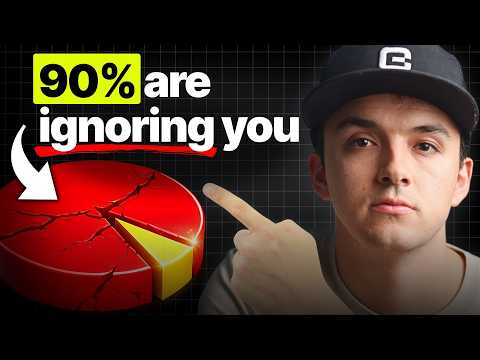
Why Your Course Isn’t Selling (And How I’d Fix It)
Stockton Walbeck
21m 18s4,854 words~25 min read
YouTube auto captions
Transcript source
YouTube auto captions
This transcript was extracted from YouTube's auto-generated caption track. The transcript below is server-rendered so it can be read, searched, cited, and shared without opening the original YouTube player.
Pull quotes
[0:00]It's failing because 90% of your market doesn't even know you exist in the first place.
[0:00]We have built three businesses using a stupid simple five-phase marketing system.
[0:00]All of those have gone on to generate multiple seven figures in sales, including my current one doing $300,000 per month.
[0:00]According to Eugene Schwartz, only about 3% of your market is ready to buy right now.
Use this transcript
Related transcript hubs
Watch on YouTube
Share
MORE TRANSCRIPTS


