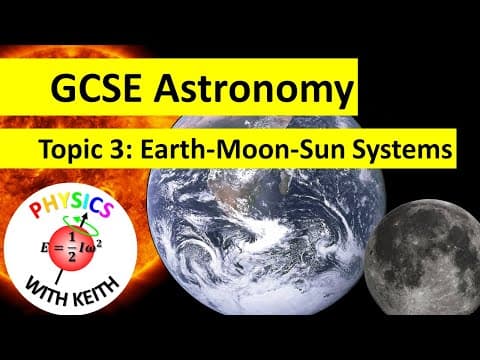
[0:00]This video is about the Earth, Moon and Sun, all working together.
[0:19]And so this is topic three of the Ed Excel GCSE in astronomy. If during this video you think, I want to watch more of these sorts of videos, you want to get notified when there are more videos released, then please don't forget to subscribe to my YouTube channel and also ring the bell. Because that way you'll get notifications when new videos are made available and also when I go live for my weekly live tutorial sessions. In this video we're going to be looking at the sizes of the Earth, Moon and Sun, how they were measured by the ancient Greeks by Eratosthenes and Aristarchus. We're going to be looking at how tides work, the interaction between the Earth, the Moon and the Sun together. We're going to be looking at precession of the Earth's axis and how that affects the appearance of the celestial sphere over longer time scales. And then we're going to have a little look at eclipses, solar eclipses, lunar eclipses, what they are, how they work and what they look like. So let's start with what might be obvious, the Earth is much smaller than the Sun. And how much smaller? Well, have a little look at these numbers. The Sun's diameter is more than a hundred times more than the Earth's diameter. And that's a scale picture of the Earth next to the Sun. You might not be able to make out the Earth, it's so small. The Earth is that small blue dot, a pale blue dot, as Carl Sagan called it, next to that large yellow circle which represents the Sun. So here is a scale picture of the Earth and the Moon. And I should point out, as with the previous picture, when I say a scale picture, I mean the sizes are to scale, but the distances between them are certainly not to scale. Here the Earth, you can see, is not even four times the diameter of the Moon. And so we can see the relative sizes of those bodies in this picture. The difficulty comes when trying to draw the Sun, the Earth and the Moon all on the same page. Uh, so I tried to do that and you can just about see a tiny slice of the Sun there with the Earth and the Moon. Again, these are to scale in terms of size. They are not to scale in terms of distance. You do not want to be that close to the Sun. Now, I zoomed out on this animation, so hopefully you'll be able to see what it looks like uh if we move further and further away. And you get a real feel for the scale of the Moon, the Earth and the Sun. The animation was a bit jittery there, so I'll try it one more time. The Moon, small. Earth, a little bit bigger. Sun, much, much bigger. 401 times larger in diameter than the Moon's diameter. And so here you almost certainly cannot make out that the Moon is included in this picture as well. It's just too small for you to see. And unfortunately, I simply cannot show you a scale picture of the Sun, the Earth and the Moon where they are to size, scaled and also their distance is scaled correctly. I just can't do it because I don't have enough space on my monitor to do so. There is a lovely website which I'm not affiliated with where you can scroll across the solar system where it is to scale. The sizes and distances are to scale. And I will put a link to that in the description below. But my own attempt to get you to understand the scale is to use something that people find familiar. Now, this is probably not familiar to you, but this is in fact the school where I work. And the car parking spaces here give you an indication of the sorts of sizes that we're talking about. This scale is 6.3 billion to one, and at that scale, the Sun is about the size of a regulation sized netball. And we're going to place it in the middle of this roundabout right here. You get a size an idea of the sizes here. So at this scale, the Sun is about 22 centimeters across. The Sun itself, as we already know, is enormous. Um, it's also very hot, about 5,500 degrees Celsius. What's interesting about the Sun is it rotates faster than the Equator of the Sun than it does near the poles. It can do that because it's not solid. So what we're now going to do is have a look at some of the other bodies that orbit the Sun. The Earth. The Earth orbits the Sun, and the Earth's orbit fits around here. So you can see it's many cars in diameter. Just a quick look at that, maybe 20 cars or something in diameter. It's a big orbit with the Earth orbiting. And on this scale, the Earth is a little chewed up piece of couscous. It's not very appetizing, but that's what it is. It's a tiny little speck. Um, orbiting that sort of distance, 24 meters away from the netball, 48 meter diameter orbit. And we know the Earth well. The Earth a range of temperatures that we can comfortably live. Um the extreme low end is perhaps less comfortable. As is the extreme high end of the temperature range, but it tends to be in the middle, a nice comfortable temperature because of the Earth's atmosphere. One day rotation, whatever that means. And we'll talk more about that later, of course. And this is the only place that we know for certain that life has begun.
[5:46]Because we live here. And so now we have to think, well, where's the Moon in this picture? And how far away from the Sun is the Moon? Well, don't forget the Moon orbits the Earth. So the Moon is the same distance away from the Sun as the Earth is. And on this scale, it's a tiny grain of salt just orbiting around the Sun, spiral itself around the Earth as it does so. Here is the picture of the Moon. Beautiful picture of the Moon that we're familiar with. If you didn't see the previous video on topic two, all about the lunar disc, then please go back. There's a playlist, a YouTube playlist for all of these videos. Go back, have a little look at that video so you know a bit more about the lunar disc. Much larger swings of temperature, despite the fact it's just as far away from the Sun as the Earth is, is because the Moon lacks an atmosphere. Here is the last photograph ever taken from the surface of the Moon, uh when humans left the Moon for the last time. Of course, by the time you watch this video, if it lasts on YouTube long enough, it might be that humans have walked on there since. Um but at the time when I made this video, only 24 people had gone to the Moon and only 12 people had walked on the Moon. And here's our distance between the Earth and the Moon to the same scale as the sizes of the Earth and the Moon. And so you can see here, this distance on the scale I was talking about, where we're about 20 car widths from one side of the Earth's orbit to the other. And that sort of scale, the distance to the Moon from the Earth is only about this far. It's not very far at all. I think I describe it here as being four finger widths away from the Earth. And that's what we've managed. We've managed to send 24 people four finger widths away from the Earth where the next nearest planet is many, many steps away. Now, these slides I took from our much larger presentation, which I will record at some point in the future. Another little plug to subscribe here, if you ever want to get notified when those videos come out. But yes, I've recorded uh I will be recording a much larger presentation where I run through the entire solar system to scale and beyond. I also go into um the nearest star, where that is on this scale. And then the next nearest star that we think may have a planet orbiting it that could possibly support life. And it may surprise you just how large those scales are given that we've gone that far. So the next part of this video is going to be about tides, but I'm not going to show you this part of the video. I'm going to put a link to what I think is the best video I've seen on YouTube, all about tides. I'm not associated with this YouTuber, but I think it's an absolutely fantastic video about tides, and I'll put a link to that below. I strongly urge you to watch that, with a provocative title like what physics teachers get wrong about the tides, space time, PBS digital studios. I don't want to get it wrong myself. That would be embarrassing. So I'll let this chap here explain it to you in a much better way. Check the link below so you can find and watch this video. And that leads us on to the next part of the video, which is all about Eratosthenes and uh Aristarchus, the two Greek philosophers who first made the first steps into measuring the dimensions of our solar system. So Eratosthenes measured the circumference of the Earth. Um it is a complete myth that humans thought the Earth was flat and then at some point there was some great revolution and people realized it. No, people knew the Earth was round for a very, very long time. Uh it's possible, for example, to see a boat going over the horizon and notice the bottom of the boat disappear over the horizon before the mast does. And that's because the Earth is curved. It's also possible, if you lie down with your chin on the floor and you get to see a sunset, if you stand up very, very quickly, you can then see the Sun set again. And that's only possible because the Earth's surface is curved. Now, there was a legend around the time of Eratosthenes, a legend that there was a place in Egypt, I think it was, where the uh at a certain time of day, at a certain time of the year, no shadows cast. If you had a pillar, there'd be no shadow from the pillar. If you had a well, you could see right down the well. And there was no such time of day at any time of year in Alexandria, where Eratosthenes was. And so he realized this meant the Earth was curved. Of course, we already knew that. And that the rays from the Sun, which were coming in parallel, must be coming from directly above this place in Egypt, but coming in at an angle where he was. And so we can do some geometry here. You can see on the diagram here, which is exaggerated a bit, um that we have two parallel lines here and here. And one line that cuts through them both. And that means we can use some basic rules about how angles work. This angle where my mouse cursor is here, is the same as this angle here, which is the same as this angle here. So if we are able to measure this angle here, the angle between the shadow and the vertical object that's casting the shadow, then we know how many degrees around the Earth we are from this place in Egypt. And we know there's 360 degrees in a full circle and we are however many degrees we are, seven degrees in this case, um then we are 7/360ths of the way around the circle. If we know how far it is from Alexandria to this place in Egypt, then we can simply multiply that by the reciprocal of that factor. We can multiply it by 360 over 7, and that will tell us the circumference of the Earth, and it works, it's basic geometry, but it works. So the legend goes that Eratosthenes hired someone to pace out the distance from Alexandria all the way down to this place in Egypt. And as he paced that distance, he counted his steps, and it in modern day um modern day numbers, he paced it out to be 800 kilometers in modern units. Uh I don't know how much truth there is in this particular legend, but that's what the legend says. So 7/360ths of a circle is just a little bit less than 2% of a circle. So a little bit less than 2% of a circle means that the total circumference is a little bit more than 50 times the distance between Alexandria and this place in Egypt. So when you multiply up that distance, you get, as it says down here, about 41,000 kilometers. The actual circumference is just a little bit less than that, a little bit more than 40,000 kilometers, just 2.7% less. And I think that is phenomenal that we were able to measure, that Eratosthenes was able to measure the circumference of the Earth with that sort of precision by pacing out distances and making basic measurements of the angle of a shadow. So now we're going to talk about Aristarchus. Now Aristarchus was born before Eratosthenes and he died after Eratosthenes. But apparently he made his discoveries uh about the measurements of the parts of the solar system after Eratosthenes. Now I, they they were contemporary with each other and I don't know if there was any communication between the two of them. I wouldn't want to guess. Maybe you can look that up. But his list of achievements is so long. And unlike people like um Aristotle who we still remember who got an awful lot of physics wrong. Eratosthenes and sorry, Aristarchus got an awful lot right. And you can see a few of his achievements here. But one of the things we're going to look at is measuring the distance to the Sun. Now before we go any further, you need to know trigonometry. You're going to need to know, sometimes it's taught as sotoa, you need to know this. So if you're stuck with this, you need to pause the video, go away, look up trigonometry and make sure you understand this before we go any further. And there's an idea in astronomy called the observer's triangle, which we're going to be using in this part of the video. And with the observer's triangle, there's a few uh slightly bit of slight of hand here. There's some approximations. For very, very small angles, what we say the arc length is equal to the opposite length. Now what do I mean by that? I mean, if you look at this angle where my mouse cursor is here, the opposite length is this length here. The arc length is the curved line that connects those two points. And you can see that the curved line is a little bit longer than the straight line. But as that angle gets smaller and smaller, those two lengths get closer and closer together. And that matters because curves, very difficult to measure the length of that. Straight lines form triangles. And we like triangles because we can do trigonometry on triangles. So if we say this angle here is alpha, then if we were to cut this triangle in half, it's an isosceles triangle, if we were to cut it in half, we would have a right angle triangle. Right angle triangles are good because we can use our sotoa. And so we're going to use tan. The tan of an angle is equal to the opposite length divided by the adjacent length. In this case, the adjacent length is going to be almost exactly the same as the radius here. The smaller the angle, the closer the opposite the adjacent length gets to that radius of this circle. And the opposite length is going to be half of the distance from this point to this point. Because remember, we've cut this triangle in half. From this point straight through the middle of the triangle in order to get a right angle. So that means just using sotoa, we get that equation at the bottom there. The circumference of a circle, we all know, is 2πr, so we know the circumference of the circle. The observer triangle allows us to make measurements of distances when we know diameters, or diameters when we know distances and we know angles. And angles are quite easy to measure. We can use instruments like protractors to measure angles. So in this example here, we have a planet, maybe maybe it's not a planet, maybe it's the Moon, maybe it's the Sun, doesn't matter, some planet with a diameter D. And then we've got some angular size. And what that means is to an observer standing here, one side of the planet is here, one side of the planet is there, and the angular size of that planet is labeled here as alpha. The distance to the planet here is labeled as R, and uh the planet diameter here is labeled D, so it's all very clear on that diagram. Now, the proportion of a full circle represented by this angle is alpha, the angle, divided by 360 degrees. That makes sense. That's the proportion of a full circle that that angular size represents. The proportion of the entire circumference that's represented by that diameter is going to be D over C. It's the same sort of argument. And those proportions are the same. Now what we can do is substitute the equation for C that's in the middle, C = 2πr, into the equation on the right, alpha over 360 is D over C, and we end up with the equation that's highlighted at the bottom here. That equation we can use where there's three unknowns. As long as we know two of them, we can calculate the third. So with that out of the way, let's first of all look at how the diameter of the Moon can be measured. Now, to measure the diameter of the Moon, there's two ways. One way can be to get a protractor and have a telescope, line up your cross hair on your telescope to one side of the Moon. Then move it around a bit, line it up with the other side of the Moon and look at the protractor and look at the angular size. But it's going to be so small that that's going to be a very inaccurate way of measuring the um what we'd call the angular size of the Moon. Um, but an angle that's much easier to measure is the angle between when the Moon enters the Earth's shadow during a lunar eclipse and when the Moon leaves the Earth's shadow during a lunar eclipse. And we'll look at a lunar eclipse a little bit later in this video. So you can see here, the Moon has just entered the Earth's shadow. It's going to carry on moving around and then it's going to leave the Earth's shadow sometime later. And that's going to form some sort of triangle. Ah, triangle, we like triangles in physics. It takes the Moon about two hours to go from just entering the Earth's shadow to just leaving the Earth's shadow during a lunar eclipse. And we can measure that angle, that angle between where the Moon entered the eclipse and exited the eclipse or the Moon shadow. We can measure that by using, as I've said, telescopes with basically protractors on them and move them across the sky. So it's quite easy to make that measurement. And you can see we've actually got a few triangles on this picture. We've got the triangle here between our point on the Earth where we're observing this, forming this triangle here. We've also got this red triangle because we've got the angular size of the Moon, difficult to measure, but you can, you can measure it. And then we've got this other triangle, which is the triangle of the Earth's shadow itself. Remember, the Sun has a larger diameter than the Earth, far away, but it means the Earth's shadow is going to form a triangle. And remember from our observer triangle that the ratio of angular sizes is the same as the ratio of lengths as part of our derivation of that observer triangle equation. So here's our two triangles. I've drawn them out here with the big black and red bold lines. And let's clear everything else out of the way so that all we've got is those two triangles. And then let's separate these two triangles out so we can see them a bit more clearly. Now, these are isosceles triangles. They're not right angle triangles. We want right angle triangles to use trigonometry. So let's cut each of these triangles in half. That's what that green line does. And get rid of the half of the triangle we're not interested in. So here, all I've done is is dragged those things to make them larger. These are those two triangles. And, you know, we know some trig, so we can apply some trigonometry to this. Let's say this angle here is alpha, and so this opposite length here is A, and let's say this angle here is beta, so let's call this opposite length B. The interesting thing is this green line, this distance is actually going to be the same for both triangles. It doesn't really look like it on this diagram because when I grab them and stretch them, I didn't do a very good job of keeping them even. Um but that length C is the same for them both. Might be easier to see that from this particular still image. Or maybe even this particular still image. Okay, those lengths are the same. C is the same. And I know you're thinking, well, it's not exactly the same, is it? No, it's not, but remember our small angle approximation. The smaller the angle becomes, the closer this length here becomes to the arc length. And therefore the closer that length in the middle comes to being the same as the length in the middle of the red triangle. You're going to see the small angle approximation all over the place in more advanced physics. So remember that physics is a way of writing equations we can use to make predictions based on the data we've got. And this makes very, very good predictions. So that's good enough for us. So let's grab those two trigonometry expressions. The tan of alpha is the opposite to alpha, which was A divided by C, and the tan of beta is the opposite to beta, which was B divided by C. And they've both got C in them, and it's the same C, the simultaneous equations. Let's rearrange each of those equations to make C the subject. That's what we've got at the top here. And then if C = A over tan alpha and C = B over tan beta, then A over tan alpha equals B over tan beta. We can rearrange that to get the equation at the bottom. The ratio A over B is the same as the ratio tan alpha over tan beta. Okay, so A, what was A? Well, that was half the diameter of the Moon. And what was B? That was half the diameter of the Earth. When I say half the diameter of the Earth, it's more like half the diameter of the Earth's shadow. The Sun's so far away that that's pretty much the same as half the diameter of the Earth. And so what was alpha? Alpha was half the angular size of the Moon. And what was beta? That was half the angular size of the shadow when viewed from the Earth, and of course, we can measure the angular size of the shadow. And we can tidy this equation up. So we've got two halves, a half on the top on the left hand side and a half on the bottom of the left hand side. Obviously they cancel. So that's going to tidy things up a bit. And then here's a remarkable fact that for very small angles, especially, you know, measure your angles in radians. If you don't know what radians are, look on your calculator, there's a radians mode. In radians, the tan of a small angle is the same as that angle. If you don't believe me, put your calculator in radians mode, uh type in a very small angle, take the tangent of it and the number won't change. It's the same thing. And this is because if you plot a graph of the tan of an angle versus the angle, so tan of an angle on the Y axis, the angle on the X axis in radians, you get a line through the origin with a gradient of one. Very quickly deviates from that, but for very, very small angles, tan of an angle is equal to the angle. And these are very small angles. These are big distances, so these are small objects with big distances. These are small angles. So we don't have to write tan of half the angular size, we can just write half the angular size.


