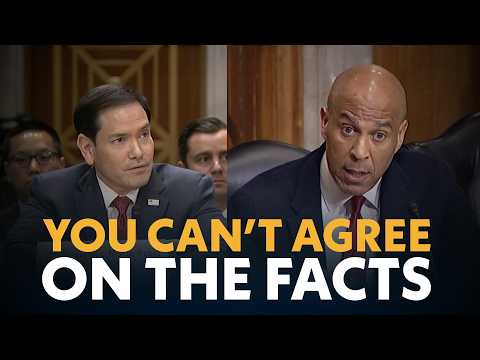
[0:01]Thank you very much. Uh, Mr. Secretary, you know I talked a lot about Africa and I raised concerns about a lot of the cuts.
[0:09]We're we're seeing globally an increase in tuberculosis, an increase uh in malaria cases, we see a continued ongoing on the continent uh HIV crisis. And the United States has pulled back from a lot of its investments in those areas. Now with the crisis with Ebola, um, we see that the challenges that have been brought about as a result of our surveillance. early detection and and the like. So I'm just very concerned about what the administration strategy is because we're clearly seeing here that what goes on on the continent of Africa directly affects our public health as well. Well, first of all, I don't agree with that assessment. I mean, first of all, it's not about cutting back as if the response here is not just how much money you spend, it's it's what results you're going to get. Now, let's talk about Ebola for a second. Ebola, the outbreak in Ebola was in a war torn, isolated rural area in the DRC. That's where that began. Since that time, our response has been very quick, very rapid. Well, so you're saying you did not cut early detection here? I'm not talking about. I'm saying that whatever you're pointing to is the cut is not the reason why there was an Ebola outbreak. Well, you are connecting. I mean you said that our cuts in Rubi, I'm not trying to get in an argument with you. I would really like to actually have my questions answered. So very quickly. We cut early detection when it comes to infectious diseases on the continent. Factually, this is not an opinion. We made those cuts. We cut early warning systems on the continent. It had nothing to do with the Ebola outbreak. So I I don't need to tell you, uh, Secretary Rubio that we're living in a place where an infectious disease crisis anywhere is a threat to public health everywhere. The United States has made major reductions in these areas that has put us at more at risk. If you're talking about this clearly Ebola crisis, there's other things and other cuts we've made and and you see it factually even our own uh even our own uh um state department personnel that I've talked to are saying we're less prepared for a global outbreak than we were before. And my worry is specifically in a budget hearing, is this budget makes even deeper cuts into the kind of things that could prevent the next outbreak or as we've seen with with unfortunately with COVID, uh have us more prepared. Yeah, I don't agree with that assessment. I don't know who told you that at the state department. So just as an example. Well, Mr. I my time is limited here. I know, but that's an important question. I don't want to eat up your time, but I need to answer that because I just don't agree with that. Mr. Secretary, you can't even agree on the facts. We make. Because that's not accurate. I mean, again, you look at what we've entered into with these countries. It's it's not accurate that we cut early detection. Because those have all been repurposed and different arrangements that we now have with these countries. As an example, when I I would like for the record because we're not going to cover it in my short time. If you're telling me, we are as prepared or more prepared before the Trump administration came in, I'd like to see the facts. I think when these reforms are finalized, which we're on the verge of doing, we're actually going to be better prepared. We are we are responding today faster, not just to humanitarian crisis, but to outbreaks than we were before. We are responding in some cases within 72 hours are able to move funds to task, which you weren't able to do in the old system. And we're also building the capacity to Mr. Secretary, my I please reclaim my time to shift gears. The Straight of Hurm, I was listening to your conversations you had with some of my colleagues. We we've now seen the street closed for months, and you explain that we're going to see an opening of the straight, and the ultimately the exchange we will get for that is after that fact, we will release certain sanctions. Is that correct? No, that's not what I said. What I said was that we if they open the streets, we will lift our blockade. The streets and the blockade are what are interrelated. And so for the nuclear program, an exchange for getting rid of the fiscal material out of country, I imagine, is what you're the highly enriched uranium. We would release sanctions. Is that correct? Well, it's not just that. It's also their enrichment activity. They would have to, you know, they would have to make very severe and significant concessions on what they intend to enrich in the. And and already with the March relaxing of sanctions, allowing Iranians to sell oil to the Chinese, estimates have been between 10 and 50 billion dollars. They got from that relaxing of sanctions. How much money might we see in a deal in a relaxings of sanctions in order to get rid of the highly-enriched Iranian and stop their enrichment. Well, let me just tell you, on that portion. The the sanctions that were released on Iran were were boats on the water. And so that that oil was already out in the marketplace. It was sold at market rates, but the sanctions covered into the extent we've been able to enforce them, we have the revenues of those sales. So yeah, the oil, the Iranian oil was unsanctioned so that it could be sold, but the revenue would have to flow back to block the accounts, which our sanctions were able to go after. We've also seized, I believe, six vessels in the Indo-Pacific that involved Iranian sanctioned oil on top of it. So that wasn't necessarily a trade. They didn't get $50 billion directly as a result of it, they might have gotten some of it, but they certainly didn't get the majority of it. They are now losing hundreds of millions of dollars a day in revenue because of the blockade, and the blockade is exist because of what they're doing in the streets. Right, and and I guess the conclusion I have in my time is expired is that the straight of Hormuz was open before this unjustified war. We're now scrambling to try to find a way to get it back opened again. Not only is it causing economic havoc to our country and to residents all around this nation, families trying to make ends meet. But you see on top of that, the Iranians finding ways to leverage that as we allow them to do with the Chinese for tens of billions of dollars. And so my point is, before we even get to a nuclear negotiation, this regime is getting money to rebuild, purchase more drones, cause more havoc. And this is before we're even trying to get back to. But I don't I apologize. I don't understand how they're getting this what what revenue you referring to? Well, there's two sources of revenue we're seeing. One is the revenue from the Chinese. That's factually documented. And number two, the revenue that you're proposing that they should receive by releasing all of their highly enriched uranium, as well as in in making a commitment about their enrichment capacities. Hold on. And that was the exact deal that you guys vilified that the President and you vilified President Obama from having. Yeah, I don't think they know. Those are not the same thing. We have a worse situation where our adversary and our enemy who's causing havoc in the region, who is funding proxies and terrorists. Has discovered thanks to you all the power of shutting down the straight of moves. No, they didn't they knew that a long time ago and they've done it before. Clearly, we all knew that a long time ago. That's why this ill conceded war should have never happened. Yeah, but they do have it now. We have made our adversary in a stronger negotiating position. We are the strongest nation on the planet Earth and we're in a stalemate with Iran. And now we're begging to get back into a deal that you all trashed in the first place. There's no one begging. I don't know. This is a serious Senator, your time's up. It would be nice if we had hearings where people had I do want to address your point because it go to the heart of the matter. No one's begging for anything here. The the Iranians might be begging because their economy is losing hundreds of millions of dollars a day. That they are losing. Understand Iran had street protests going on before all of this started. All of those factors, economic factors in Iran are far worse today than they were six months ago when those protests were happening. They have hyperinflation, their currency's completely devalued. They're struggling to make payroll for their government workers. Iran is in a very serious situation. And if it was up to the political class there, and I understand everybody there is sort of radical in some way, but if it was up to the people that actually like go to elections and wear the suits and you see on TV, they probably make a deal tomorrow. It's the issue they're facing is that the Supreme Leader and the IRGC Corps are a little bit more immune from those pressures until they can be convinced otherwise. And I and I think that's the direction that they're moving in because the reality of the Iran I don't know where you're getting this perception that Iran is stronger. Iran has no navy left. They've lost a substantial percentage of their defense industrial base. That Iran has lost a substantial percentage of their missile launchers, and their economy is far worse today, and I mean far worse today than it was six to nine months ago, and they are looking at hundreds of billions of dollars of reconstruction costs just to get to where they were. Mr. Ruby, you keep telling us how we're winning this war. The President keeps saying We've completely annihilated them. The war is not over. The war's over now. And yet the American people see how we're losing at the pump and with their costs, and yet this thing still hasn't been resolved. Every day he tweets out, oh, we've obliterate them, we've annihilated them, they're going to surrender, but yet we still find ourselves spending billions of dollars a week in a war abroad. Senator Booker, you've gone way over, and I appreciate It would be nice if we had hearings where people had Thank you, Senator Booker.


