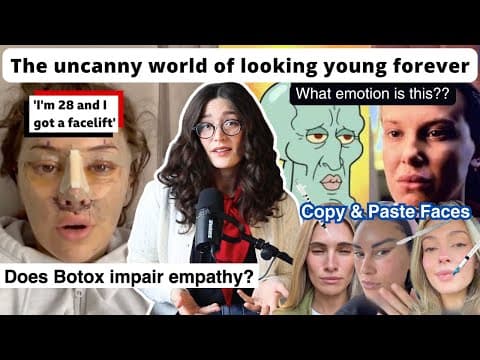
[0:00]You look so young. Oh my your skin looks so you are aging so well. What do you mean? Am I Am I old now? 27. I don't know about anyone else, but I'm scared of growing old and getting wrinkles. Already getting some smile lines and then up top like they're already coming in. I just saw a video of a really normal-looking 30-year-old woman. Um, the comments, is this rage bait? Are you actually 30? Botox, filler, getting work done has literally rotted your brains. What the fuck am I supposed to do? I'm definitely getting a lot of plastic surgery because I'm. With all the filler and the the snatching and the everybody looks the same. Everybody looks the same. What happens when it becomes common place to just perpetually look 35 to 40? When you show an emotion, you actually begin to feel the emotion. So people who have Botox their smile wrinkles can't make a true happy face and actually feel less happy. If if the muscles can't contract to feel the emotions, the brain doesn't feel the emotions. But next time you see me, I'll probably be looking five years younger. We live in a society of abundance, where basic needs are largely met, as we have more access to food, shelter, and goods and services than at any point in history. But the human instinct to crave more doesn't disappear just because our survival is no longer a primary concern. So what's left to strive for when you already have everything you could ever want? Well, time itself. In a post-scarcity society, youth has become a currency and a clear marker of success and vitality. With previously unimaginable tools to manipulate our appearance now at our fingertips, aging is no longer inevitable, but optional. Every flaw, imperfection you see staring back at you in the mirror can now be pulled, smoothed, and snipped away. At this point, cosmetic enhancements have become the norm rather than the exception, and if you choose to deny it, then you're the outlier. But to that we have to ask ourselves, is this really our fate or just the premise of one of my favorite teen dystopian series the Uglies I read at 13? Honestly, it's hard to tell, isn't it? And that's why we're having this conversation today, because the anti-aging industry is freaking me out. Just look up any celebrity over the age of 30, and they seem to be defying the passage of time. So that's what we're going to dive into today, how the anti-aging industry got here, the trickle-down effects on the everyday person, and what it really costs to chase the fountain of youth.
[2:35]So it's not new for people to obsess over beauty and with it usefulness, as they go hand in hand. No one wants to be young but ugly, or God forbid, beautiful but old. It all goes back to the fact that humans are naturally drawn to signs of health and vitality, because that's what you needed for survival and reproduction. So in that sense, it adds up, but in today's day and age, at least in North America, we don't need to pick our partners based on who's spry enough to scavenge for berries and mushrooms anymore. Yet we're all still caught in the grip of the anti-aging culture, aren't we? Because whether you want to subscribe to this ideology or not, the unavoidable exposure from media and advertising keeps a message ingrained in us. Come with me to get my elbow pit brightened. Can we normalize short thumbs? My ex-rays are so ugly. Let's go get my knuckles shaved down. to the point that the anti-aging industry is now estimated to be worth 47 billion US dollars as of 2023. But just because everyone wants to stay young forever, doesn't mean they can, right? If I learned anything from growing up in the 90s/early 2000s, it's that all of these women who slathered on the Olay total effects anti-aging moisturizer, still aged, didn't they? But the reason we're talking about this today is because those tides are turning and we're slowly creeping upon sci-fi levels of glow-ups, where women are seemingly turning back time. The most notable example being Chris Jenner, whose facelift last year sent a shockwaves through our feeds, as we've never seen such a believable transformation before. And now she's the poster child, or poster elder, I guess, for 70 going on 30. This is the start of a new age of anti-aging procedures and treatments, where they are becoming undetectable. Previously, facelifts were something to pity over, like, oh, did you see what she did to her face? What a tragedy. Because they did look a little crazy, didn't they, when their cheeks were pulled up to their temples and their lips stretched out like the Joker? But that is no longer the case because now, if you didn't know who Chris was, you probably wouldn't be able to tell that she had a facelift. This phenomenon that bleeds into the anti-aging industry as a whole is what the Cut has called Forever 35, as we approach the final frontier of reversing age, one unit of 11s Botox at a time. Between filler, Botox, upper and lower bleffs, fox eye lifts, and a myriad of topical treatments. As we've said, aging is becoming something that you can opt out of. Now you might be thinking, okay, but this is celebrity culture, which is not very reflective of the everyday person. But it's not actually as disconnected as we would hope, because as these procedures and products become more normalized, and more importantly, affordable, the layman gains access as well as social acceptance. As said by Dr. John Diaz, it used to be that not everyone had access to a plastic surgeon. That was reserved within the realm of the elite. Well, not anymore. I have celebrities, executives, and business owners come in, but also teachers and waiters. There's this democratization of attractiveness. Take Botox for example. I never heard of it being used much at all 10 years ago. Mind you, I was 20 at the time, so you would hope that I didn't hear about its usage much. But still, the usage has skyrocketed since then, where it's pretty normal for middle-class women to get shot up regularly. According to the American Society of Plastic Surgeons, Botox among 20- to 29-year-olds has jumped 28% since 2010. This newer adoption of Botox as early as 20 even has a cutey little name, Baby Botox, with the main goal of preventing wrinkles before they start. So let's talk cause of this increased interest in youthfulness before we get into effect. Like we know, people have always tried to appear younger, so the desire isn't new, but the players are. Our main culprit is, of course, social media, because we have never before been able to see so many faces in our lives. Even if you live in a city like New York and pass hundreds of people on the street, you're not seeing their faces in 4K resolution under a ring light while they state their exact age for the camera so that strangers can judge their facial maturation for consumption. No, that, my friend, is new. Which is a really interesting fact that we don't think about enough. Like for millennia, humans only knew the faces of the people in their village or who they were in direct contact with, and now we have access to around 4.6 billion faces on social media, which is half of the global population. Or at least that's how many users there are. Arguably, the number of faces would be closer to half of that, but still, that's insane. And the effects of this is substantial and takes a huge toll on our self-perception. Okay, so the thing I want to emphasize in this conversation is that caring about your appearance isn't the problem here. Because how we present ourselves to the world says a lot about who we are, what our values are, and feeds into our individuality. But when society keeps selling us the idea of anti-aging, it makes life feel like a constant race against time, and I would much rather focus on things that feel effortless and pressure-free. The key here is to approach our appearance from a place of embracing who we are and finding peace in that. This is something that I've been working on a lot over the past few months, which is to let my style support my identity, rather than diminish it. And today's partner Vivaya has been my go-to for matching the perfect shoes with my outfits, offering sustainable, stylish, and unbelievably comfortable footwear. Long gone are the days of needing band-aids to wear your loafers, the Audrey loafers combination of the heel pillow with arch support means that you can wear these all day without worrying about foot pain. They're so fun, too, with 10 different embroidered patterns to choose from to match your style. I went for the puffins because they're so adorable and playful. On top of that, you don't need to stress about getting them dirty because you can just throw them in the wash and they come out looking brand new. Another addition to my collection is the Yancy in brick red, as they add the perfect pop of color to any outfit and are also featherlight. On top of that, they are customizable. Each pair comes with this double lace design, and you can choose from multiple lace options. Vivaya is also launching another more sporty sneakerina called the Carol Jogger Sneakerina in February, so keep your eye out for that. But overall, whether I'm running to the coffee shop or walking trails with my kids, Vivaya gives me the versatility to tackle it all. I have linked these shoes in the description for you to check out if you've also been searching for comfortable shoes that match your style, and with my discount code VAE, which stands for Vivaya Ashley Embers, you can get 12% off within the first three days after this video goes live, and then it's 10% afterwards. On top of seeing way too many faces, we also see way too many phony faces between all the filters that snatch and smooth over our features. Just a little friendly reminder that there is a new Old Glamour filter out there that looks super realistic. It does not glitch when things are in front of your face, and it's not at all real. Be safe out there. Thus we've arrived at a place where youthful glass skin is the standard, and when anyone sees a face that doesn't align with that expectation, they react as if they've seen a ghost. Child, and that's an ugly pillowcase. The use of digital enhancement on social media is so commonplace nowadays that people use filters and apps to completely reshape their face and body and think that it's normal, says cosmetic surgeon Dr Paul Banwell. You're now able to quickly create a new version of yourself that is comparable to looking in the mirror every day. Because these filters and edits have become the norm among influencers and celebrities, it's altering people's perception of normal beauty ideals worldwide. As I've mentioned before, there was a trend of women in their mid-to-late 30s sharing their faces up close and personal with no filter to show what real faces actually look like. And apparently, bullying is back in fashion because these women got ripped apart for it. With comments like, we shouldn't normalize sun damage like this. Girl, wear sunscreen. And I'm also 27, and I can promise you that wrinkles like that are not normal. Which all just makes everyone feel bad, as if it's their fault for aging. As technology is rapidly advancing, so is peer influence. This factor alone creates a negative environment with the perspective that aging is an appalling experience. I just think the media makes people think that once you begin the aging process, everything is over, English teacher Anne Marie Dominguez said. So that is part of the story, but I also was reading about another influence primarily affecting Millennials view on anti-aging, which is that a bad economy opens up women's finances to exploring more anti-aging treatments, funny enough. This Bustle article explores the idea that when women are priced out of historically typical expenses, like homeownership or children, they'll pursue other avenues with their money, like youthfulness. If the cost of beauty sounds high, it's nothing compared to real estate. Though 52% of Millennials are now homeowners, another 24% believe they'll never be able to save enough for a down payment. However, on average, they spend more money on cosmetics and What sits in that gap? The Millennial Glow-Up. Now, ages 29 to 44, many Millennials are bringing in enough cash to splurge on their well-being, but maybe not enough to reach more traditional financial goals, like buying a home and affording children. Caught in the middle, many are taking the same approach as Lana. I don't have enough money for these bigger investments, so why don't I just be gorgeous? Honestly, hilarious, and go for it. And so now we live in a world where all the tweakments and procedures are fair game because what else do we have going for us other than beauty? Before I go any further, I really should take a second to say that I did not make this video to shame women for going through with beautifying and anti-aging treatments. There are so many legit reasons why women do them. I'm thinking of the fact that we're living through very chaotic times where so much is out of our control. And this is one thing that you can take action on, even if it's frivolous. Also, there is immense pressure women face each year as aging creeps up, and society burdens them with the weight of being less than the second you get smile lines. We can't pretend like that doesn't take a huge toll on us. This is the thing that I really want to transmit with this record, because I have lots of like Gen Z women who are fans and they're so scrutinized right now, like they're in their 20s and they feel pressure about how they look, they feel fear about aging and it's like the trick of the patriarchy is to make you think that your value disappears after you're like not deemed attractive. And finally, there's the fact that women who appear more youthful get more respect in the workplace and make more money. So it really is an investment, isn't it? In the workplace especially, the difference between males and females is evident. From a female perspective, one of the biggest things people may be perceived by is their looks and how they present themselves. If they don't look young and fresh and energetic and all this other stuff, they think that somehow that is going to affect their thinking and their skills and their ability to do their job right, Dominguez said. So, I get it, but I think it's important to talk about the downsides of these things so you can make an educated decision on what procedures and treatments you think are really worth the trade-offs. Speaking of which, let's get into the drawbacks of being 35 forever, shall we?
[13:42]Okay, so I want to primarily talk about Botox now, because while all these beautifying procedures make impacts on social beauty standards, etcetera, Botox has a deeper impact on our day-to-day lives. Not a sentence I ever thought I'd say in my life, but to unpack this, with the surge of people hopping on the Botox trend, research suggests that it's impacting our relationships. I should also specify for those who don't know what Botox actually does. It numbs the muscles in the injection site to inhibit movement, therefore preventing wrinkles because when your skin doesn't crease, then deep seat wrinkles can't form. But as a byproduct, it's affecting our ability to express emotions, experience emotions, and effectively communicate with others. Because the human species has evolved to read facial language, to understand expressions that signal our feelings, and when that's blocked, we're no longer able to differentiate between emotions, like say, anger from contempt, or happiness from surprise. In the worst case scenarios, these faces are so frozen that it gives uncanny valley, because you have no idea what emotion is being thrown your way. The Botox, I can't show emotion for another hour and a half. But we're not just talking about the over-injected celebrities who have gone so far as to completely eliminate movement in their faces. It's just as much of a problem when muscle movement is only partially limited, and this is because of the importance of micro-expressions, which are kind of a subconscious emotional leak, where our brain processes emotions faster than our conscious mind can manage them, leading to a quick flash of emotion. Humans use these signals for a lot of things, like building trust, as we can detect deception, as hidden emotions or intentions are revealed ever so slightly. But even more interestingly, when we see the emotions of others, we actually mirror them through our micro-expressions, helping us understand how they feel and strengthening our connection. Facial mimicry is almost instantaneous as we humans have this miraculous ability to track the slightest flicker of change in one another's faces. These micro-expressions are often so subtle and hard to detect that they can only be measured through electromyography, or EMG, which uses electrodes that are sensitive to the faintest movements of the facial muscles. Most of the time, you're not even consciously aware that you and the other person are involved in this micro-mirroring exercise, but the brain registers it, and it contributes to your feelings of connectedness. Likewise, if you or your partner fails to reflect each other, you may feel unsettled and disconnected, without knowing why.
[16:13]And, as you can guess, pretty much any amount of Botox impacts this muscle reaction and limits the brain's ability to interpret other people's facial expressions. And so, as a result, this can take a toll on relationships if you feel like they aren't engaging naturally. But it doesn't stop there, because, as it turns out, micro-expressions aren't just a window into someone else's feelings, but they're vital to experiencing your own. When we reproduce emotions through micro-expressions, we naturally experience a small portion of the emotion ourselves by replicating the facial response. And this is a huge part in building empathy, as we are literally embodying the feelings of others. Because they're unable to mimic the person. We we have mirror neurons. We mimic people's emotions back to them. So when somebody's like crying, you go, oh, you know, you lose that when you're all botoxed up. The study was done exactly on this, where they had patients read dozens of sentences of each kind, both before Botox treatment and two weeks later. The scientists not only verified their theory of language processing, they also showed that getting rid of frowns selectively impairs the ability to understand angry and sad sentences. In other words, it's normal to frown--undetectably--when we try to process anger and sadness. If we can't frown, our emotional understanding breaks down. Now, the first thing my brain thought of when I learned this was, what about the children? Because as a mom, I obviously am thinking about how this impacts the parent-child relationship. If you didn't know, our emotional connection with our kids plays a huge part in their development. Maybe that's an obvious thing. That's kind of obvious, right? Okay, and there's many sides to this, including the conversation going on right now about how parental screen time is arguably more harmful than kid screen time. Because for one, don't neglect your kids, but also, kids need face-to-face interaction with you to learn from and connect with. This is partially based on a famous study from the so-called blank face experiments. In these experiments, researchers studied infant facial reactions when their mothers faced them and deliberately displayed no facial responses whatsoever. And to no one's surprise, the young children quickly became distressed, confused, and withdrawn. What these studies concluded was that children heavily rely on facial expressions to learn about emotions, social cues, and how to respond appropriately. Well, the same thing is applicable to Botox, where if you aren't able to give the appropriate facial response to kids, then that impacts their emotional development. When I raise my eyebrows because I'm interested in what my children are saying and I have lines in my forehead, it only furthers the expression. It's like an exclamation point on my expression. If I could not raise my eyebrows, I couldn't be shocked at the shit my kids are saying. And then they wouldn't know that I'm truly invested in the words that are coming out of my mouth. Do you know what I mean? Because as much as we emphasize, I'm so upset with you because you broke my favorite vase, or maybe the modern version of that is you broke the switch controller, I don't know. It just doesn't hit the same when during that conversation your face is serving the whole time. As Dr. Ed Tronick explained, Botox likely does limit and distort parent-infant communication, possibly making the parent look flat emotionally. Facial expressions for parents and young children are really critical ways in which we communicate our intentions or whether we're angry or sad, and that involves this very complex array of all the muscles that go into making facial expressions. So if you limit that range of expression, especially with very young children who are really attuned to reading facial expressions, then you limit the amount of information, the amount of emotion that you communicate using a facial expression. But it is important to note that there are no studies done as of yet that directly prove this. It's just an educated conclusion based on what we already know.
[20:04]So what does all this mean moving forward? Because we're definitely heading in the trajectory of increased normalization of facial alterations. Well, let's look at media and celebrity culture because, again, they are usually the first to try out these new procedures, as they have the funds to do so, and also face the most pressure to do so. I feel like I have to start with Millie Bobby Brown and Stranger Things because that has been such a hot topic lately. If you haven't been following the series or the conversation online, Millie has been getting quite a bit of backlash for her inability to emote in the recent season as a result of her Botox and lip filler. And I do want to say that people are being so mean about her appearance, and that's the kind of thing that leads celebrities to doing the anti-aging work in the first place. So we need to check ourselves a little bit. But I do still think a respectful conversation about Botox and movies is warranted. I did in fact watch the season and had a very hard time believing a lot of her scenes, and that has nothing to do with her ability to act, as we know from previous seasons, she can really hold her own and draw us into the story. But that just means that it's extra tragic when the skill is hindered by limited facial movements. I was actually super surprised that they let Millie get Botox like this while she was filming Stranger Things. She looks amazing, by the way, but she's not able to make much expression. Like, this was my recording. This is a great example of the differences between these two actors. Expressions look at her forehead and the movement compared to Millie's and she's crying. And this is just one example of so many in Hollywood right now. These days, it's honestly hard to find a new movie or series without actors whose cosmetic work ends up ruining the story for us. People are out here saying that Claire Dane's face looks like a Snapchat filter. That's how unfamiliar we have become with a normal, real, expressive 46-year-old face. What is the long-term implication of that? Like if you are a director and you've made a movie and you've cast someone who has tons of Botox in their face, what does that do to your art? To how that is connecting with the audience. I first noticed this when Oppenheimer came out and Emily Blunt had so much cheek filler that I was completely taken out of the story. It's based in the early 1900s, like, why do we look like that? And it's not coming from a place of judgment towards people for choosing these beauty treatments, but because our brain literally cannot connect with a story that doesn't make sense. Another huge one I've heard about is Bridgerton, which I haven't watched, but everyone apparently looks way too modern with perfect skin, filler and veneers. Like you're trying to sell to us that everyone in the 1800s had brilliant pearly whites. I don't think so. But all of this just foreshadows what we'll have to deal with in real life soon enough, a time when you can't believe a story someone's telling you from their direct experience, because there's just a blank face behind it. The future looks pretty bleak - at least in my mind, which conjures visions of a Black Mirror-coded future, full of ageless-looking octogenarians, interacting with as much warmth as a robot. The other concern that people have brought up is now that faces are endlessly manipulable, everyone is starting to look the same. Since the same beauty standards apply to everyone, if you have enough money, you can buy beauty just like everyone else. I feel like Instagram Face of the 2010s played a major role in this, because it was our first glimpse into how homogenous faces could become between filters and FaceTune. Everyone had poorless skin and plump high cheekbones, cat-like eyes, and a small button nose. This shift came when people could start bringing these altered photos of themselves into plastic surgeon offices and become real-life versions of their online avatars. This tweet right here, Damn bro, you used to look like a Greek God, and now you look like you listen to podcasts. And so we're moving toward a culture of sameness where Instagram face has become an offline reality and doesn't even feel strange anymore. It's true that there is something destabilizing about being among meticulously altered faces for a sustained period of time. They appear almost two-dimensional - like you should be looking at them on a screen. The handiwork is so subtle that the more you look, the less you can tell what has been moved, cut, and erased, and the less tethered you become to the origin point: what a face modified by time and gravity should look like. Instead, the new faces appear as if they were always that way, belonging to an airbrushed species of another planet. Now I know this sounds far-fetched, but again, just look at the celebrities. They weren't always carbon copies of each other, they were beautiful and distinct. The quirky features that today would be seen as flaws, only added to their beauty, rather than diminishing it. There was once a time when TV show actors had different looks, with crooked teeth, laugh lines, and unique smiles that weren't full of veneers or lip injections. More and more, however, with beauty standards off the charts and so far gone that I can't keep up with them from day to day, it's hard to find that same uniqueness. What happened to all the faces? So last night I'm watching one of my favorite Christmas movies from the 80s, Scrooged, where Karen Allen plays the Angenoo. Here's Karen Allen right here. This is her real face. This is a very real like smile lines around the eyes, a gummy smile, and I'm not saying that is a bad thing, I think she has a beautiful smile. I'm just saying that this is what a real person looks like, and she was the ingenue, the main love interest. And not only this, but the Indiana Jones franchise. On Jenu. On Jenu. On Jenu. On Jenu. Rest in peace, but also on you. This group of women has some of the most prolific acting credits of all time, and all of them look like real people. Beautiful people, don't get me wrong, but how many of these people do you think would pass for modern day beauty standards? Now all these quirks have been deleted from existence, and all the celebrities are looking the same. We're talking Christina Aguilera, Lindsay Lohan, Anne Hathaway, and Mandy Moore being the most notable. But the men are in on it too, like Bradley Cooper and Brad Pitt clearly have gotten work done. They're slowly erasing the features that made them who they are. Watching older movies and TV shows makes me feel a little bit sad. And that's because I feel myself mourning the loss of variation in faces, the plastic surgery standard of working actors now. It's been creeping in, like it's been so gradual and so ubiquitous that it was kind of easy not to notice it happening. But when you watch stuff now and then you watch something that's like 20 or 30 years old, the difference is night and day.
[26:37]I mean, I watched the old Star Trek movies recently, and I was like, oh my God, these people's faces have wrinkles. Their skin has texture. They feel like real people. And you don't really get that now, even with older actors, like they they don't have texture. It's all just so interesting for multiple reasons. But the question at the top of my mind is, what is the goal here? My follow-up question is, what even is beauty? Without getting too far down into the trenches of that question, because I feel like you could write an entire essay on that topic. But beauty in regards to physical attractiveness is often said to be about symmetry and health, but it's also about scarcity. When it comes to humans, beauty in many ways is just a comparison game, where we're drawn to others based on our biological drive to pick the best partner. As we stated before, the berries and the mushrooms scaveging. But if everyone looks the same, then nothing sets us apart, and the very concept of beauty fades. Like the idea that if everyone is beautiful, is anyone beautiful? If beauty is everywhere, it's not beauty, it's average. But what everybody wants, every consumer wants is they want the ability to get beauty but not their peers. Yeah. Right. That's what everybody is fighting for, and then that's where money comes into play. Can you buy the beauty that the other people can't? But I think we all just need to take a breath and think about the implications of all these anti-aging treatments before we just rush into them blindly. And ask ourselves whether we're giving up what makes us us to get there. Like is it really that important for us to look fabulous to school drop off like this mom shared post facelift, or should we be redirecting that energy to something better for us all?
[28:22]Okay, final thoughts. Um, so as you can probably tell, I'm not planning on getting any face altering treatments done in my future. But I also just entered my 30s and haven't settled into my wrinkles yet, so I don't know the full extent of the pressure of aging. Um, and we'll see how I handle that. But when you participate in anti-aging procedures, you are contributing to the narrative that we as women shouldn't age. And I think, or at least I hope that that will be enough for me to hold my ground. But also where is the line in that, because I'm no stranger to retinal creams and red light therapy, because I personally think that's fine, but maybe other people think that's part of the problem still. Let me know what you think. Ultimately, this problem only will be solved by a title change in what society regards as beautiful. And I have been seeing some of that online, which is really encouraging about people celebrating their uniqueness.
[29:20]I'll have my natural nose, thank you. So that's really cool to see. But that is all I have for you today. Make sure you subscribe if you haven't, if you want more video essays like this. Also check out the merch, all the proceeds go to the essay Foundation, and I will leave you with this quote. We've been taught to fear age, but aging means we've lived. Laugh lines mean you laughed. Silver hair means you've seen things and survived. I think that's beautiful and worth celebrating. I just got an ad for Botox cause I'm almost 28 and the algorithm knows that now's the time to fix my face, and they say that it's preventive of a woman's sordid fate. So I must stick to this expression and freeze my eyebrows into place, and I actually don't hate my face, or is that not allowed? Am I supposed to find something to be more insecure about? Cause if one day I wake up and find myself at 93, I hope we'd have much more to talk about than wrinkles and crow's feet. Yes, I know that it's preventive. Preventing what though, exactly? Plus getting Botox is expensive. I'd rather just get old for free.


