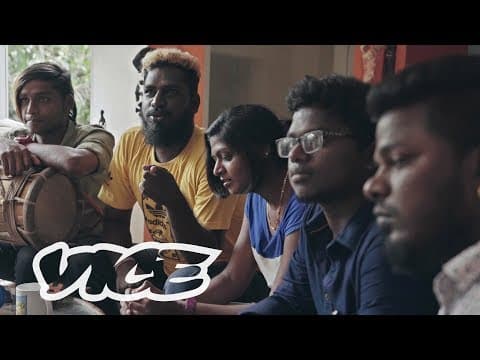
[0:02]If you say that I'm coming from a village, they'll ask you in which street you live. It's asking which caste you belong to, that's not equality. I'm a human just like you and I want to be free as well. For millennia, India has had a discriminatory caste-based society. It has limited the lives of people - from where they live, the meat they eat, marriages, occupation, and even what music they play or listen to. They say, "You play music at funerals. You shouldn't come near us. I have to bathe just because I spoke to you." People don't like to talk about it or they look at it from an upper caste perspective. While government initiatives to reduce the gaps exist, social discrimination is still rampant. Over 600 villages in Tamil Nadu still ostracise people based on caste. In urban areas, the divide is more insidious. We want to make a casteless generation here. If this generation also follows the caste [system], then nobody can save the next generations.
[1:06]Your forefathers kept mine oppressed Isn't that why we are given our quota? Your forefathers kept mine oppressed Isn't that why we are given our quota? Don't be so proud because you get all you want Unlike our ancestors, we won't remain calm! Jai Bhim! Jai Bhim!
[1:42]Welcome to Madras (Chennai). We're at Bodhi, the birthplace of folk music, a lot of folk artists actually. And we're The Casteless Collective.
[1:56]Hi bro! Bro, huh?
[2:02]I've been an independent musician for over 15 years. I started my life as a funeral musician. My first paycheck was INR 45 ($ 0.65). Then I was in a very big band called Kurangan. I started a big band called Kurangan. And on the parallel end I started this thing called Madras Indie Collective. Basically, I wanted to redesign the Chennai music ecosystem. I wanted to figure out who I am within the person. Because my entire focus is that identity politics. That's when I got the call from Ranjith. Ranjith is a celebrated filmmaker. He did Kaala, Kabali, Madras, and Attakathi. He's got the other life, which is the social activist life, like, he's a very, very political person, I'm a very political person. So, the only outcome from that was a political band. In India, caste is an important issue. It's in towns, villages, roads, cities, and in any media, from wherever. People either don't talk about it or they look at it from an upper caste perspective. We have to question this. Now, my question has become an art form. So we created the residency, the music residency to collaborate, using this collective to basically bring people together. And he gave me 20 days and he said, "Listen, can you come up with songs? And we'll put a performance." And we started The Casteless Collective. The meat we love, the meat, our heartbeat Which meat is it? Let me hear it It is beef curry The taste is extraordinary Add salt, spice pepper, makes the soup better Justice, self-respect, rightful anger eat this meat to feel the power All other meat will only make you diabetic... The sound of The Casteless Collective is the sound of the soil of Madras, the blood and sweat of Madras. When we speak of the people's issues and struggles and needs, and bring about equality and that is why The Casteless Collective exists. The most important thing is to annihilate the whole caste idea. It's to be casteless. That is the Casteless Collective.
[4:15]So we wanted to create that idea, build the idea with Gaana music because Gaana music comes from a lot of emotional pain. Gaana artists have been over-exploited for many years, many decades.
[4:29]And as a form Gaana, it wasn't academic, so you can't learn Gaana. And it's all based on percussion movement and it's just a feeling. Isaivani says one beautiful thing. She says, "Folk music is for body pain. Gaana is for emotional pain." One, two, three. Go! Fry this meat in oil to get the best beef. Eat it from a bowl, it will be wonderful Fry this meat in oil to get the best beef. Eat it from a bowl, it will be wonderful Kavappu [Beef delicacy] Karikallu [Beef delicacy] Karikallu [Beef delicacy] Karikallu [Beef delicacy] Kavappu [Beef delicacy]
[5:16]Native to the Dalits who had been pushed outside the caste hierarchy, Gaana music was born in the by-lanes and graveyards of North Chennai.
[5:29]It started as a way to mourn the dead, but now has transformed to tell stories of the Dalit community.
[5:51]My name is Gautham. I have been playing the katte molom from a young age. Hi, my name is Sarath. I play the satti. This is a traditional instrument. It is made to be loud.
[6:08]You can play a guitar and all, I don't know if our people would dance to that music, but when we play this, people will definitely dance.
[6:21]I live in a place called Otteri. As soon as I woke up and came out, I would see the graveyards. To one side was a Christian graveyard and the other side was a Hindu one. The funeral processions that came in would have this instrument being played, I would forget everything and dance. There was a graveyard opposite to my house too. My mother would come after me and tell me not to go, that there were ghosts and spirits there. But this instrument has some power. I had to learn how to play. I learned to play in the graveyard.
[6:51]Now, the concept of this music being played for a particular caste or being reserved only for Brahmins, this music doesn't have these divisions. Now, if you look at Carnatic music, the mridangam, the tabla, the nadaswaram, the tavil, they won't even let us near them. At these gatherings, we have gone to many places and asked them to give us a listen. We also play.
[7:19]They say, "You play music at funerals. I have to bathe just because I spoke to you." The molom. It is played when a death occurs. It is looked upon with shame. You can't keep going on and on about how it is played at the time of death. And what I'm trying to say is that people who play the molom, aren't people you look down upon or shun. This is also music. This is my music. This music is my life. Without it I'm nothing. Once we went in and played, they were looking at us in awe. They are humans, we are too, they have red blood, we also have red blood. For what purpose does caste etc exist? Why do they separate us? We should all be one. Humans should live as humankind. That's it.
[8:04]Gaana music, it's like the blues. It's the blues of the Tamil music scene. And it comes from the same place of pain of hip-hop. And to make hip-hop sync with this was a difficult task. But someone like Arivu rapped and sang folk music. So, his contribution sort of like, locked everything.
[8:26]You man, afraid of skin of salted beef Don't cross my way Avappu Kavaapu Oxtail soup smells good Eating is one's personal affair Why is your stomach hurting? He narrated different stories for different meat and made us untouchables Leg piece and bone marrow If you dont get it, leave now We eat soup and meat Look at my broad chest Charred meat, entrails, intestines, dry meat You, shameless, determine caste by blood... I used to listen to stories of my grandfather. They used to say, "We were landless. We were not allowed to get into other's home through the front door. We were not given water in a tumbler. Water would be poured like this." These things have been continuing for thousands of years, and they are still like that only. I was unable to experience this until I came into my college life and I started reading about these things. And then I got to know that there is a big caste oppression, that modern untouchability still exists in society. People are landless here. The son of a manual scavenger is compelled to do manual scavenging. You won't see caste. You will be sitting comfortably and you will be telling this. But your forefathers of forefathers would have been landowners. They would have oppressed so many people. Generations of those people are living on the streets. You, right now, go to a private school, go to an international school, get educated there and say, "I don't see caste." It's ridiculous. So I started educating myself and I wanted to do it in an artistic way so that everyone can understand what I'm coming to tell. Art is the most influential way to get into the mind of a person.
[10:03]I always wanted to become an artist, a songwriter who writes about the original things, the raw things from the streets. I wanted to be an artist. After getting into my college I started writing poems. I wanted to show my pain. I wanted to cry out while singing. So I just put in word play. My friends noticed me and said, "This sounds like rap. You continue, you can become a rapper." After coming into the rap scene I studied that rap has a very big history, it's a big voice of oppression. I was like very happy when I got to know that OK, this is what we are also trying and we should also sing about the lifestyle of our people through rap. What we have to do is we have to discuss about it. By skipping a conversation you can't find a solution. The story that I narrate now Listen keenly and you will be in awe The whole country is filled with caste bias Schools we can't enroll Temples will not save our soul Roads we can't walk Kill us even, no one will ask Thousand years passed by like this Things are changed, tell me who ensured this? Revisit your history See who changed our story Jai, Jai Bhim! Let's raise our voice No more caste, let's rejoice
[11:14]Jai, Jai Bhim! Let's raise our voice No more caste, let's rejoice Jai Bhim!
[11:31]We are all musicians. If you were to sing one of our songs, which one would you sing? For me, the most liked song is Kaalu Ruba Dhuttu. My favourite song is Kaalu Ruba.
[11:44]If I'm doing some work and I hear that song, I fall asleep. While we were composing it also, I slept. I got scolded for that. It had that kind of a vibe.
[12:00]I get paid peanuts but it's still a government job Going all around town shovelling faeces... For people working in Metro Water (sewage cleaning), their lunch break is at 1:30 PM. After eating lunch, they listen to this song and fall asleep. So they love this song. Even when the trash is rotten, I pick it up quickly And that is when you will call this a city... In that job, you can be killed by the gas. There is no safety. It's horrible. Men are made to clean men's waste. That's the sort of work they give to people who come from the slums. No one thinks about them. When they listen to this song they think, "Now, someone has given us a song about our problems."
[12:57]For our concerts people will come as families, not as only youngsters, only girls. People will come with their whole families, kids will come Grandmothers will come and dance in our concerts. "No one has ever sung about me on any stage", that was their feeling. This is the first time they are listening to their own story in a big musical concert. After The Casteless Collective, those who sang in a dirty t-shirt and lungi [a garment wrapped around the waist] are now playing music wearing a suit on a big stage. It is a loud sound with a crowd of 10,000 people. This brings us immense joy. Even at home, things have changed. My mother has changed. Now they say, "It's not bad. You play on TV." The person who spoke against this molom, my mother, now she says, "I want you to only play the molom and earn." Today I run my family. We need to put an end to this caste hierarchy. Right now we need to see whether people are thinking about this or not. The fact that their lives have changed because of The Casteless Collective, makes us happy. After that, I want this to raise questions in people's minds. Even if they start thinking and looking for answers to those questions, I'll be happy. One, two, three. Go!
[14:22]Fry this meat in oil to get the best beef. Eat it from a bowl, it will be wonderful Fry this meat in oil to get the best beef Eat it from a bowl, it will be wonderful...


