[0:00]Hi, I'm Scott Hahn, and I want to talk with you today about the Transfiguration as we find it in Matthew 17. Why? Well, first of all, I want to say that the Feast of the Transfiguration may be the most undervalued feast in the Church's liturgical calendar. And I think as we reflect upon some of the key elements of the Transfiguration narrative, you might just see why. I want to begin by reading the narrative in Matthew 17:1-9. And after six days, Jesus took with him Peter, and James, and John his brother, and led them up a high mountain, apart. And he was transfigured before them. And his face shone like the sun, and his garments became white as light. And behold, there appeared to them Moses and Elijah talking with him. And Peter said to Jesus, "Lord, it is well that we are here. If you wish, I will make three booths here. One for you, and one for Moses, and one for Elijah." He was still speaking. When, lo, a bright cloud overshadowed them. And a voice from the cloud said, "This is my beloved Son, with whom I am well pleased. Listen to him." When the disciples heard this, they fell on their faces, and were filled with awe. But Jesus came and touched them, saying, "Rise, and have no fear." And when they lifted up their eyes, they saw no one but Jesus only. And as they were coming down the mountain, Jesus commanded them, "Tell no one the vision. Until the Son of Man is raised from the dead." What a beautiful gospel. I want to just touch upon a few preliminary thoughts before we look more directly into the core of this narrative. First of all, it's worth pointing out that this story is found in all three of the Synoptic Gospels. In Mark 9 as well as Luke 9 and here, of course, in Matthew 17. And all three of the Synoptic Gospels place it chronologically immediately after Peter's confession on the one hand, and Jesus' Passion prediction on the other. So, on the one hand, Peter is confessing Jesus to be the Christ, the Son of God. And you think this is a real climax. And indeed, it is. On the other hand, there's a sort of counterpoint in Jesus' response because he uses Peter's profession of faith as the occasion for announcing his own upcoming passion. Such as we find in Matthew 16. From that time, Jesus began to show his disciples that he first must go to Jerusalem, second, and suffer many things from the elders and chief priests and scribes. Oh, and thirdly, be killed. And finally, and on the third day be raised. Well, that was too much for Peter. Peter took him aside and began to rebuke him saying, "God forbid, Lord, this shall never happen to you." If you've just established me with primacy, made me in effect a prime minister, there is no way I can let this happen. But little does Peter understand things from a supernatural outlook. And so, Jesus responds with a firm rebuke, a fraternal correction. He turned and said to Peter, "Get B, get behind me, Satan, you are a hindrance, literally a scandal, a stumbling block to me, for you are not on the side of God, but of man." So, it's in all three of the Synoptic Gospels, it comes after Peter's profession of faith. It also comes immediately after Jesus' rebuke, and also his passion prediction. And then we give, we we find something here that Jesus gives us at the end of Matthew 16. Where it seems to be an interlude, but it's anything but. Jesus said to the disciples, "If any man would come after me, let him deny himself, and take up his cross, and follow me." Well, I mean, that's like a a thunderbolt or a lightning strike, you know, on a a bright sunny summer day. What do you mean? Take up your cross. The crucifixion hasn't happened yet. These words doesn't, you know, don't seem to be all that meaningful, because they didn't hear him describe exactly the manner of his death. But Jesus is here planning a seed, both for them and for us, because in a certain sense, Jesus accommodates himself to their weaknesses and to ours. Because if we knew the future, we would probably be plunged into despair. And so Jesus gives us just enough truth and grace to take the next step in faith. But he continues, for whoever would lose, for whoever would save his life will lose it. And whoever loses his life for my sake will find it. For what will it profit a man, if he gains the whole world and forfeits his life, or what shall a man give in return for his life? And I mean, I could go on for five hours about this because for me, this is the law of love. But it's a mystery, a sacred mystery that has been planted like a seed underground, and that takes a great deal of time, and faith, and patience to really understand. That this is not just plan B. Well, you're going to have to lose your life for my sake in order to find it, because you're all sinners. No, this is the law of love, from the very beginning. This is, as I like to say, plan A. This was there in the beginning, back at the in the early pages of Genesis. But it's not going to be unveiled, it's not going to be manifested until Jesus, at long last, fulfills the promises and the prophecies that constitute the Old Testament. And so this is going to show us how, for the first time, when Jesus is going to Jerusalem, where he is arrested and tried and executed. He is not going to die by losing his life. He's going to die by laying down his life as a gift of love. Life-giving love that will empower us to do the same thing and to find life. And ultimately, where do we find the origin or the source of this life-giving love in the eternal Trinity, in the Blessed Communion of the Father, Son and Holy Spirit? You might be thinking I'm getting ahead of myself, and I most certainly am. But, notice how that sets the stage for the next preliminary item. And that is where Jesus says something that has baffled readers for many years. He says, "Truly, I say to you, there are some standing here, who will not taste death before they see the Son of Man coming in his kingdom." Well, doesn't that sound a lot like the Second Coming to you? Well, yeah, and to a lot of other readers too. We just naturally assume that what Jesus is predicting here goes far into the future, long after his passion, his death and his resurrection. But wait, press pause, not so fast. Because the nature of the Son of Man coming in his kingdom is not reducible to the eschaton, to the last event at the end of time. How do we know it? Because he said there are some standing here who will not see death, who will not taste death before they see all of this. See all of what? The Son of Man coming in his kingdom. Well, just interrupt. I want to press pause for a moment and say that this is why, about 130 years ago, many scholars who just simply misunderstood Jesus' statement. Concluded that Jesus clearly expected to come again at, you know, in the first century, during the lifetime of his apostles. And this is the source of why the apostles taught the imminent eschaton back then. And this was going to create a great scandal, a great problem of the postponement of the parousia, because practically everybody back then, 130 years ago, reduced the coming of the Son of Man into his kingdom to the parousia, and that is to the cataclysmic end of time. But is that what God's kingdom really consists of? If Jesus has just unveiled the mystery of the kingdom in terms of life-giving love, in in the context of predicting his own passion, then maybe Jesus wasn't wrong after all. Maybe the apostles weren't wrong in following Jesus. Maybe Jesus is talking about something other than the cataclysmic end that comes only at the eschaton. Perhaps this reductionistic materialistic misreading of Jesus, you know, that would make Jesus and the apostles the proto-fundamentalist going all the way back to the first century. Maybe all of this is off, and I think it is. Drawing from Pope Benedict's trilogy, Jesus of Nazareth, especially in his first volume, where he discusses the baptism of Jesus in the Jordan all the way to the Transfiguration, the closing chapter of that first volume. He points out something very significant. And that is after six days, Jesus took with him Peter, James, and John his brother. In other words, there were some standing there, three of them to be exact, who are about to see the Son of Man coming into his kingdom because the glory of the Transfiguration manifests what? Well, not just the luminosity of the kingdom, but more specifically, the precise meaning of the sacred mystery of the kingdom of God, which is what? The Holy Trinity. The Father is speaking, "This is my beloved Son," as the cloud overshadows them all. This term overshadow, Epi-skein, is a very rare term, scarcely used. It it occurs, for example, in Luke chapter 1, where the the power of the Most High will come upon you, the spirit of God will come upon you, and the power of the Most High will overshadow you. This was the verb used to describe the glory spirit overshadowing the Ark of the Covenant in the Old Testament, overshadowing the Blessed Virgin Mary as God's spirit gloriously came upon her, enabling her to conceive virulently the eternal Son of God. And so, privately there was a manifestation of the Father for by the Father of the Son in the power of the Spirit to the Blessed Virgin Mary. This doesn't happen again until the baptism, but that was a private revelation to John the Baptist. Because John's the one who hears the voice of the Father as he's baptizing the Son, and discovering that he is the one who will baptize with the Holy Spirit. In other words, heaven is not where we go to enter into a kingdom where we can catch a glimpse of the Holy Trinity. No, heaven is the Holy Trinity. Heaven is not a place as much as it is a person, namely the Son, who has become the servant in order to transform servants like us into those who share in his own divine sonship. And so, some standing here, not tasting death until they see the Son of God, the Son of Man coming in his kingdom. This is the prerogative, this is the privilege that is given uniquely to Peter, James, and John, precisely by witnessing this glorious transformation that we call the Transfiguration. Now, I want to just again, stop for a moment and emphasize this point, that the revelation of the Trinity here to these three disciples is a manifestation of the truth and the power, and the beauty, and the reality of the kingdom of God. Period. And so, this is the provisional fulfillment of Jesus' pledge that there were some standing there who would not taste death before they saw the Son of Man coming into his kingdom. Another thing I want to point out is the fact that this happens to occur on a high mountain. A high mountain. This is a pattern that we can trace throughout the Old Testament. As my dear friend and colleague, Dr. John Bergsma emphasizes in his series called Mountains and Mediators, that, you know, it is always on a high mountain where God ratifies the Covenant and renews it. There was a mountain, yes, in the Garden of Eden. There is also the Mount Ararat, where Noah's Ark, uh, rests and where the Covenant is renewed. And then, of course, there is Mount Moriah with Abraham. There is Mount Sinai with Moses. There is Mount Zion with David. And back to Mount Sinai, Horeb with Elijah in First Kings 19. And no wonder, then, who should appear but Moses and Elijah. Men who are familiar with meeting up with the Lord God and His glory on a high mountain. Men who also represent the Law and the Prophets, both pointing to the coming Messiah. Moses gave the law. Elijah was the greatest of the prophets. And they also happen to be the only two men in the Old Testament who fasted for 40 days and nights like our Lord. And not only survived and lived to tell about it, but bore witness to Christ who would come and fast and pray, and manifest the glory of the kingdom precisely in these terms. So, it's not a geographical accident that this is occurring on a high mountain. It's also not incidental that the mountain is not identified. Personally, I believe that Mount Tabor was the mountain. But the specific name of the mountain is not what's important. The fact that it's a high mountain where the glory of God is revealed, where suddenly Moses and Elijah appear. This shows us not only the continuity as we move from the law, through the prophets, to the Messiah. But it also shows how the climax of all of salvation history is being unveiled to these three principal apostles, Peter, James and John, and through their testimony that is subsequently given to all of us. But the Transfiguration itself is something that is really significant. Why? Because, you know, on the one hand, we might be tempted to say, well, you know, the Father recognizes that now that his Son has not only predicted his own passion and death. But pledged himself publicly to perform this. Well, it would be fitting to provide the Son with some powerful consolation. You know, and so the Transfiguration at a minimum is that. But much more than consolation for the Son, this is revelation to the apostles. This is the manifestation of the Son who in a certain sense lives a life that is hidden as a servant. And so, at one level, we're tempted to say that the sacred humanity of Jesus is like a veil that conceals his divinity. And that is most certainly true. But at another level, an even deeper level, if the divinity of Christ is being unveiled, it's not simply being unveiled in terms of the spectacle of this luminous glory that is bright, you know, that is bright as the sun. Oh, wow. I mean, that's something. But even more, the spectacular glory of of God's kingdom is manifested in the pledge of Jesus' passion, his death, and his resurrection. Because that is the stuff of which God's kingdom consists of. That is the means by which we enter into it. And that pledge is going to be confirmed by the Transfiguration, so that suddenly the Apostles reveal or shown, this isn't just another martyrdom. This is the manifestation of the eternal mystery of divine supremacy. That what is supreme in God is not reducible to the fact that he's the creator and can dominate the entire creation and every creature, even the big beasts and all of that. No, the supremacy of God is precisely the glory of the love of the Father, the Son, and the Holy Spirit that is at the very core of Jesus' being as the Son of God, who becomes the Son of Man, so that through suffering, death, and resurrection, he is going to not only manifest the inner logic of the love that is the Trinity. He is going to convey that to us precisely by allowing us to receive him in his resurrected body, in the Eucharist. As I treat in my book, Hope to Die, because the real presence of Christ's body, blood, soul, and divinity is precisely the body that was crucified, died, and buried, and then is now resurrected. It is the resurrected, glorified, ascended, and enthroned humanity of Christ that we receive in the body, blood, soul, and divinity of Christ. One other thought I want to share before I conclude, and that is what Luke 9 tells us in verse 28. It's a detail that Luke alone includes, that is, Jesus went up this high mountain for the purpose of what? To pray. I mean, we find more instances of Jesus' prayer life in Luke than in Matthew, Mark, and John combined. And Luke also gives us a sequel, we call it the Book of Acts, because in the Acts of the Apostles, we we discovered that the power of prayer is the source of the Church's life and mission as well. And not just the Church in a collective sense, but every single member of the Church, personally, privately for us. So, he's going up there for the purpose of prayer. You know, the the glory of the Transfiguration is a visible sign of the invisible reality of Jesus' prayer life in general. But more specifically, of the communion that the prayer expresses, the communion of the Father to the Son. Everything Jesus says and does is the outgrowth of the prayer. Every part of his adult life, every part of his entire human experience is the prayer, which is this ongoing conversation, not just with God, the Creator. But with Abba Father, who has sent his Son for the purpose of giving us the Holy Spirit, so that we might be drawn into the glory of his kingdom and given resurrected bodies that will be transfigured just like his. He doesn't get anything out of the entire proposition of the incarnation, of his passion, death, and resurrection. So, why to go, why go to all of that trouble? To give it to us. To resurrect our bodies, to transfigure our bodies and our souls forever, to draw us into the prayer life here on earth, into the everlasting communion of the Father, Son, and Holy Spirit. What's the big deal? That is the eternal kingdom. That is the Kingdom of God. That is the Kingdom of Heaven. So, what should the Feast of the Transfiguration remind us of? Well, certainly the divinity of the Son, manifested in his humanity, generally. But more specifically, in his ministry. But at the climax of that ministry is the passion, the death, and the resurrection. This is not something that he just kind of, this is not something that just happened to him, and he was able to salvage our redemption from it. No, this is the very purpose of his incarnation. This is the very purpose of God creating the universe, and calling us to become his sons and daughters. Through Christ, by the Spirit, but most especially by means of prayer. By addressing God, personally, by sharing with him our gratitude, by giving to him his well-deserved praise, but also by sharing with him our fear, our anxiety. Jesus said, "Do not be afraid," for a reason, because he knows that there are not only excuses for us to give in to fear. There are really solid reasons for us to be fearful, but there's one overarching reason that makes our fearlessness even more reasonable. And that is the Kingdom of God in our midst. The power of God's Son, manifested in the glory of the Holy Spirit. This is really and truly who I am, who you are, who we are, as the family that is extended from the Father, through the Son, in the Spirit. This is a kingdom like no other. And why? Because the kingdom is not primarily political. The kingdom is primarily familial. That is, the King of the Universe just happens to be our oldest brother. And therefore, "I go to my Father and your Father," he tells the disciples after the resurrection. And he does that not to distance himself from us, but to take his sacred, glorified humanity into the glorious Trinity. So that what is always been true of God from eternity is now, for the first time, true for us in our humanity because the Son has assumed our humanity to impart that to us to make us what? Not just forgiven sinners, not just pardoned and acquitted criminals, not just patients who've undergone healing, but prodigal sons and daughters who have been reconciled, reborn. We truly been adopted, and we are being raised up by the Father, through the Son, in the Spirit to be transformed from sinners, prodigal sons and daughters, into true saints. So, the concluding note of all of this is is simply this. That is, God is our Father. Abba Father. He's given us fathers so that we can come to know him for who he is. But let's face it, he's given us all fathers who have faults, who have failed us. Who have flaws, and so there are all signs that point beyond themselves to the only true Father, the eternal Father, the perfect Father, the loving Father, God the Father Almighty. We have freedom and power to sin, but his freedom and love and power to save us, to make us holy, is immeasurably greater than my feeble power in misuse of freedom to sin and to distance myself from him. So, you know, let's join with Peter, James, and John in entering into this kingdom. You know, and don't fault Peter for saying, "Let's build three tents," you know, one for Jesus, one for Moses, and one for Elijah, because as as Pope Benedict indicates. Peter is speaking not out of folly, but out of ecstasy. He can't believe his eyes, and yet he has to. He can't believe his ears, but again, he's empowered to. What God has in store for us, as Isaiah says, as Saint Paul quotes him in Second, First Corinthians 2. I hasn't seen, ear hasn't heard. It's never entered into our minds or our hearts what God has in store for us. Believe me, the best is yet to come. And so this will get us through our crosses. This will show us how reasonable it is to lose our lives for his sake in order to find it. And to encourage others, as good apostles, to do the same thing. Not because this is some kind of holy masochism. It's not. Not because God is some kind of sacred sadist. He loves us more than we love ourselves, and the Transfiguration is proof that there is going to be the profession of faith in Christ, the Messiah. There is going to be the prediction of his passion and death and resurrection. But not just for him, but for each and every one of us. Let's let's not forget that the mortality rate is 100%. Not just in the Old Testament, but the new. But so is the immortality rate. Everyone who ever lived and died still lives some in one state or another, a state of shame or a state of glory. And it's precisely that glory that is revealed to us, to which we are called. Let's let's ask our Lord now to to not only write this on our hearts, but I mean to etch the mystery of his power and love manifested in the Transfiguration to really etch that on our hearts. It reminds me of Jeremiah 31, where God doesn't just want to write his law upon stone tablets. God wants to use a diamond to etch to carve into our hearts, the new covenant, the new law, this new love that is not finite, created, or natural, but infinite, uncreated, and eternal. This supernatural grace that is our life as God's children. In the name of the Father, and of the Son, and of the Holy Spirit. Amen. Almighty God, our Father in Heaven, we give you thanks and praise for the gift of your son. And in his holy name, we pray for the gift of the Holy Spirit to make us holy, because we, like Peter, James, and John, are proud and willful, wayward, and fearful. And we need to be healed not only of illness, but we need to also be healed of our fear of suffering and dying. To be delivered into the Kingdom of Love, that is life-giving love and has been from all eternity. These are really deep mysteries. They are inexhaustible. But at the same time, Father, you sent your son to be our teacher. And so by the power of the Holy Spirit, write this on our hearts. Etch this into our lives, so that others may see Christ when they see us. For we ask all of these things not only in the powerful name of Jesus, but in union with the intercession of his mother. Hail Mary, full of grace, the Lord is with thee. Blessed art thou among women, and blessed is the fruit of thy womb, Jesus. Holy Mary, Mother of God, pray for us sinners, now and at the hour of our death. Amen. In the name of the Father, and of the Son, and of the Holy Spirit. Amen. Thank you for joining me.
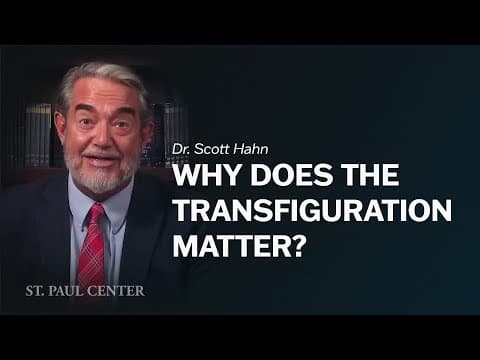
Why Does the Transfiguration Matter?
St. Paul Center
39m 57s4,283 words~22 min read
YouTube auto captions
Transcript source
YouTube auto captions
This transcript was extracted from YouTube's auto-generated caption track. The transcript below is server-rendered so it can be read, searched, cited, and shared without opening the original YouTube player.
Pull quotes
[0:00]Hi, I'm Scott Hahn, and I want to talk with you today about the Transfiguration as we find it in Matthew 17.
[0:00]Well, first of all, I want to say that the Feast of the Transfiguration may be the most undervalued feast in the Church's liturgical calendar.
[0:00]And I think as we reflect upon some of the key elements of the Transfiguration narrative, you might just see why.
[0:00]And after six days, Jesus took with him Peter, and James, and John his brother, and led them up a high mountain, apart.
Use this transcript
Related transcript hubs
Watch on YouTube
Share
MORE TRANSCRIPTS


