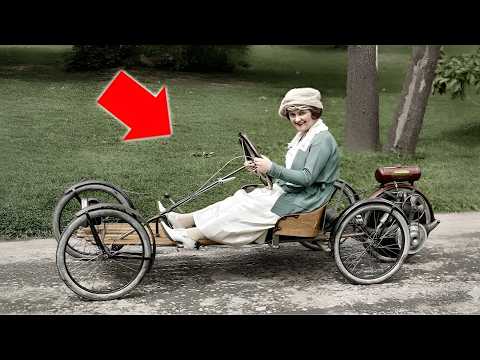
[0:00]Two planks of wood, four bicycle wheels, one engine bolted to the back. That's it. That's the whole car. Meet the Smith Flyer, one of the strangest, cheapest, and most brilliant vehicles ever built in America. And the story behind it is wilder than the machine itself. The AO Smith Corporation was known for making frames and parts for other car companies. But in 1914, they decided to build something of their own. What they built changed American transportation, not because it was powerful or beautiful, but because it was something nobody had seen before. The key wasn't the car, it was the wheel. Specifically, a motor wheel, a single unit combining an engine, a hub, and a tire. One self-contained power plant that could attach to almost anything. The concept was originally developed by Arthur William Wall in the UK, who used it to motorize bicycles. AO Smith licensed the design, applied it to bicycles first, then around 1915 to 1916, bolted it onto a simple wooden frame and called it the Smith Flyer. Chief engineer Ruben Stanley Smith filed multiple patents, including US Patent 1,373,918. That paperwork would later matter a great deal. A wooden buckboard, two seats, no roof, no windshield, no suspension. The wooden frame itself flexed slightly over bumps. That was your ride comfort, all of it. The motor wheel hung off the back like a fifth wheel, and that's exactly what it was. To start moving, the driver lowered the motor wheel onto the road, to idle, they lifted it off. That was the entire transmission system. No clutch, no gearbox, no reverse. The throttle was on the steering tiller. The only brake was a foot pedal on the front wheels, and if that wasn't enough, well, that was your problem. The engine itself was a single cylinder air cooled four-stroke gasoline unit, around 200 cc displacement. Early versions produced about one horsepower, not a typo. One. Wheelbase 62 inches, width 30 inches, weight 135 pounds. Top speed 22 miles per hour. At a time when a Ford Model T cost over $400, the Smith Flyer sold for $135 in 1917. For people who needed cheap basic transportation, it was a genuine option. In 1919, Briggs and Stratton, already established in small engine manufacturing, purchased the Flyer program from AO Smith. They saw exactly what AO Smith had built, not a car company, an engine platform. They immediately upgraded the motor wheel, stronger connecting rod, larger bore, flywheel magneto ignition, and bumped output to two horsepower. They even launched a dedicated publication called Motor Age to support the growing user base. The flyer continued in limited production, but Briggs and Stratton's real interest was the engine. By 1925, they sold the flyer rights entirely and kept the motor. That motor became the foundation of Briggs and Stratton's small engine empire, lawnmowers, snowblowers, generators, equipment that's still in garages across the world today. The flyer is gone. The engine it carried is everywhere. AO Smith produced approximately 25,000 motor wheels before the 1919 sale. The flyers were just one application among several. Exact production numbers for the flyer itself are not fully documented. Today, surviving examples are extremely rare. Estimates put the number of intact original flyers at only a few dozen. They show up occasionally at major auctions and in museum collections, but not often. In 1917, the Smith Flyer cost $135, around $3700 adjusted for today. By 1918, a chassis alone was $145 with the motor wheel $225, roughly $6100 today. In the modern collector market, a 1919 Briggs and Stratton Flyer sold at RM Sotheby's Hershey in 2019 for $27,500. A 1916 Smith Flyer sold that same year for $18,700. A Briggs and Stratton example sold at Amelia Island in 2006 for $20,900. Today, well-preserved original flyers with correct motor wheels typically sell between $15,000 and $30,000,
[4:46]depending on condition and provenance. The Smith Flyer wasn't the fastest, the safest, or the most comfortable vehicle of its era. It was none of those things, but it was accessible. It was affordable. It solved a real problem for real people, getting from one place to another without a horse, without a Model T budget and without complexity. And the engine at its heart outlasted the vehicle by a century. That's the Smith Flyer, a wooden platform with a borrowed wheel and a borrowed idea that quietly ended up powering the world. If you found this interesting, subscribe. More forgotten machines, real engineering history, and the stories behind things that shaped how we live, every week.


