[0:00]If you're struggling to make the intro to your documentary, you're not alone. It's not an easy task. I mean, you basically have to take a total stranger and convince them in 10, maybe 20 seconds if you're lucky, that your film, amongst the sea of other films out there, is going to be worth their time. Today, I want to demystify the art of making great documentary intros by breaking down the five most common types of intros and the mechanics of how they actually hook the audience and keep them watching. To do that, I'm going to walk you through a documentary I edited called Lando Steey. The goal of this video is that by the end of it, you should understand what type of documentary intro would suit your film best and be able to use that framework in a way that will allow you to essentially maximize the impact of your intro. The most captivating documentaries of all time all have one thing in common. They fill our brains to the brim with curiosity. They create questions within the audience that demand answers. and they do so with the following five approaches: spectacle, contradiction, stakes, mystery, and character. Spectacle is the hardest of the five intros because it relies pretty much entirely on insane cinematography or sound design. Think Planet Earth, for example. The goal of these types of intros is essentially to immerse the audience in a world they've never experienced before through groundbreaking cinematography and insane sound design. The problem is that if you're watching this video, you probably realistically don't have the budget to pull off this type of intro. Contradiction messes with people's heads in the best way. The goal of a contradictory intro is to essentially shock the audience with information that completely counters their opinions or beliefs. Contradiction relies on the audience's desire to update their view of the world. When you present them with facts that don't immediately make sense to them, they want to stick around to try and bring order back into their worldview. The social dilemma, for example, nails this type of intro. I mean, opening up with the inventors of these different apps and tech admitting that their inventions are ruining society is not what you expect to hear right away. And when you open up with that contradiction, you want to stick around to understand why the people that know so much about these apps are the same ones that are condemning them. Stakes are kind of the most straightforward category in this list because it's such an easy way to hook your audience. You throw them into a highstakes situation where they literally can't look away. Will Alex Honold fall off Elcap to his death? Will Phipe cross the Twin Towers in one piece? When there's that much on the line, we need to know what happens next. So, if your film has any life or death situations, you know, any physical danger, any high consequence moments, stakes might be the best way to go. Mystery is all about the question, how did we end up here? The goal of this type of intro is to create the maximum amount of curiosity in our audience possible. A perfect example of a documentary that uses this type of intro is that whole train wreck series that's on Netflix right now. Pretty much every episode opens up with what was promised and then the version of what actually happened with nothing in between. They spend the rest of the documentary essentially explaining that middle piece of how we got from point A, which was, you know, this wonderful promise, to this living hell that we see in the intro. And last but not least is character-driven intros. Character intros or character-driven documentaries are probably going to be the type of documentary that you come across the most often. The reason for this is that they're generally the easiest to shoot. You can shoot them on lower budgets and they don't require, you know, life or death stakes. Uh they don't require groundbreaking cinematography. There doesn't have to be some over-the-top mystery. What we're relying on here is just a really interesting person that the audience wants to get to know more about. The key to making these types of intros as compelling as possible is to find what makes your character, your main character, so unique and intriguing that they're unlike anyone else in this world. And then you want to show that side of their personality as soon as you possibly can. Are they quirky and funny? Are they serious? Are they poetic? Are they counterculture and weird? We want to see that right away. Don't ease into it. Don't try and beat around the bush. Just hit the audience over the head with that part of their personality. The intro of almost every documentary fits into one of these five buckets. So, when you're sitting there staring at your footage wondering how the hell you're going to start your documentary, all you need to do is look at these five categories and figure out which one to lean into most. Once you know that, you have a road map for building an intro that actually hooks your audience. Which leads me to the most common mistake that people make with intros, and that is information overload. We think we're being helpful by dumping all this information on the audience within the first 30 seconds. Because to understand this, you also need to understand this, which relies on this and this. And so before you know it, you just end up having 30 seconds that's just crammed with interview quotes and information, but it doesn't actually give the audience a chance to feel anything. Our audience doesn't care about a person's backstory until they have a reason to care about the person first. So resist every urge to cram information into your intro to try and make it make sense to the audience because when they're a little confused, it breeds curiosity and curiosity creates questions in their mind, questions that demand answers. And that right there is your hook. You can think of the intro to your film like a trailer for your film where you're seeing the most interesting moments but explaining nothing. When you give the audience too much information upfront, they don't have a chance to be confused. They don't have a chance to start forming questions in their head and you've completely killed all curiosity before it even started. Now that we understand the five different categories of intros, I want to show you how this framework applies to real documentaries. And to do that, I'm going to walk you through a documentary I edited called Lando Steey. So Leo Orlando, the main character of the film, is a black guy from Manchester in the UK who grew up riding bikes but always felt a little different in a sport that was predominantly white. So, the tempting way to open up this documentary would be to start with Leo's backstory. The problem with opening up with his backstory is that it assumes that whoever clicked on this video already cares about Leo and his story, but they don't. So, I knew I needed to open up with something that got you on Leo's side, that made you like him, that made you want to root for him immediately. So instead of easing them into Lando's world and his upbringing, I just hit the audience with this. >> So I was speaking to the mechanic in in the shop and he remembers me saying, "I'm going to be the biggest fat black athlete on a mountain bike. I'm not stopping till it's done. >> No one clicks on a cycling film to get a lesson in diversity and inclusion." you know, they want to be entertained first and foremost because in documentary, people don't care about issues. They care about people who are experiencing the issues and then in turn care about the issues. I knew the moment I got into the editing booth that this wasn't going to be, you know, a spectaclebased intro. We only had 4 days to shoot it. So, there wasn't anything groundbreaking in there. I knew that there wasn't any life or death stakes, but what I had was even better. I had Leo, who is an absolute beauty of a human being. He's such a unique and charismatic and interesting guy that I knew that if I could just show that to the audience that they would see what we saw in Leo and want to root for him or honestly be his friend. That line about being the biggest fat black athlete on a mountain bike is so unexpected and it's also so Lando. Like that's him to a core. The entire time we were there, he would just have these oneliners that made us laugh our ass off. When he laughs after saying it to, you can't tell if he's serious or not. And then when you cut to footage of him shredding, you're like, "Oh no, never mind. This guy's rad." So, in the first 10 seconds, we already have an interesting reason to stick around and learn more about Leo, which gives us a chance to then tell the deeper story. Now that the audience is on his side and they care about him, they'll care way more about the issues that he's facing and his point of view on diversity and cycling. So, how do you actually apply this to your documentary? Go through your footage and find the most emotionally moving moment that you possibly can. Whether it's that interview quote that started to make you tear up in the timeline or that moment that stopped you dead in your tracks that you had to replay seven times as you're editing. Once you found that moment, figure out what bucket that moment fits into. whether it's a mysterious moment or, you know, a highstakes scene or even an interesting line from a character and lean fully into that. Don't explain it. Don't set it up. Don't add any context. Just drop your audience right into the middle of that moment and let their natural curiosity pull them through the rest. Whether you're working with spectacular footage or life and death stakes or even just a really interesting character, the principle remains the same. Lead with emotion. Leave out the backstory and trust that the questions you create will keep people watching. Now that you know how to hook the audience within the first 30 seconds of your film, you're probably asking yourself, "What do I do with the rest of this footage?" If you're sitting there staring at hours of interviews and B-roll, wondering how the hell you're going to turn it into a film, check out this video here, where I break down the exact technique I use to transform an overwhelming amount of footage into a proper documentary. That's it for me today, guys, and I'll catch you in the next one later.
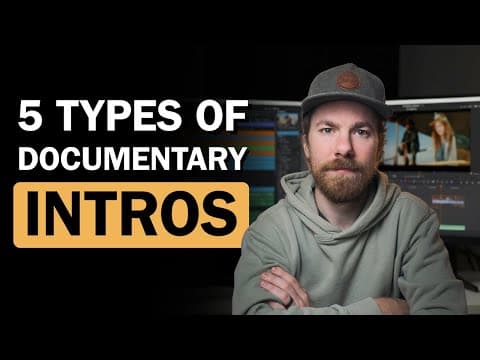
The 5 Types of Documentary Intros (And How to Find Yours)
Mark Johansson
10m 45s1,868 words~10 min read
YouTube auto captions
Transcript source
YouTube auto captions
This transcript was extracted from YouTube's auto-generated caption track. The transcript below is server-rendered so it can be read, searched, cited, and shared without opening the original YouTube player.
Pull quotes
[0:00]I mean, you basically have to take a total stranger and convince them in 10, maybe 20 seconds if you're lucky, that your film, amongst the sea of other films out there, is going to be worth their time.
[0:00]Today, I want to demystify the art of making great documentary intros by breaking down the five most common types of intros and the mechanics of how they actually hook the audience and keep them watching.
[0:00]To do that, I'm going to walk you through a documentary I edited called Lando Steey.
[0:00]and they do so with the following five approaches: spectacle, contradiction, stakes, mystery, and character.
Use this transcript
Related transcript hubs
Watch on YouTube
Share
MORE TRANSCRIPTS


