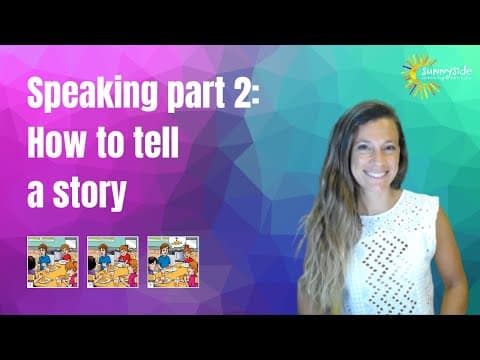
[0:00]Hi there. I hope you're ready to keep learning with us. Today I will teach you how to tell a story by looking at pictures.
[0:12]The day of the exam, the examiner will show you four pictures like this.
[0:24]They will introduce the title of the story and they will give you the name of the characters as well. They will say something like, "These pictures show a story. It's called Fred loves food." Look at the pictures first. Fred is at home with his family. They are in the kitchen, and his mom is giving him his dinner. Now, you continue with the story. In order to do this, you have to consider one thing. The story must be told in the present, that is to say, in the simple present or in the present continuous. Do not use the past here, or it will be rather confusing.
[1:06]One good way to start telling the story is by focusing on the main characters' actions, in this case, Fred. Let's look at picture number two. What is Fred doing? Why is he doing this? And from these actions, pay attention to the other characters' reactions. For example, in picture number three, have a look at Fred's sister. How is she feeling? Is she happy? Is she surprised and why? And the same thing can be done with picture number four. But this time, you will have to pay attention to Fred's father. Knowing this, the story could be told like this. Fred's family is having dinner. Fred is very hungry and he's finishing his chips. His dad is talking to his mom. Fred is still hungry. He's eating his father's chips. Fred's sister is very surprised. Fred's father is looking at his plate. He can't find his chips. He looks surprised. Fred's sister is laughing. Fred is not hungry anymore. Now it's time for you to use your imagination and practice all the tips that I have just given you. I will show you four new pictures for you to put into practice your storytelling skills. If you like this video or you find it useful, don't forget to subscribe, like the video and follow us on Instagram. Here are your four


