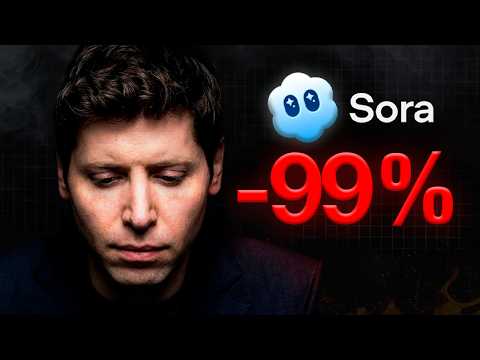
[0:00]You've probably read the headlines. Open AI released Sora 2, the newest, most advanced video generator, but in just 30 days, user retention dropped to just 1%. But that's just the beginning. Something strange is happening in the world of AI. After Microsoft announced big AI spending, their market cap fell by $360 billion in just one day. CEOs are pleading with people to stop being so negative. And people just aren't using AI tools like they used to. What's happening? Is this giant experiment finally, finally about to come crashing down?
[0:46]In January 2026, Satya Nadella, CEO of Microsoft said, "For this not to be a bubble by definition, it requires that the benefits of this are much more evenly spread. A telltale sign of if it's a bubble would be if only tech groups were benefiting from the rise of AI, rather than companies in other sectors." He also asked people to stop calling AI slop. Pretty weird things to say if you spent $200 billion since 2024. Jensen Huang is also doing something similar. I think we've done a lot of damage with very well respected people who have painted a doom narrative, and the world narrative, science fiction narrative. It's not helpful to people, it's not helpful to the industry, it's not helpful to society, it's not helpful to the governments. So, why are the faces of AI suddenly so insecure about AI? Well, it gets much weirder. If you've been tracking Big Tech lately, you've probably noticed this. Nvidia for the past several months has actually just been going sideways. And some AI plays have been tumbling hard, like Oracle. After they peaked with their big OpenAI deal, their stock has fallen over 50% in the last five months. But the worst might be in Microsoft's most recent earnings report. This was a great earnings report. Azure Cloud grew 39% and revenue was up 17% to $81.3 billion this quarter alone. Both of those were higher than expectations. But after they announced this, Microsoft's market cap fell $360 billion in one day. Even though revenue was higher than expected, after a week, their market cap had fallen by over 500 billion. What happened? Well, their capital spend was up 66%. 37.5 billion spent in just one quarter. Two thirds of it was on chips, GPUs and CPUs. Spending for AI. It turns out that investors aren't actually happy about the AI money pit. "One big obvious issue is that revenues are up 17% and the cost of revenues are up 19%. So if that is a new long-term trend, that is one of my concerns," said Eric Clark, portfolio manager of the Logo ETF, which holds Microsoft shares. And the results of Microsoft's big AI projects are even more confusing. Right after, Oracle announced a plan to spend 50 billion on AI in 2026 and their stock fell. Investors have grown wary of the rising costs for Oracle's AI push and the time needed to see payback. But something that makes all this worse is Nvidia. Their original plan last year was to invest up to $100 billion into OpenAI. But just recently, Huang's walking that back and said, "No, no, nothing like that, and that the agreement was non-binding and not finalized." OpenAI is the biggest customer, which is why all these companies pour billions into it, but OpenAI doesn't have any money. According to the Wall Street Journal, privately Huang has criticized what he has described as a lack of discipline in OpenAI's business approach and expressed concern about the competition it faces from the likes of Google and Anthropic. Revenue passed $20 billion in 2025, up $6 billion from 2024, but its total cash flow projection is, wait for it, negative $143 billion. They don't expect to be profitable until 2030, and they might run out of money by 2027. These are essentially OpenAI suppliers who are funnelling money into their biggest customer who will send it back to them for cloud, GPUs and other things to keep Chat GPT alive. Amazon, Nvidia and Microsoft are talking about investing $60 billion into Open AI. But this is barely enough to feed this monster with an endless hunger. This whole system is beginning to wobble, and it's not just investors who are worried. Senator Elizabeth Warren wrote that OpenAI has committed to more than a trillion dollars in spending, despite not yet turning a profit and appears to be seeking government assistance should it prove unable to pay its bills. Ironically, it's something that both Democrats and Republicans seem to agree on. The government does not want to bail out the startup that needs unlimited money. OpenAI denied this, though confidence wasn't helped by their CEO suggesting taxpayers should backstop the company's heavy infrastructure investments even if she quickly walked it back. But OpenAI, Microsoft, and Nvidia have another bigger problem, which is making investors question this entire gamble. Is there a world where the bubble bursts and AI disappears altogether? I don't think so, but there is something Jensen Huang said that I do agree with. reason from first principles, not surprisingly, the number of radiologists have gone up. A radiologist, their job, the purpose of their job is to diagnose disease, to help patients diagnose this. That's the purpose of their job. The task of the job includes studying scans. The fact that they're able to study scans now infinitely fast allows them to spend more time with patients. More than changing the entire world, AI has brought quantum leaps to small individual worlds. AI has produced breakthroughs in predicting protein structures, which dramatically increases how fast we can discover new medicine. It's helping us detect breast cancer earlier. It's allowing us to forecast weather, floods, and storms faster. AI is being used to understand the alphabet and language of whales. Anthropic was even used to help NASA with the Martian Rover. Where AI can help professionals do their job better, I think is a great use for AI. Unfortunately, many CEOs saw AI as a way to reduce cost and thus reduce workers. And for this to make a real return for these companies, I think they need the hype curve to look like this. We seem to have two different approaches with AI that these are going to flip the world upside down, produce some kind of post-work utopia, and every industry will change. And the other more sober view that these products will simply help us achieve more, but can't replace work altogether. As an investor, I am now avoiding companies that bet on AI tourists, users seeking dopamine and entertainment. But AI doesn't stop here, and thank you Cape. Remember to subscribe for more.


