[0:00]Welcome to Anatomy Files, where science unlocks secrets. Imagine you take a bite of a hot cheesy pizza slice. But have you ever wondered what magical journey that slice takes inside your body from the mouth to the stomach and small intestine? It's a scientific marvel that fuels your body and powers your life. If you want to know how our stomach digests food, this video is for you. Welcome to Anatomy Files, where we unravel the mysteries of the human body in a simple and fascinating way. So how does our stomach digest food? When we eat food, it embarks on the long, complex journey through an approximately 30 ft long digestive tract. This system is a powerhouse of our body, working silently every day. Its purpose is to extract nutrients like carbohydrates, proteins, fats, vitamins, and minerals that fuel our cells for energy, growth, and repair. The digestion journey starts in the mouth, and it's not just about chewing. When you break food with your teeth, you turn it into smaller pieces to make digestion easier. But the real science begins with saliva. Your mouth has three major salivary glands, parotid, submandibular, and sublingual, that produce about 1 to 1 and 1/2 liters of saliva daily. This saliva contains an enzyme called amylase, which starts breaking down carbohydrates. For example, if you're eating a pizza or sandwich, amylase converts its starch into simple sugars like glucose. This process is so fast that the food might taste sweeter if you chew it longer. Saliva doesn't just digest; it also softens and lubricates food to make swallowing easier. Plus, it protects your teeth from germs and keeps your mouth clean. Then, when you swallow, the food travels through the esophagus to the stomach. The esophagus is a muscular tube that pushes food downward through a process called peristalsis. Think of it like squeezing a toothpaste tube. All this happens in just a few seconds, and the food reaches the stomach's doorstep. Now we're in the stomach, the powerhouse of the digestive system. The stomach is like a muscular sack that can hold about one liter of food. This is where the real digestion happens. The stomach releases hydrochloric acid and enzymes like pepsin. Hydrochloric acid is so powerful that it kills germs in the food and prepares it for digestion. Pepsin breaks proteins into smaller peptides. For example, if you eat a steak or chicken burger, its proteins start breaking down here. The stomach's muscular movements mix and grind the food, turning it into a thick liquid called chyme. This process takes 2 to 4 hours. But if you've eaten a heavy meal like a pizza or steak, it can take up to 6 hours. The stomach's acidity, pH 1 to 3, makes it a machine that breaks down food and protects against germs. But did you know the stomach produces a thick mucus layer to protect its walls from this acid? If this layer weakens due to stress, spicy foods, or excessive medications, issues like ulcers or heartburn can occur. That's why doctors always say, eat a healthy diet, eat smaller portions, and chew well. From the stomach, chyme enters the small intestine, the most critical part of digestion. The small intestine is about 20 feet long, but its inner surface is so intricately designed that if spread out, it would cover the size of a tennis court. Its walls have tiny villi-like structures called villi, which increase nutrient absorption capacity tenfold. Three key players work here: the pancreas, liver, and gallbladder. The pancreas produces enzymes like amylase for carbohydrates, lipase for fats, and trypsin for proteins. The liver makes bile, which is stored in the gallbladder and released into the small intestine. Bile breaks fats into tiny droplets, like soap removing oil stains, so lipase can digest them. For example, if you eat pizza with extra cheese, bile breaks down the cheese's fats. In the small intestine, carbohydrates turn into sugars, proteins into amino acids, and fats into fatty acids and glycerol. These nutrients are absorbed into the blood or lymph and reach the body's cells, where they're used for energy, growth, and repair. This process takes 3 to 6 hours, but if the small intestine doesn't function properly, like in celiac disease, where gluten causes damage, or lactose intolerance, nutrient deficiencies, abdominal pain, or diarrhea can occur. For example, if you drink milk and your small intestine doesn't produce lactase enzyme, you might experience bloating or gas. That's why some people opt for lactose-free milk. So let's summarize: saliva in the mouth breaks down food. The stomach turns it into chyme, and the small intestine absorbs nutrients. This system fuels our body, but if you eat too many fatty foods or have small intestine issues, digestion can be affected. That's why a balanced diet with fiber, protein, and healthy fats is crucial. So that was the incredible process of how the stomach and small intestine digest food. Comment with what body mysteries you want to explore next, and subscribe to catch more medical marvels with Anatomy Files.
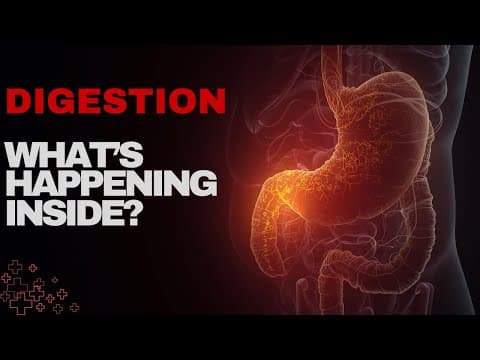
How Digestion Really Works | Real Human Stomach & Small Intestine 3D Animation
Anatomy Files
6m 9s850 words~5 min read
YouTube auto captions
Transcript source
YouTube auto captions
This transcript was extracted from YouTube's auto-generated caption track. The transcript below is server-rendered so it can be read, searched, cited, and shared without opening the original YouTube player.
Pull quotes
[0:00]But have you ever wondered what magical journey that slice takes inside your body from the mouth to the stomach and small intestine?
[0:00]Welcome to Anatomy Files, where we unravel the mysteries of the human body in a simple and fascinating way.
[0:00]When we eat food, it embarks on the long, complex journey through an approximately 30 ft long digestive tract.
[0:00]Its purpose is to extract nutrients like carbohydrates, proteins, fats, vitamins, and minerals that fuel our cells for energy, growth, and repair.
Use this transcript
Related transcript hubs
Watch on YouTube
Share
MORE TRANSCRIPTS


