[0:00]Study of language, chapter 18, Regional Variation in Language.
[0:11]A language can exhibit variations such as variations in spoken English across Australia, Britain, and the USA, as well as regional variations within these countries, such as Hawaiian English. We investigate the aspects of language variation based on linguistic geography. First, we should identify the particular variety that we have normally assumed when we referred to a language as English, Spanish or Swahili.
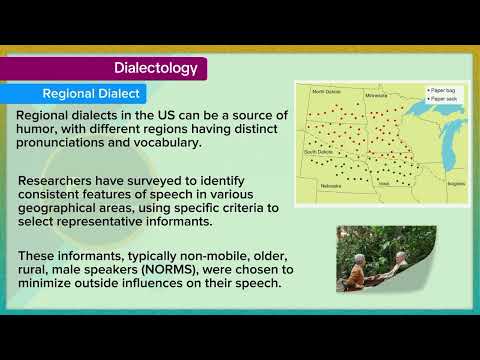
[0:44]The Standard Language. The Standard Language refers to an idealized variety of a language that is not specific to any region and government, and is often used in writing and public broadcasting. It is the variety taught in schools and to non-native speakers. While standard language is often considered the norm, there are variations of standard language in different regions, such as Standard American English, Standard British English, and Standard Australian English. These regional variations share common features with standard language but also have distinct characteristics. Dialectology. The study of dialects is called dialectogy. Despite some challenges, speakers of different English dialects generally understand each other, a key factor in distinguishing dialects from languages. This mutual intelligibility doesn't necessarily define a dialect, but it highlights the equal value of each dialect for linguistic analysis. While linguistically, no dialect is inherently superior, socially, some dialects gain prestige, often due to association with economic and political power centers (e.g., London for British English). Nevertheless, regional variations persist, coexisting with standard languages. Accent and Dialect. It is a myth that some speakers have accents while others do not. Every language-users speak with an accent, however, some speakers have very distinct or easily recognized types of accent while others may have more subtle or less noticeable accents. Accents refer to the unique pronunciation features that identify a speaker's regional or social origin. Accents differ from dialects, which encompass grammar, vocabulary, and pronunciation characteristics. The example sentence: "You don't know what you're talking about" illustrate the difference that the first sentence is written in Standard English but can be spoken with various accents like that of American or Scottish accent, etc. While the second sentence: "Ye dinnae ken whit yer haverin aboot" is written in a Scottish dialect, showing distinct vocabulary as "ken, haverin", and grammar "dinnae, yer", and pronunciation as "ye, whit and aboot". Variation in Grammar. We can easily recognize the differences in vocabulary, however the dialect variations in the meaning of grammatical constructions are less frequently documented. In a conversation in Donegal, Ireland, a local Irish English speaker A asks two British English visitors B and C: "How long are youse here?" This in speaker A's dialect means; "How long have you been here?" (in past). However, B misunderstands and answers as if the question meant "How long will you stay?" (in future). C clarifies by answering in past tense "We came on Sunday" and A acknowledges it, using the present tense "Youse're here" to refer to past time, showcasing dialect differences in grammatical constructions and vocabulary as youse = plural "you". Regional Dialect. Regional dialects in the US can be a source of humor, with different regions having distinct pronunciations and vocabulary. Researchers have surveyed to identify consistent features of speech in various geographical areas, using specific criteria to select representative informants. These informants, typically non-mobile, older, rural, male speakers (NORMS), were chosen to minimize outside influences on their speech. While this approach may result in descriptions that are less representative of contemporary speech, it has led to the creation of detailed linguistic atlases for countries and regions, providing valuable insights into dialect variation. Isoglosses and dialect boundaries. An Isogloss is a line on a map separating two areas in which a particular linguistic feature is significantly different, used in the study of dialect. The Linguistic Atlas of the Upper Midwest US surveyed regional language variations, identifying differences in speech patterns across areas.
[5:42]Researchers drew isoglosses, on a map to separate areas based on specific linguistic features, such as us of: "Paper bag" VS "Paper sack" or "Pail" VS "bucket". These isoglosses helped define dialect areas, including the Northern dialect (Minnesota, North Dakota, South Dakota, and Northern Iowa) and the Midland dialect (Iowa and Nebraska). Pronunciation and vocabulary differences between these dialects show that speakers from different regions have distinct language characteristics. While individual variations exist. So, if a speaker born in a specific Linguistic geography pronounces a word the way which is not pronounced by the majority of the people living in that area, then he is not likely to have grown up and spent most of his life in that particular area. The dialect continuum. The gradual merging of one regional variety of a language into another is called the Dialect Continuum. Dialect boundaries are gradual transitions rather than sharp divisions. Dialects often merge into one another, forming a continuum of regional variation. This is similar to the transition between related languages across political borders, like Dutch and German. Speakers in these areas may be bidialectal, using different varieties with ease. Bidialectalism is common, as many people use one dialect in informal settings and another in formal settings, like school. This is similar to the transition between related languages across political borders, like Dutch and German. In some cases, people may speak one language at home and another in school, making them bilingual. This nuanced understanding of dialects and languages helps us better appreciate the complexity of language use in different regions. Bilingualism and Diglossia. Regional variation involve distinct languages, not just dialects.
[8:07]Canada, for example, has both French and English as official languages, with French speakers in Quebec having had to fight for linguistic rights. In such situations, individual bilingualism is common, especially among minority groups. Bilingualism can also occur when parents speak different languages, with one language often becoming dominant. Diglossia is a special situation where two varieties of language coexist, with a "low" variety for everyday use and a "high" variety for formal occasions, like Classical Arabic in Arabic-speaking countries. Historically, Latin was the "high" variety in Europe, with local languages like Italian, French, and Spanish being the "low" varieties. Language planning. Many countries are assumed to be monolingual, but in reality, they have significant minority bilingual groups. The US, for example, has large Spanish-speaking populations, and Guatemala has 26 Mayan languages spoken alongside Spanish. This diversity raises questions about language planning, such as which language to use in education and government. Countries like Israel, India, and the Philippines have faced challenges in selecting an official language, while Tanzania has successfully implemented Swahili as its national language through a gradual process of selection, codification, elaboration, implementation, and acceptance. This process involves establishing a standard variety, developing it for use in all aspects of life, encouraging its use, and eventually achieving widespread acceptance as a symbol of national identity. Pidgins and Creoles. Pidgin is a variety of a language that developed for a practical purpose such as trade, but which has no native speakers. Creole on the other hand is a variety of a language that developed from a pidgin and is used as a first language by a population of native speakers. Pidgins, like "Tok Pisin" in Papua New Guinea, can develop into creoles, which become the first language of a community and are more complex. Creoles, like Hawai Creole English and French creole in Haiti, have large numbers of native speakers and are used in various contexts. Pidgins and creoles have distinct grammatical structures and vocabulary, often borrowing from source languages like English, but with modifications. Over time, pidgins can evolve into creoles, with vocabulary elements becoming grammatical elements, and structure simplifying or changing.
[11:15]The Post-Creole Continuum. Creoles can evolve and change over time, some speakers shift away from creole forms and structures towards a more standard variety of the language. This process is called Decreolization. The Post-Creol Continuum is the range of varieties that evolves in communities where a creole is spoken, usually as a result of decreolization. Speakers may use different varieties depending on the situation, and their choices are often tied to social values and identity. In Jamaica, for example, speakers may use different varieties of Jamaican Creole or Standard English, depending on the context. Chapter completed. We also have solved the study questions of this chapter from Yule's, The Study of Language. Link for the study questions is given in the description of this video. See you in the next chapter. Goodbye.