[0:08]Hello, and welcome to 6 Minute English from BBC Learning English. I'm Beth. And I'm Neil. Today, we're going to talk about climate change and how it can affect people's mental health. Natural disasters and the impacts of climate change can be stressful, isn't that right, Beth? Yeah, definitely. In today's episode, we're going to find out about how people can protect their mental health from the impacts of climate change. We'll be hearing from a psychiatry expert and a man who survived a wildfire and helped rebuild his town. But first, Beth, I have a question for you. Scientists aren't always sure whether natural disasters, like floods and wildfires, are as a result of human caused climate change. But in January 2025, big wildfires affected big parts of Los Angeles in California. But according to the research organization World Weather attribution, human caused climate change made the fires A, 10% more likely, B, 35% more likely, or C, 20% less likely? Um, I'm going to say 10% more likely. Okay. Well, we'll find out the answer at the end of the program. Now, natural disasters like floods and wildfires can destroy homes and communities. People who live in areas affected by natural disasters can often experience climate trauma. Trauma is what we call the very bad and long-lasting emotional effects of an event or experience. Professor Jyoti Mishra is an expert in climate trauma at the University of California. She explained more about the condition to Gray Jackson, host of BBC World Service program, The Climate Question. Climate trauma is not an individual trauma, it's a community-wide trauma, which really requires community-wide healing. Yeah, I'm really struck by what you've said about the fact that it's whole communities that are affected, not individuals, but also part of the solution is about the community and how it rebuilds and re-knits together. Absolutely. Yes. So we found that individuals who have a greater sense of positive support from their family and a greater sense of meaningful connection with their community, they are in general more resilient. Jyoti's research on climate trauma has found that it affects communities rather than individuals. Host of the program, Gray Jackson is struck by what Jyoti says. If you're struck by an idea, you find it particularly interesting or impressive. Gray says that part of the solution to climate trauma could be in how the community re-knits together. This means how the social connections in a community are restored. We can often describe a community as close-knit, which means everyone helps and supports each other. Jyoti explains that having a strong community also helps reduce or heal climate trauma. She says that research has found that people who have a strong community are more resilient when bad things like natural disasters happen. If you're resilient, you're able to get better more easily after something difficult or bad happens. One person who had to be resilient is Brad Sherwood. He survived a wildfire in Northern California in 2017 called The Tubspire. But when he returned home, his neighborhood was destroyed. Brad started to volunteer for a local support network called After the Fire to try to rebuild his community. As he explained to BBC World Service program, The Climate Question. The silver lining in all this is, I mean, if it wasn't for the Tubbs Fire, we wouldn't be working as a community right now to build a new community plaza. We were a close community before the Tubbs, but afterwards, we are so much stronger and resilient. And I, I think our children are as well. They can jump over any hurdle. Brad says that the work to rebuild and improve his community is the silver lining to the fire. The expression silver lining means a positive thing but comes from a negative situation. Brad's community became more resilient after the fire, including the children. He says that they can jump over any hurdle. We can describe challenges or difficult things in life as hurdles. And it's quite inspiring, I think, to hear how Brad has taken a bad situation and tried to stay resilient. Now, the organization that Brad volunteers for, after the Fire, are helping those impacted by the fires in LA in January. Which reminds me, I asked you, Beth, about the impacts of human-made climate change on the wildfires in LA in January. And I said 10% more likely. Which was, I'm afraid, the wrong answer. It was actually 35%. Wow. Okay. Well, let's recap the vocabulary we've learned, starting with trauma, which is what we call the very bad and long-lasting emotional effects of an event or experience. If you're struck by an idea or something someone has said, you find it particularly interesting or impressive. If a community re-knits together, it becomes closer again. And a close-knit community is where everyone looks after each other. Resilient means able to get better more easily when bad things happen. A silver lining is a positive thing that comes from a negative situation. And we can describe challenges or difficult things in life as hurdles. Once again, our six minutes are up, but why not try the interactive quiz on our website to test what you've learned. And we have a free worksheet as well. Just visit BBC learningenglish.com. Thanks for listening and goodbye. Bye.
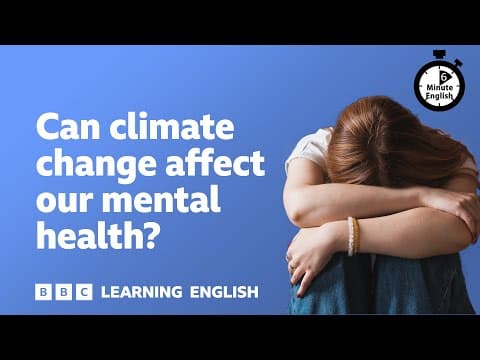
Can climate change affect our mental health? ⏲️ 6 Minute English
BBC Learning English
6m 7s892 words~5 min read
YouTube auto captions
Transcript source
YouTube auto captions
This transcript was extracted from YouTube's auto-generated caption track. The transcript below is server-rendered so it can be read, searched, cited, and shared without opening the original YouTube player.
Pull quotes
[0:08]Today, we're going to talk about climate change and how it can affect people's mental health.
[0:08]Natural disasters and the impacts of climate change can be stressful, isn't that right, Beth?
[0:08]In today's episode, we're going to find out about how people can protect their mental health from the impacts of climate change.
[0:08]We'll be hearing from a psychiatry expert and a man who survived a wildfire and helped rebuild his town.
Use this transcript
Related transcript hubs
Watch on YouTube
Share
MORE TRANSCRIPTS


