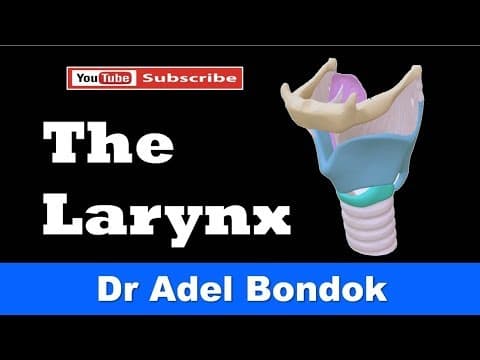
[0:40]Good morning. This is Dr. Adel Bondok, Professor of Anatomy and Neuroscience, Mansoura University, Egypt. Today I will talk about the anatomy of the larynx and its nerve supply and injuries of the laryngeal nerves. The objectives of this presentation are, first, skeleton of the larynx, formed of cartilages and joints. Then we'll talk about the membranes and ligaments and the laryngeal inlet, the inlet between or the communication between the pharynx and the larynx. And then we'll talk about the laryngeal cavity and muscles of the larynx, blood supply, nerve supply, and lymph drainage. Regarding the muscles of the larynx, we have two types of muscles: extrinsic muscles and intrinsic muscles. Extrinsic muscles move the larynx up and down. Intrinsic muscles act on vocal cord and inlet.
[1:45]Regarding the extrinsic muscles, we have elevators and depressors. Elevators elevate the larynx up. Depressors move the larynx down. So, elevators are the suprahyoid muscles. Depressors are the infrahyoid muscles. They move the larynx up and down during swallowing. Intrinsic muscles act on the vocal cord and laryngeal inlet. Acting on the vocal cord, they move the vocal cord in four directions: adduction, abduction, elongation, and shortening. And then laryngeal inlet, either closure or opening. Start by the skeleton of the larynx.
[2:37]The larynx is formed of nine cartilages: three single and three paired. So, three single cartilages and three paired cartilages. The three single cartilages are the midline cartilages. The largest one is the thyroid cartilage. Below the thyroid cartilage, we have a ring-shaped cartilage, this one, cricoid cartilage. And behind the thyroid cartilage, the epiglottis. So the three single cartilages: thyroid, cricoid, and epiglottis. The three paired cartilages, right and left. The first one is the arytenoid. On the top of the arytenoid, corniculate. On the top of the corniculate cuneiform. Let us give some information about each one. Okay, thyroid cartilage, this is the thyroid cartilage, this is the thyroid cartilage. It is the largest one. It is formed of two laminae, this one and this one. And each lamina has superior horn and inferior horn.
[3:57]And each lamina has this line, oblique ridge or oblique line for muscle attachment. The upper border of the thyroid cartilage, this is the upper border, forms the thyroid notch. This is the thyroid notch. Below the thyroid notch, the laryngeal prominence or Adam's apple. So Adam's apple is the laryngeal prominence. Adam's apple or the laryngeal prominence is more prominent in males than in females. That's why the vocal cord is longer in males than in females. Second one is the cricoid cartilage. This is the cricoid cartilage. Cricoid cartilage is ring-shaped cartilage. It has anterior narrow arch and posterior wide arch. This is the posterior arch and this is the anterior arch. The cricoid cartilage forms two joints. One with the thyroid cartilage, this one, and one with the arytenoid cartilage. So, we have cricothyroid joint, this one, this one, and cricoarytenoid joint, this one, this one. So, two joints: cricothyroid and cricoarytenoid. Cricothyroid joint is hinge joint, synovial. The two are synovial. Cricothyroid is synovial hinge variety. It permits or it adjusts the tension of the vocal cord of the vocal cord.
[5:46]Cricoarytenoid joint permits rotatory movement. It is ball and socket synovial joint. It permits adduction and abduction of the vocal cord. Third one, third important one is this one, arytenoid cartilage. This arytenoid cartilage is pyramidal in shape. It has apex and two processes. The apex is related to the corniculate cartilage, this one. And the two processes, one for muscle attachment and one for the attachment of the vocal cord. So two processes: muscular process, this one, and vocal process. Muscular process is lateral and it is for attachment of muscles. Vocal process is anterior and for the attachment of the vocal cord.
[6:45]So we finished with the skeleton of the larynx. Then the membranes of the larynx, membranes. We have two types of membranes: external membranes and internal membranes. Three external membranes and two internal. The three external membranes, this is the first one. External membranes, three external membranes. This is the first one, thyrohyoid membrane.
[7:17]This is the second one between the cricoid and the thyroid, cricothyroid membrane. And this is the third one between the cricoid and trachea. First ring of the trachea, cricotracheal membrane. So the external membranes are thyrohyoid membrane, cricothyroid membrane, cricotracheal membrane. The thyrohyoid membrane is pierced by two structures. Pierced by nerve and blood vessels. The nerve is the internal laryngeal nerve, branch from the vagus, or actually branch from the superior laryngeal branch of the vagus. And this artery and vein, superior laryngeal vessels.
[8:12]So the external membranes, thyrohyoid membrane, cricothyroid membrane, cricotracheal membrane. The thyrohyoid membrane is pierced by the internal laryngeal nerve and superior laryngeal vessels, artery and vein. Then two internal membranes, upper and lower. The upper one is called quadrangular membrane. This is the quadrangular membrane.
[8:43]The quadrangular membrane, the upper border of the quadrangular membrane, this one, this is the upper border of the quadrangular membrane, forms aryepiglottic fold. Aryepiglottic fold. The lower border of the quadrangular membrane forms the vestibular fold. So the first membrane, quadrangular membrane. Upper border forms aryepiglottic fold. Lower border forms vestibular fold. Second one, this one, cricothyroid membrane. Okay, cricothyroid, between the cricoid and thyroid. This cricothyroid membrane or cricothyroid ligament, okay, the upper border, this is the upper border, forms the vocal cord.
[9:49]Again, two membranes. This is the first one, this is the second one. The first one, okay. So the internal membranes are located beneath, deep, to the mucous membrane. So the first one is the quadrangular membrane, upper part. Quadrangular membrane between epiglottis and arytenoid. Upper border forms aryepiglottic fold. Lower border forms the vestibular fold.
[10:24]Second membrane, cricothyroid membrane, the lower part. Cricothyroid ligament between cricoid and arytenoid and thyroid cartilage. The upper border forms the vocal cord. Again, two membranes. Quadrangular membrane. This is the quadrangular membrane.
[10:55]The upper border forms aryepiglottic fold. The lower border forms the vestibular fold. Second one, cricothyroid, or cricovocal ligament.
[11:13]This one. And the upper border forms the vocal cord or the vocal fold.
[11:30]Therefore, we have two ligaments or two folds on each side. This is the first one, this is the vestibular fold which is the lower border of the quadrangular membrane. Second one is the vocal fold, okay, the space between the two vestibular folds is called rima vestibuli. Second one, the vestibular fold, which is upper border of cricothyroid membrane. And the space between the two vocal folds is called rima glottidis. So again, we have two folds: vestibular and vocal. The vestibular is the lower border of the quadrangular membrane. The vocal is the upper border of cricothyroid membrane. The space, the red space between the vestibular folds is called rima vestibuli. The space between the vocal folds or the vocal cords is called rima glottidis. Rima vestibuli is located above rima glottidis. Rima vestibuli is wider than rima glottidis.
[12:54]Then we'll talk about the laryngeal inlet. This is the laryngeal inlet. The communication between the pharynx and the laryngeal cavity. We'll talk about the boundaries. Anterior boundary is the epiglottis. This is the anterior boundary. Posterior boundary is the arytenoid and interarytenoid fold.
[13:20]Actually, on the top of the arytenoid, this is the corniculate tubercle and this is the cuneiform tubercle. Okay? So posteriorly arytenoid and interarytenoid fold. And on each side, aryepiglottic fold. So the boundaries of the laryngeal inlet: anteriorly epiglottis, posteriorly arytenoid and interarytenoid fold. On each side, aryepiglottic fold. Then we'll talk about the laryngeal cavity. This is the laryngeal cavity. The features in the laryngeal cavity are two folds on each side. Okay? And two spaces in the midline, this space and this space. And two compartments on each side: one, two, three.
[14:16]The two folds on each side: the vestibular and the vocal. So vestibular fold above and vocal fold below.
[14:31]Remember, the vestibular fold is the lower border of the quadrangular membrane. The vocal fold is the upper border of cricothyroid membrane. Then two spaces in the midline: the space between the two vestibular folds, rima vestibuli. Yes, and the space between the vocal folds is rima glottidis.
[14:57]And then three compartments on each side. This is the upper compartment, is called vestibule, or supraglottic space, above the vestibular fold. Second compartment, between the vestibular and vocal folds, is called ventricle. And the third compartment below the vestibular fold, below the vocal fold, is called infraglottic space.
[15:45]Again, cavity of the larynx. Two folds on each side, this one and this one. This is the vestibular fold and this is the vocal fold. Two spaces in the midline, space between the vestibular folds, rima vestibuli. And space between the vocal folds, rima glottidis. And then three compartments on each side: this is the vestibule and this is the ventricle, and this is the infraglottic space.
[16:29]Then we'll talk about the functions of the larynx. The larynx has four important functions. The first function is respiration. And during inspiration, the vocal cords are abducted to open rima glottidis for air.
[16:58]Second function is phonation, production of sound. And during phonation, the vocal cords are adducted to force the air between the two cords and produce sound. Third function, protection by the epiglottis. The epiglottis actually closes the laryngeal inlet during swallowing. And also protection by cough reflex.
[17:46]Then we'll talk about the muscles of the larynx. Muscles of the larynx, as I said, extrinsic muscles and intrinsic muscles. Extrinsic muscles move the larynx up and down. So elevators: suprahyoid muscles. And depressors: infrahyoid muscles. We have four elevators of the larynx: first one is mylohyoid muscle. This is the mylohyoid. Second one is geniohyoid. This is the geniohyoid. And this is the stylohyoid muscle. And this is digastric. So the four muscles: mylohyoid, geniohyoid, stylohyoid, and digastric. They elevate the hyoid bone. Depressors: infrahyoid muscles. The first one between the sternum and the hyoid bone, sternohyoid. Second one between the sternum and oblique line of thyroid cartilage, it is the sternothyroid. And between the hyoid bone and the scapula, it is the omohyoid. So extrinsic muscles are elevators and depressors, suprahyoid and infrahyoid muscles. Now we'll talk about the intrinsic muscles of the larynx. Intrinsic muscles of the larynx are divided into two. Muscles acting on the vocal cord and muscles acting on the laryngeal inlet. This is the laryngeal inlet, this is the laryngeal inlet. Muscles acting on the vocal cord in four directions: abduction, move the vocal cords away from the midline. Adduction, move the vocal cord towards the midline. Tension, tensor, elongation of the vocal cord. Relaxation, shortening of the vocal cord. Muscles acting on the laryngeal inlet either open the inlet or close the inlet. Start by muscles acting on the vocal cord. Abduction. Adduction.
[20:20]Abduction. The only one muscle, this one, posterior cricoarytenoid muscle. This posterior cricoarytenoid muscle is called muscle of life. Because paralysis of the posterior cricoarytenoid causes abduction of the vocal cord and stridor if the paralysis is bilateral. So the first muscle acting on the vocal cord is the posterior cricoarytenoid muscle. This muscle abduct the vocal cord. Then adduction. We have two muscles: lateral cricoarytenoid and interarytenoid or transverse arytenoid.
[21:14]So adduction of the vocal cord is produced by posterior cricoarytenoid. Adduction of the vocal cord by lateral cricoarytenoid and interarytenoid or transverse arytenoid muscle. Then we have elongation and shortening. Tensor of the vocal cord or lengthening of the vocal cord. By the cricothyroid muscle. And then relaxation or shortening of the vocal cord by two muscles. Tensor or elongation of the vocal cord by cricothyroid muscle. So actually the cricothyroid muscle increases the pitch of sound.
[22:04]Shortening or relaxation, thyroarytenoid muscle and along the upper border of the thyroarytenoid muscle is the vocalis muscle. So relaxation or shortening: two muscles, vocalis and thyroarytenoid. Muscles acting on the laryngeal inlet: closure, aryepiglottic muscle and this aryepiglottic muscle is called oblique arytenoid.
[22:39]And opening by thyroepiglottic muscle. So closure and opening. Then the nerve supply of the larynx. The larynx is supplied by two nerves, the laryngeal nerves. Superior laryngeal nerve from the vagus, and recurrent laryngeal nerve from the vagus too.
[23:10]Superior laryngeal nerve divides into two branches: one motor and one sensory. External laryngeal nerve, which is motor and it supplies the cricothyroid muscle, this one. Second one is sensory, internal laryngeal nerve. This internal laryngeal nerve pierces the thyrohyoid membrane to supply the mucous membrane above the vocal cord, sensory. So the first branch, superior laryngeal nerve, divides into external laryngeal and internal laryngeal nerves. Second one recurrent laryngeal nerve. This recurrent laryngeal nerve, it supplies all the muscles of the larynx except cricothyroid. And it supplies the mucous membrane below the vocal cord. Again, nerve supply of the larynx from the vagus. Laryngeal nerves. So we'll talk about motor and sensory. Motor from the vagus nerve to the intrinsic muscles. Sensory also from the vagus.
[24:22]Motor: we have two nerves. Cricothyroid muscle: external laryngeal nerve. All the other muscles: recurrent laryngeal nerve. Sensory: above the vocal cord and below the vocal cord. Above the vocal cord: internal laryngeal nerve (superior laryngeal nerve). Below the vocal cord: recurrent laryngeal nerve. So nerve supply motor and sensory for the vagus. Motor nerve supply: cricothyroid by the external laryngeal branch. All the other muscles by the recurrent laryngeal branch. Sensory: above the vocal cord internal laryngeal nerve. Below the vocal cord recurrent laryngeal nerve. Then we'll talk about laryngeal nerve paralysis. Laryngeal nerve paralysis: two main causes. Thyroid and parathyroid gland surgery, because the external laryngeal nerve and recurrent laryngeal nerve are closely related to the thyroid and parathyroid gland. Second cause: think about nuclear lesion in the brain. Lesion in nucleus ambiguus, part of lateral medullary syndrome.
[25:48]So start by superior laryngeal nerve lesion. In superior laryngeal nerve lesion, or recurrent laryngeal nerve lesion, we should know two points: What are the structures paralyzed and what is the effect on the vocal cord? So superior laryngeal nerve lesion will lead to motor and sensory. Paralysis of the cricothyroid muscle and sensory loss above the vocal cord. This is the external laryngeal branch, this is the internal laryngeal branch. What is the effect on the vocal cord? Remember, cricothyroid elongates or tenses the vocal cord. So loss of tension of the vocal cord, it causes shortening of the vocal cord. Then recurrent laryngeal nerve lesion. It leads to and what is the effect on the vocal cord?
[26:55]In recurrent laryngeal nerve lesion, we have two types of lesion: either complete cut or crushing or partial injury. In complete cut, I'll talk about unilateral. In complete cut, it will result in paralysis of all muscles of the larynx except cricothyroid muscle on one side.
[27:21]Unilateral complete cut. In unilateral partial crush lesion, it is injury of the peripheral fibers which supply the abductor, posterior cricoarytenoid. According to recent studies, they found that the peripheral fibers of the recurrent laryngeal nerve supply the abductor, the posterior cricoarytenoid. While the deep fibers supply the other muscles. Therefore, in partial lesion, in crushing lesion, it will effect only the abductor, the posterior cricoarytenoid. And in complete cut lesion, it will lead to paralysis of all muscles except the cricothyroid muscle. So what is the effect on the vocal cord? I will talk about complete cut and partial lesion. In complete cut, unilateral complete cut, remember, paralysis of all muscles except cricothyroid. So paralysis of the adductors and abductors. So the vocal cord assumes midway between adduction and abduction. It is called cadaveric position.
[28:47]More serious is the partial lesion. In unilateral partial lesion, crushing lesion, it will lead to paralysis of the abductor, the posterior cricoarytenoid. So the vocal cord is adducted, is moved toward the midline position. And if the lesion is bilateral, it will cause severe stridor. Then we'll talk about bilateral lesion. Bilateral lesion, if it is complete cut, midway between adduction and abduction. If it is partial lesion, serious, it will lead to adduction of the two vocal cords. Then arterial supply and lymph drainage. The larynx is supplied by two arteries: superior laryngeal artery from the superior thyroid artery and inferior laryngeal artery from the inferior thyroid artery. Superior laryngeal artery accompanies the internal laryngeal nerve. Inferior laryngeal artery accompanies the recurrent laryngeal nerve. Regarding lymph drainage: upper part of the larynx drains into upper deep cervical lymph nodes. And lower part of the larynx drains into the lower deep cervical lymph nodes. And thank you very much. Thanks for watching. And please don't forget to like, share, and comment.
[30:31]Your subscription is highly appreciated because it supports my channel.


