[0:05]To understand how electricity works, we need to zoom in on atoms, the things that make up all matter. Atoms are made up of three basic particles. That is protons, which have a positive electric charge, neutrons, which have no electric charge, and electrons which have a negative electric charge. The protons and neutrons are tightly packed in the core or nucleus of an atom, while electrons move about this nucleus in regions known as shells or orbitals. Right now, this atom is electrically neutral, as it has the same number of protons and electrons. With enough energy, an electron may be stripped away, leaving the atom with a net positive charge. Likewise, another atom may receive a free electron, which then makes the atom electrically negative. When we have two objects with different electric charges due to the absence or presence of excess electrons, we say that we have static electricity. We can demonstrate this using a balloon and a soda can. When I rub a piece of cloth against the balloon, I strip away electrons from the piece of cloth and add them to the balloon. As a result, this balloon now has a net negative charge. When we bring it close to the can, the can chases the balloon. Let's look at why that's happening. The aluminum in the can is a conductor, which means that the electrons can freely move about the material. As we bring the negatively charged balloon near the metal, the electrons are pushed away to the far side of the can, since like charges repel. That leaves an excess of positive charge on the side of the can nearest the balloon, which is pulled toward the balloon as opposite charges attract. Since the positive charges are closer to the balloon than the negative charges, the attractive force is greater than the repulsive force. This results in a net force that pulls the can toward the balloon. Let's see that again in instant replay. Before we go any further, let's talk about units. The SI unit for electric charge is the Coulomb, generally abbreviated with an upper case C. An electron has a charge of about negative 1.602 times 10 to the negative 19th Coulombs, and a proton has a charge of about positive 1.602 times 10 to the negative 19th Coulombs. Energy is usually given in joules, which is abbreviated with the symbol upper case J. 1 joule is equal to the amount of energy transferred to an object when a force of 1 Newton is applied to that object over a distance of 1 meter. Energy can either be potential, which results from an object's position or arrangement, or kinetic, resulting from the object's motion. Both kinetic and potential energy are given in joules. Now we can define voltage. Voltage is a measure of electric potential between two points. The unit volt is defined as 1 joule of potential energy per unit charge given in Coulombs. Let's explain this with an example. Let's say that I've got a particle with a negative 1 Coulomb of charge. Then, let's say there is a particle with positive 1 Coulomb of charge next to it. Since opposites attract and the positive particle is as close as it can get to the negative particle, everything is at rest. There is no kinetic or potential energy. Now, let's say that I need to use 10 Joules of energy to move the positive particle from its resting position to this point. If I were to release it, it would move back to the negative particle. As a result, we can say that it has 10 joules of electric potential energy, so long as I hold it here. Now, if I repeated this demo with three positively charged particles, it would take 30 joules of energy to move them the same distance away from the negative particle. So, they have 30 joules of potential energy as long as I'm holding them here. As we defined earlier, voltage is the electric potential between two points. To calculate the voltage between their starting and ending points, we know that I did 30 joules of work to move the particles and the total charge is 3 Coulombs. So, the voltage is 30 joules divided by 3 Coulombs, which is 10 volts. We would say that the electric potential between these two points is 10 volts. If I released one of the particles, it would move back to the negatively charged particle. That would leave me with 20 joules of potential energy and 2 Coulombs of charge, so the potential is still 10 volts. Even if I had no positive particles, the potential between the two points is still 10 volts. As you can see, electric potential energy is not the same as electric potential. When we start talking about moving electrons through conductors and electronic components, we are talking about current electricity, which is slightly different than static electricity. Let's take a look at a battery. It doesn't really matter how far apart the terminals of a battery are. The chemicals inside a battery determine the electrical potential between the terminals. A fully charged double-A alkaline battery is listed as having 1.5 volts. That means each Coulomb of charge moving from one end of the battery will do 1.5 joules of work. Now, compare that to a much larger D cell battery. Each Coulomb of charge will still only do 1.5 joules of work, but a D cell has far more Coulombs of charge than a double-A. As a result, D cells will last a lot longer than double-A batteries doing the same amount of work. Static electricity can be a lot of fun, but more often than not, it's considered dangerous or a nuisance. One of the most dramatic displays of static electricity happens in nature. Storm clouds can build up a potential difference of millions of volts when compared to the Earth. And at some point, the electrons actually force their way through the air, creating lightning, in order to balance out that charge difference. This sudden flow of electricity in an attempt to neutralize two statically charged objects is known as electrostatic discharge or ESD. While lightning is a rather extreme display of electrostatic buildup and discharge, static electricity can still be quite useful. For example, many factory and power plant smoke stacks employ a technology that uses static electricity to pull soot and ash out of the air as it flows up through the pipe, resulting in less pollution. Also, most cars are painted using a process called powder coating. In this, paint leaving the spray nozzle is given an electric charge and the car body is given a different electric charge, which creates a stronger bond between the paint and the car body. This allows for a more uniform paint coverage and reduces paint waste since less of it's likely to stick around in the air or drip off the car body. Next time we'll dive into current electricity and talk about making it do work for us.
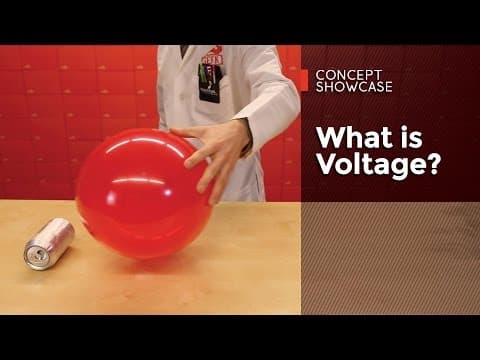
What is Voltage?
SparkFun Electronics
6m 36s1,182 words~6 min read
YouTube auto captions
Transcript source
YouTube auto captions
This transcript was extracted from YouTube's auto-generated caption track. The transcript below is server-rendered so it can be read, searched, cited, and shared without opening the original YouTube player.
Pull quotes
[0:05]To understand how electricity works, we need to zoom in on atoms, the things that make up all matter.
[0:05]That is protons, which have a positive electric charge, neutrons, which have no electric charge, and electrons which have a negative electric charge.
[0:05]The protons and neutrons are tightly packed in the core or nucleus of an atom, while electrons move about this nucleus in regions known as shells or orbitals.
[0:05]Right now, this atom is electrically neutral, as it has the same number of protons and electrons.
Use this transcript
Related transcript hubs
Watch on YouTube
Share
MORE TRANSCRIPTS


