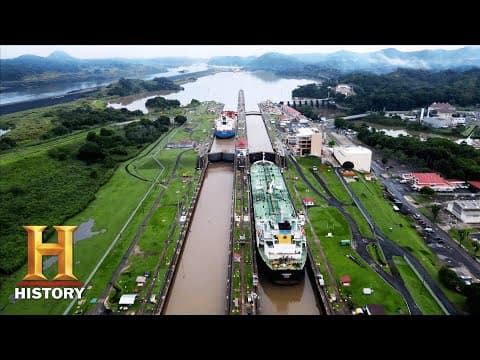
[0:00]One of the great engineering wonders of the world. It has allowed for the movement of well over a million ships back and forth from the Atlantic to the Pacific Ocean, carrying a quarter trillion dollars worth of cargo. That was a huge boom to the American economy. But a little over a century ago, the Panama Canal doesn't exist. The dream to build it is an unrelenting 35-year struggle. Kind of bonkers idea. This was the biggest real estate transaction in the history of the world. In a race to engineer the impossible, failure is not an option. There's no other project of that scale and magnitude. It was an endeavor like none other.
[0:46]This is the story of the Panama Canal.
[0:56]John Frank Stevens was an engineer's engineer. Come on, let's pick up the pace. He had built some of the most challenging railroads in North America. This guy lived to build ambitious infrastructure. It took his wife to convince him that every engineering project he'd ever completed had led him to this one moment, the big project. Larger and more consequential than anything he had taken on before. But a year and a half into his time on the Canal, there's still one thing Stevens hasn't been able to conquer.
[1:38]The jungle itself is what holds the soil together in Panama. And so when they start digging away and exposing it, and it gets wet, it no longer has that cohesiveness and becomes basically just like a sticky fluid that's going to flow downhill. And whatever's underneath it is going to get smashed. Stevens and his workers face nearly 10 mudslides a year, which erase any progress cutting the mountains down to sea level. It'll never work. Sea level canal will never work. We can't go through the mountain, we'll have to go over it. Stevens is convinced the only way to succeed is to build a lock canal instead. But in order to put his more expensive plan into action, he'll have to do something more difficult than moving a mountain. Convince the United States government to completely change course.
[2:37]A lock canal will take eight years. A sea level 18, if it can be done at all. Stevens claims that while his new plan will cost over 150 million, it will save 100 million in the long run. A few days later, the lock canal passes. And with Congress setting the deadline for 1914, just eight years away, Stevens has no room for error. A lock canal required a lot of more diverse skills. If you think of a sea level canal, it's just excavation and dirt disposal. Building locks required a lot of engineering. For Stevens's plan, 160 feet of the Culebra mountains will still need to be excavated. 40 feet less than the French were attempting and then flooded. Two sets of locks will be built on the Pacific side, one set on the Atlantic side, which can raise and lower ships to 85 feet above sea level. They'll sail between the locks using the largest man-made lake in the world. But creating it will mean building the largest earthen dam in history.
[3:49]Stevens and his team came up with a plan to dam the Chagres River, turn a major part of the interior of Panama into a giant lake. This was brilliant for several reasons. For one, it helped them control the mudslides that had been wiping away equipment and causing all kinds of problems. Two, they didn't even have to dig the canal through central Panama, because for more than 20 miles, the boats could just sail across this giant lake. Within months, dirt trains are carrying soil and rock to build the gigantic earthen wall. But progress is still slow. And there's worry that the lock canal might also be impossible to build. Undoubtedly, he's feeling stress and pressure. You have to imagine it's at this moment that he thinks, or fears maybe that that he's not the man for the job. For Stevens, the timing couldn't be worse for a visit from the President. In 1906, Roosevelt decides that he needs to go down to personally inspect the progress of the Canal. And so, as with anything with Roosevelt, it's going to be a political and media spectacle. The timing of his visit comes at a moment when the canal project is under serious threat. Roosevelt believes that the only way to reinspire the public and to inspire Congress that this project can be completed is to go there in person. But for the Chief Engineer, it's just another obstacle. Stevens lacked the skill of managing and massaging superiors who wanted to stick their nose in what you were doing. He did not tolerate unwarranted interference. He was in charge. He knew better. It drove him crazy.
[5:52]For the past several years, I've had my methods questioned by people I wouldn't wipe my boots on. I've given up hundreds of thousands of dollars of income, time with my family. He looked at himself hard and decided that this is the wrong direction and he can't work on the Canal anymore. Less than 20 months into his tenure, America's Panama Canal Chief Engineer resigns. Leaving the world to wonder whether it can ever be built at all. President Teddy Roosevelt loses another Chief Engineer. But for his replacement, rather than look for someone who won't quit, Roosevelt finds someone who can't. He names George Washington Goethals, Chief Engineer. Goethals was an army engineer, and so he wasn't going anywhere. He knew the chain of command, he knew how to follow an order. He wasn't going to stop until he was told to stop. So if ever there was a person to finish a job, it would be an army man like Goethals. Over the next three years, Goethals completes the Gatun Locks on the Atlantic and Pedro Miguel Locks on the Pacific. But by 1912, concrete isn't done being poured on the final set of locks, and the Culebra Cut is still being excavated. This road will be finished in six years, not two. To have any hope of finishing on time, Goethals needs a miracle. He has an idea to separate his workers into two groups and use a psychological strategy to motivate them. Gentlemen, on the other side of that lake are a bunch of soldiers who are too soft for real battle. He tells the civilians that there's no way they could beat the military guys. And he tells the military workers that they're lagging behind the civilians. On the other side of that lake are a bunch of soft railroad workers who think they can pour concrete faster than you can. Soon enough, there's a full-fledged competition between the two groups, each one vying to outdo the other. Prove them wrong. Now, the re-energized workforce turns their attention to the massive iron gates that will seal the water in the locks. By May 1913, a year ahead of schedule, all three sets of locks are finally completed. On the afternoon of October 10th, 1913, the newly elected President Woodrow Wilson presses a button in Washington that blows the center dike. Waters from the Gatun Lake immediately begin filling the Culebra Cut, creating a single path of water 51 miles long and as much as 1,000 feet wide. It's the culmination of centuries of dreaming and a decade of hard work. On August 15th, 1914, the SS Ancon becomes the first ship to travel through the Panama Canal. Nothing is ever the same again. The world is utterly transformed. We go from having an Atlantic and a Pacific Ocean, functionally to having one global ocean. The Panama Canal is one of those ideas that is literally world-changing. And even though there was plenty of failure, even though it was very expensive, there was something inevitable about it. It had to happen. And it almost had to happen at this time, and it almost had to happen for this nation. It changed the world.


