[0:00]Again to another session of understanding about computer organization and computer architecture. My name is uh Mchiri Nyaga. So I'll be taking you through this session. Uh the main objective of this session is to explain the operational units of a computer system. Uh so we first understand by trying to get the difference between the computer organization and computer architecture. Although it's very difficult to give a precise definition uh about computer organization and computer architecture, a consensus uh has been reached about the area covered by both areas, meaning the computer organization and computer architecture. So, uh, the computer architecture refers to those attributes of a system that have a direct impact on the logical execution of a program.
[1:15]Examples of those architectural attributes include the instruction set, the number of bits used to represent various data types, the input output mechanism, the memory address techniques. While on the other side on the computer architecture, oh sorry, computer organization refers to the operational units and their interconnections that realize the architectural specifications. Examples are things that are transparent to the programmer: 1. Control signals, 2. Interfaces between computer and peripherals, 3. The memory technology being used. Right. So when we talk about the operational units, we're talking about the control signals, um, the interfaces between computer and peripherals and the memory technology being used. All right. So, um, the organizational attribute include those hardware details transparent to the programmer. Such as the control signals, interfaces between computer peripherals and the memory technology used.
[2:28]So, um, we can proceed so that we really understand these two terms and how they are inter-related with one another. We have the structure and the function. Right? So the structure, um, a computer, um, is, um, is a system that has a specific objective and contains so many electronic components.
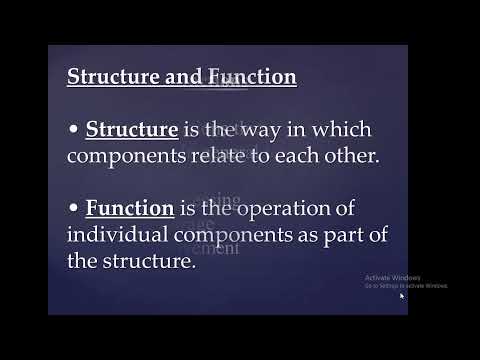
[2:59]And this system can be divided into two areas that the structure and the function. The structure is the way in which the components are interrelated, and on the other side, the functions are the operation of each individual component as part of the structure.
[3:23]So, uh, starting maybe from the bottom, you can see, um, both the structure and, uh, the functioning of a computer can be, um, can be explained, um, in some very basic, uh, functions, like on the computer function, the basic functions that a computer can perform. In general terms, there are only four: Data processing, data storage, data movement, and control.
[4:00]The, uh, when you talk about the data, data may take a wide variety of forms and the range of processing requirement is broad. So it's very essential to really understand that a computer stores data. Even if a computer is processing, uh, any type of data, regardless of the form, we have to all agree that it stores data. We have either, uh, a computer can be storing data temporarily or permanently. Uh, uh, first of the data are stored in the sub, subsequent retrieval and can, uh, depending on the retrieval and how, uh, how frequent they are updated. So on the other side, on the other side, we have the computer must be able to move data between itself and the outside world. Whenever we talk about the outside world, we bring the element of the liveware of the humans, uh, the computer's operating environment consists of devices that serve as either the source of the sources or destination of data. When data is received from a device that is directly connected to a computer, the process is, uh, basically referred to as the input output, right? So we have the, uh, abbreviation I-O, meaning the input output.
[5:49]These devices are also referred to as the peripheral devices. When data is moved around these, uh, devices, they, uh, must be the control. Right? It must have control. These are, um, these are very basic functions that, uh, every data cannot just move around the system, computer system. So there is an element of control. Right? The control is exercised by individuals who provide computers with instructions.
[6:33]Within the computer, which manages the resources. So apart from data, remember data can also be referred to as a resource and control is very, very, uh, important when it comes to the functioning of a computer. On the other side, uh, on the other side, we have the, the structural components of a computer. So the the structural components are, uh, the central processing unit (CPU) that controls the operation of the computer and performs its data processing functions. Often, uh, or simply refer to as the processor. So, uh, as you move on, you just realize that we'll stop using the word, uh, CPU or central processing unit, and we'll be talking about a processor.
[7:39]Simply we mean one and the same thing, they can be used, um, interchangeably. Um, on the other another structural component, we have, uh, the main memory, which stores data. We have the input output that moves data between data between the computers and its external environment. Uh, something that commonly, most people don't discuss is the system interconnection. Um, this interconnection provides communication among the CPU, memory, input, uh, the input output, uh, system.
[8:24]Uh, a common, um, example of a system interconnection is by the use of the system buses, which consist of a number of wires that work together to to move data from different location. So, um, I will check you back to the processor or the CPU which is a bit a complex component. And it's divided into different, uh, different parts, which is we have the control unit, which controls the operation of the CPU and hence the computer.
[9:12]And then we also have the arithmetic and logic unit (ALU) that performs the computer data processing. Still on the CPU, we have registers that provide internal, um, we have that provides, uh, internal storage of the CPU. And then lastly on this, uh, structural components, we have the CPU, uh, interconnection. Are these are some of the mechanisms that provide communication among the control unit, uh, arithmetic logic unit, and the registers. So, uh, thank you for watching. Uh, a video will, we'll be posting more materials regarding the computer components. Um, so thank you.


