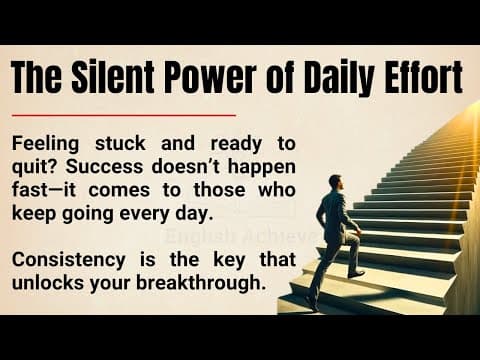
[0:00]Do you want to hear something that can completely change your life? It's not a new gadget. It's not a magic formula. It's not a secret talent. It's something more powerful, something that anyone can use. It doesn't matter how old you are, where you come from, or what you've done in the past. This one thing can help you build a better future, step by step. That powerful thing is called consistency. Yes, consistency is not loud, but it is strong. It doesn't look exciting, but it builds success. Most people fail not because they are not smart or talented, but because they don't stay consistent. They start something, get excited for a few days, then stop. But success belongs to those who keep going—even when it's boring, hard, or slow. You see, motivation is great, but it comes and goes. One day you feel like doing everything. Another day, you feel like doing nothing. That's normal. Everyone feels that way. But consistency is what helps you keep moving—even on the days when motivation is gone. And that is why consistency is more powerful than motivation. Let me ask you this: If you read one page of a book every day, what will happen after a year? You will finish a book. If you do ten push-ups every day, what will happen after a few months? You will become stronger. If you practice English for just fifteen minutes each day, what will happen after six months? You will speak better English. These are small actions. But when you do them every day, they create big results. That is the power of consistency—small efforts repeated daily. Many people make a big mistake. They think they need to do something big to succeed. So they try to study for five hours in one day and then do nothing for a week. Or they go to the gym for two hours once a month. But real success doesn't come from big actions once in a while. It comes from small actions every single day. Like a drop of water falling on a rock—one drop does nothing. But drops falling every day can make a hole in the rock. That's how consistency works. Consistency creates habits, and habits shape your life. Think about it. Your life today is the result of your daily habits. If you eat healthy every day, you will become healthier. If you practice positive thinking every day, your mind becomes stronger. If you study a little every day, you become smarter. Good habits lead to success. Bad habits lead to problems. And consistency is what builds those habits. But let's be honest. Staying consistent is not easy. It takes discipline. It takes patience. It takes self-control. Some days, you will feel lazy. Some days, you will feel tired. Some days, you won't want to do anything. And that's okay. You're human. The key is not to give up. Even on bad days, do something small. If you can't do a full workout, just stretch for five minutes. If you can't read ten pages, read one. If you don't feel like writing, write one sentence. Small actions still count. The goal is to keep going. Let's talk about progress. Progress is not always visible. When you go to the gym for a week, you don't see big muscles. When you study English for a month, you may not speak like a native. That's why many people quit. They think it's not working. But progress is silent. It grows under the surface. You don't see the results immediately, but that doesn't mean they're not happening. Every time you practice, you are getting better—even if you don't see it yet. Imagine planting a seed. You water it every day. For weeks, you see nothing. But then one day, a small plant grows. That's how consistency works. You may not see the results for a while. But if you keep watering your goals, they will grow. Here's another truth: Consistency builds self-trust. When you say, “I will do this every day,” and you do it, your mind starts to trust you. You feel proud. You feel strong. That builds confidence. But if you say, “I will do this,” and you don't, you lose trust in yourself. You feel weak. So every time you show up—even for a few minutes—you are building inner strength. Consistency is also the best way to beat procrastination. We often say, “I'll do it later,” and then we don't do it at all. But if you have a daily routine, it becomes automatic. You don't have to think about it. You just do it. Like brushing your teeth. You don't ask, “Do I feel motivated to brush today?” No, you just brush. That's the power of routine. That's what consistency gives you. Let's now look at time management. Many people say, “I don't have time.” But the truth is, everyone has time for what they make a priority. If something is important, you will find time. You don't need hours. You just need a few minutes every day. Even ten minutes a day can change your life. The key is to use that time well—every day. Also, don't compare your journey with others. Some people will improve faster. Some will improve slower. That doesn't matter. What matters is that you keep going. Your only competition is who you were yesterday. As long as you are moving forward, you are winning. Let's talk about goals. Goals give you direction. But consistency helps you reach them. Think of your goal as a mountain. It looks big and scary. You can't climb it in one jump. But if you take one step every day, you will reach the top. Not in one day, but one day for sure. Many people fail because they wait for the perfect moment. But the perfect moment never comes. There will always be distractions. There will always be problems. So start now, with what you have. Do what you can. Then repeat it tomorrow. That is consistency. Success is not about speed. It's about direction. It's not about how fast you go, but about not stopping. Even if you move slowly, you will reach your goal if you don't quit. Remember this: Slow progress is still progress. Now let's understand how consistency affects your mindset. When you do something every day, you start thinking differently. You stop looking for excuses. You stop blaming others. You take responsibility. You say, “I will do my part.” That mindset makes you powerful. That mindset makes you a winner. Many people focus on results. But results come from routines. So if you want better results, build better routines. And if you want better routines, stay consistent. That's the formula. Here's something powerful to remember: Discipline is more important than motivation. Motivation is like a fire—it burns bright and dies fast. But discipline is like a river. It keeps flowing. Even when you're tired. Even when you don't feel like it. Consistency builds that discipline. And discipline brings freedom. When you are consistent, you have more time, more focus, more energy. You don't waste time thinking, “Should I do this?” You just do it. That saves mental energy. That makes you stronger. Let's talk about long-term success. The world loves quick results. But real success takes time. Olympic athletes train for years. Writers work for months or years on a book. Business owners spend years building their companies. Behind every success, there is a long period of consistent work. So don't be fooled by what you see on social media. People show the results, not the process. But the process is what really matters. The process is where the growth happens. The process is where the power lies. Consistency is not exciting. But it is effective. It is not shiny. But it is strong. It is the key to everything you want in life. Whether it's learning a language, building a career, improving your health, or growing your mind—consistency is the bridge between dreams and reality. Here are some simple tips to stay consistent: 1. Start Small – One Step at a Time. When people begin something new, they often feel excited. That excitement makes them want to do a lot on the first day. They say things like, “I'll study English for 3 hours every day,” or “I'll exercise for 2 hours starting tomorrow.” But this excitement does not last long. After a few days, they feel tired or overwhelmed, and they stop. That's why it's important to start small. Begin with just one simple action. Something so easy, you can do it even on your busiest or laziest day. For example, instead of studying for an hour, begin with just 10 minutes a day. Instead of doing 100 push-ups, start with 5. The smaller your first steps are, the easier it is to build a habit. Starting small helps your brain feel safe. It says, “This is easy. I can do this.” Over time, as you repeat the small action daily, your mind becomes stronger. Your habit becomes part of your routine. Later, you can increase the time or effort slowly. But in the beginning, make it so small that you can't fail. 2. Be Clear – Know Exactly What to Do. If your goal is not clear, your mind gets confused. You might say, “I want to study more,” or “I want to be healthier,” but what does that mean? When your goal is not specific, it's easy to delay it. It's easy to say, “I'll do it later,” because you don't know exactly what “it” is. So the second tip is to be very clear. Know exactly what you want to do and when you will do it. Instead of saying, “I'll practice English,” say, “I will practice English for 15 minutes every day at 7 PM.” That's a clear plan. You know what to do, how long to do it, and when to do it. Clear actions remove doubt. They make your routine automatic. You don't have to think or decide every day. You already know what's next. This clarity builds consistency because it removes the need to negotiate with yourself. You are not asking, “Should I do it now?” Instead, you're saying, “It's 7 PM. Time to practice.” That simple change can make a huge difference. 3. Use a Timer or a Checklist – Track Your Progress. One of the biggest problems with long-term goals is that we don't see results immediately. When results are slow, we can feel like nothing is happening. That can make us feel discouraged and give up. But when we track our progress, we can see how far we've come, and that gives us the motivation to keep going. Using a timer or a checklist is a great way to do this. Set a timer for 10, 15, or 20 minutes when you begin your activity. This helps your mind focus. You know you only need to give your best for that short time. It makes your task feel manageable. And when the timer stops, you feel good. You did it! You can also use a calendar or notebook to mark each day you complete your habit. Make a big checkmark or a happy face. Over time, you'll see a long line of marks. That line shows your commitment. It shows your effort. You can look back and say, “Wow! I've been doing this for 10 days!” That feeling is powerful. It makes you want to continue. It creates momentum. Progress you can see is progress you will believe in. So keep track of your journey. Make it visible. Celebrate your streak. 4. Stay Flexible – Life is Not Perfect. Life is full of surprises. Some days are easy. Some are difficult. You might feel sick. You might be tired. You might have family problems, work stress, or just a bad mood. That's normal. That's part of being human. Many people fail because they try to be perfect. They say, “I must never miss a day.” But when they miss one day, they feel bad. Then they miss another day. Soon, they give up completely. But remember this: missing one day is okay. What matters most is not never missing, but always returning.
[16:11]The secret to long-term consistency is flexibility. If you can't do your full routine, do a smaller version. If you miss a day, forgive yourself and return the next day. Don't be hard on yourself. Don't say, “I failed.” Say, “I had a tough day, but I'm back now.” This mindset keeps your habit alive. Flexibility is not weakness—it's wisdom. It allows your routine to survive real life. Because real life is not perfect, but consistency can still exist inside it. 5. Celebrate Small Wins – Be Proud of Every Step. Sometimes we think we should only celebrate big successes. We wait for big changes, big results, or big achievements. But in truth, success is built from small wins. Every day you show up, even for a few minutes, is a success. Every step forward is worth celebrating. Why? Because celebrating small wins builds motivation. It makes your brain feel good. It says, “That was good! Let's do it again!” This feeling helps your habit grow stronger. You begin to enjoy the process, not just the result. So how do you celebrate? You can smile and say, “Yes, I did it!” You can give yourself a high-five. You can take a deep breath and feel proud. Or you can treat yourself to something small and positive like a favorite song, a few minutes of rest, or a warm drink. You don't need to wait for big success. Let every effort be a reason to feel good. When you feel proud of your consistency, it becomes part of who you are. You begin to say, “I am the kind of person who shows up.” That belief becomes your identity—and once something becomes part of your identity, it becomes automatic. And remember: You don't need to feel motivated to take action. But action will often create motivation. Once you start, you'll feel good. That feeling will push you to continue. 5. A Better Life – Everything Improves When You Are Consistent. Now let's look at the big picture. What happens when you become consistent in your habits? When you show up daily, build better skills, grow your confidence, care for your health, and strengthen your mindset? The answer is simple: your whole life gets better. You begin to feel proud of who you are. You trust yourself. You know that if you set a goal, you will work toward it, step by step. This trust changes how you think, how you act, and how you feel. Your relationships improve. Your work becomes better. Your mood becomes more positive. You begin to live a life of progress, not perfection. Consistency gives you freedom. Freedom from fear. Freedom from excuses. Freedom from regret. It gives you the power to say, “I may not be the best today, but I'm better than yesterday. And tomorrow, I'll be even better.” You become the kind of person who creates change. Who doesn't just dream, but acts. Who doesn't just plan, but performs. That's a powerful life. That's a meaningful life. So if you want a better life, don't search for magic. Don't wait for the perfect time. Don't depend on luck. Instead, look at your habits. Look at your daily actions. That is where real success begins.
[21:23]Final Words – Your Life Is Built By What You Do Daily. Consistency is not just about discipline. It's about transformation. The person you become is shaped by what you do, again and again. Even small actions, when repeated, build a better version of you. One that is skilled, confident, healthy, strong, and proud. So take a deep breath. Start small. Keep showing up. And remember—every small step matters. You don't have to do it all today. Just do something. And keep doing it. Your future self will thank you.
[22:20]Stay consistent. Stay strong. Your better life is waiting. And remember, here on English Achieve, we're with you every step of the way.


