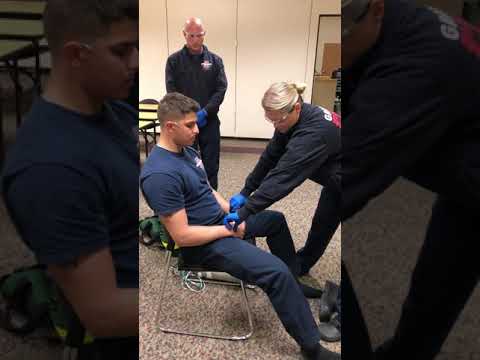
[0:05]So, me and my crew have our standard precautions. We have our gloves, our glasses, sorry, and our gloves. This is a nature of illness, respiratory distress. We have one patient. There's no need for additional resources at this time and no need for C-spine. Um, my general impression of this patient is he currently is stable with potentially unstable. Um, we're going to get his, um, level of alertness. Hi, sir, what's your name? Troy. Troy. I'm Sarah, it's nice to meet you. So my patient is alert. Are you know, his person, where are you at right now? Uh, I'm at home. Okay, place. Troy, do you know what month it is? Uh, I think it's April. Okay, time. And what happened today for you to call 911? Uh, I was just trying to get my, you know, pumping some iron, get my pump on and, uh, just felt a little short of breath. Getting your pump on, feeling shorter of breath. Oh yeah. Event. Okay. So, chief complaint is going to be shortness of breath after exercise. Um, and we are going to move onto, so he's A times four. Now we're going to move on to airway. So Troy, open your mouth for me really quick. So his airway is open, patent, no need for an adjunct at this point. Um, go ahead and give him, uh, 4 liters via non- or nasal cannula for his oxygen cuz he's kind of having a hard time breathing. 4 L nasal cannula. So right now his respiratory rate is slightly elevated, so it's a little bit fast. Rhythm is regular. Quality is unlabored and then depth is kind of shallow because he's breathing a little bit fast.
[1:38]Um, so therefore, his, uh, respirations are somewhat adequate with this oxygenation that we're going to give him. And therefore we're determining that he needs that 2 liters or 4 liters of O2. Uh, so in our circulation, we've now accomplished airway and breathing. So with circulation, we're going to do a quick rapid scan to make sure that he's not bleeding anywhere. So Georgia, are you bleeding anywhere that you know of? Nope. Okay, 16 and 90 seconds. So we're going to check his head and face. Check your gloves, make sure that you don't have any blood on your hands after the fact. Neck, shoulders, down the chest. Take a big deep breath for me. Okay. So equal chest rise and expansion. Chest check the abdomen. No pain there? Nope. Okay, push on the hips. No pain there. Down the legs. Nothing there. And use opposing forces. So you're using opposing forces so you know that that bone is stable. At this point we're going to take off his boots. He's gonna grab his chest, sorry. And we're going to check bilateral pulses. Sorry, they might be a little sweaty. Been working hard in there.
[2:54]So, as far as his pulses go, the rate is not fast, nor slow. It is regular and it's not bounding nor thready. Okay? We're going to come back up and check the top part of his body. So same thing with arms, opposing forces. Check your gloves, opposing forces. And then again, your pulses bilaterally. And same rate, not fast, not slow, rhythm is regular. Quality is not bounding or thready. Okay? And then as I check pulses in his hands, I'm gonna go down and check for cap refill. So we're pressing on that finger, checking for cap refill, making sure that it's less than 2 seconds. Skin is pink, warm, and dry. All right, and then we're going to move into vitals. So if you will get a blood pressure and pulse for me. Blood pressure and pulse. I'll have you get pupils and respirations. Pupils and respirations. And then they're going to count. Sir, go ahead and look right at my nose. Pupils are pearl at five. Let's see your arm here, buddy.
[4:24]Respirations were 12 in 30 seconds so we'll put him at 24.
[4:44]Blood pressure is 116 over 72. 116 over 72. Heart rate is 60, strong and regular. Heart rate 60, strong and regular. So based off that information that we collected, we're going to determine that he is a stable patient at this point. So our transport decision is going to be routine and then we're going to move into our history taking. So OPQRST and sample, so O is onset. So George, what time did this start for you? Uh, about 30 minutes ago. 30 minutes ago? About when I stopped working out and I'm just still shorter of breath. Is there anything that makes it better or worse, provocation palliation? No, just sitting here helps. Can you describe exactly how that feels, quality? Um, just a little hard to breathe. Okay, little hard to breathe. Um, does it go anywhere? Nope. Okay, so radiation. On a scale of 1 to 10, how bad is it? Solid five. Solid five. Okay, so severity. And then is it consistent or is it intermittent kind of coming and going? It's consistent. So time it's going to be consistent. Um, do you have any allergies to any medications? No allergies. None at all, even environmental? None at all. Are you on any medications currently? Tryptilin. Okay. Um, anything past medical history that has to do with respiratory? Nope. No? Okay. Um, last oral intake? About 20 minutes ago. Okay. And then we know that our sample E event, he already said he was working out and that he had a hard time breathing after he started working out.
[6:21]Um, so my field impression of him is going to be still stable. Uh, we missed really quick just the secondary assessment of that. So we're going to go back to secondary assessment and go, we're just skip the cut, just keep rolling. So, secondary assessment, we're going to get farther into that, um, respiratory issue and dive a little bit deeper, right? So I'm going to listen to lung sounds.
[6:57]George, go ahead and lean forward a little bit for me. That's Troy. Troy, sorry, Troy. It's okay.
[7:23]And you can also ask any secondary questions at this point. So Troy, have you had a cough cold at all recently? No. No production you haven't spit anything up? None at all. Okay. Um, so then we're going to do a second set of vitals, if you guys could repeat the vitals that you did before. Our first set is intended for a baseline. Our second set is intended to help us, uh, follow that trend. Blood pressure again. I'm going to check his people again, sir, looking at my nose. Pupils are pearl at four.
[8:08]His respirations are slower now. It's eight in 30 seconds, so we're at 16. Blood pressure is 112 over 68. 112 over 68. And heart rate's 64. 64 heart rate. All right. So you know that he is writing that information on his glove because you're going to have to come back and give a report later. So make sure that you have somebody scribing for you, or you carry a piece of paper that you can write that information down so you can watch that trend of vitals. Um, so again, we're going to state our field impression, and again, I think he is still stable. Uh, we should bring him to the hospital because we don't know what is going on as far as his respiratory issue right now. Um, how was that oxygen train you, George? It's good. Troy, sorry, Troy. So good. We're checking our intervention to make sure that that intervention is working. We're reassessing, we already did a second set of vitals there. Uh, and then lastly, we need to give a report to the hospital. So you're going to give the hospital call and give him a quick hit report on your way there. So that's going to look something like this. How old are you today, George? About 24. 24. So I have a 24-year-old male that's complaining of respiratory distress, started about 30 minutes ago, uh, while he was working out. Uh, nothing makes it really better or worse for him. His quality described as. Having trouble breathing. Just having trouble breathing. Nothing significant. It didn't radiate anywhere. And he says that it's kind of constant. Um, vitals were last one I got was. Pupils were four, pearl with a respiration rate of 16, BP of 112 over 68 and pulse of 64. Will beat to you in 5 to 10 minutes. Any further questions? Click, and then that's the end of that. Sorry, I just on my phone. Trying to get this.


