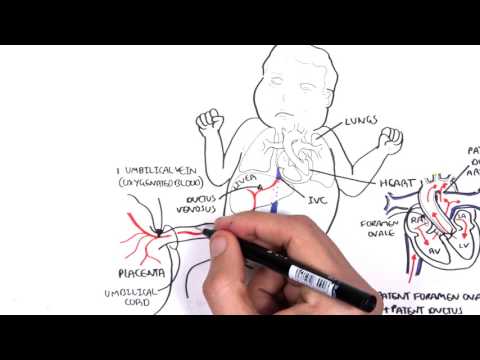
[0:05]Hello, in this video we're going to talk about fetal circulation. Uh the fetus is you when you were inside your mother's womb, the uterus. Now, the fetal circulation is actually very complicated and different to the circulation of a baby, which is essentially the circulation of an adult. In this video, um it is assumed that the viewer, you will already have some understanding of normal adult human circulation. So, if you don't, please revise that. Now let us focus on fetal circulation. Here is a fetus and its lungs and heart. Let's zoom in and focus on the heart. The heart has four chambers. The right consists of the right atrium and right ventricle. The right side of the heart is responsible to pump blood into the lungs. Blood returns to the heart to the right side via veins here in blue, and will enter the right atrium and then the right ventricle before being pumped by the heart into the lungs. However, in the fetal circulation, there is actually an anatomical opening, a hole, called the foramen ovale, which is the connection between the right atrium and the left atrium. And so, when the blood flows from the right atrium to the right ventricle, blood will also flow from the right atrium to the left atrium. The left side of the heart, it consists of the left atrium and left ventricle. The left side of the heart is responsible for pumping blood to the rest of the fetal body. Aside for the anatomical hole, the patent foramen ovale, there is another important connection or sort of hole, called the patent ductus arteriosus. The patent ductus arteriosus is the connection between the pulmonary artery and the aorta. And so, in the fetal circulation, blood traveling through the pulmonary artery can bypass the lungs and go straight to the aorta and be then transported to the rest of the fetal tissue. The blood can bypass the lungs because there is a lot of pressure in the fetal lungs, and so blood can't can actually easily go in into the aorta. The patent foramen ovale and patent ductus arteriosus allow a right to left shunt, which means blood normally entering the right side of the heart can easily be shunted to the left side of the heart, bypassing the lungs. In fetal circulation, there is really no need for blood to go into the lungs, because the fetus is not breathing air anyway. Rather, the fetus relies on the oxygen delivered by the maternal circulation in the placenta. See, the placenta is this important connection between the mother and the fetus. The placenta delivers oxygen and nutrients to the growing fetus via the umbilical cord. The umbilical cord attaches the fetus to the placenta. The umbilical cord is not just a cord, it actually contains veins and arteries. The umbilical vein here drawn in red, travels from the placenta to the fetal liver. There is one umbilical vein, and it is drawn here in red because it is oxygenated. It contains oxygenated blood, which was delivered from the mom. It's called a umbilical vein because vein travels back to the heart. Again, the one umbilical vein, which is oxygenated, travels to the fetal liver and becomes the ductus venosus, which then will join with the inferior vena cava here drawn in blue. The inferior vena cava in blue here is blue because it contains deoxygenated blood from the fetal circulation. The inferior vena cava that is about to enter the right side of the fetal heart now will contain partly oxygenated blood and partly deoxygenated blood. And so, this blood will enter the right atrium, and then either go into the right ventricle or it will go through the patent foramen ovale into the left atrium, bypassing the lungs, and then it will enter the left ventricle, um which which then will be the blood will be pumped into the aorta and into circulation.
[5:06]The blood that is pumped from the right ventricle can also go through the pulmonary artery and enter the lungs, or mainly it can bypass the lungs and just go straight into the aorta via the patent ductus arteriosus. Okay, so now you have partly oxygenated blood in the aorta, where it will now be delivered to the fetal tissue. The fetus needs oxygenated blood. Once the oxygenated blood is used by the tissue, blood will then normally return back to the heart via the veins. So, here the veins are in blue, which indicates deoxygenated blood. But in fetal circulation, there are actually umbilical arteries, which carry some of this deoxygenated blood back towards the placenta. And there are two umbilical arteries that do this, and they again contain deoxygenated blood, and their aim is to go to the placenta to re reoxygenate the blood via the maternal blood. So, let's take a closer look at what happens here. So here on the left, you have the maternal circulation, and on the right, you have the fetal circulation. These things here are red blood cells, the cells that actually carry your oxygen.
[6:45]What happens in the placenta is that the red blood cells from the maternal circulation will transfer its oxygen to the red blood cells in the fetal circulation. And the fetal red blood cells will then offload their carbon dioxide into the maternal circulation. And so, the umbilical artery um is becoming essentially a reoxygenated um by the maternal circulation. But how is this possible? Why is the mom giving oxygen to the fetus? Well, it's because the maternal red blood cell and the fetal red blood cell are actually very different. You see, the maternal red blood cell, like the fetal red blood cell, contain hemoglobin molecules. Um the molecules that actually carry the oxygen. But in the fetal red blood cells, there are actually more hemoglobin molecules, and the fetal hemoglobin has more affinity for oxygen. And this has to do with the genes that are active early on in um in the fetus. Anyway, this is the reason why oxygen is usually taken from the maternal red blood cells and into fetal red blood cells. So, the umbilical vein, which is now oxygenated oxygenated thanks to the maternal circulation, will travel back to the fetus via the umbilical vein, and it will go to the heart, and then it will be pumped by the fetal heart to feed the fetal tissues. So, what happens in the fetal tissues? Well, let's take a look. So here is the fetal capillary, here is a fetal cell. Let's just say it's the skin cell, and here is the red blood cell of the fetus, which contains hemoglobin, the molecule that carries the oxygen. Now, once once in the fetal tissues, so let's just say the skin or whatnot, oxygen will detach from hemoglobin, and will go into the fetal tissue, fetal cell. And it will and it will undergo a reaction together with glucose to produce energy for the cell, and also produce carbon dioxide and water, H2O as well. Carbon dioxide is a byproduct and actually needs to be excreted, otherwise it can be dangerous. One way that carbon dioxide is excreted is that it can react with water in the blood vessel or in the red blood cell. And here it will form bicarbonate ions. The bicarbonate ions can travel in plasma. This blood now is actually deoxygenated blood because it contains less oxygen. Carbon dioxide is largely carried in blood in the form of bicarbonate ions, and so this deoxygenated blood will now go back to the placenta via the two umbilical arteries we talked about. In the placenta, this um fetal circulation will again meet the maternal circulation. And so, the maternal red blood cell and fetal red blood cell will meet sort of. And the bicarbonate ions will react with hydrogen again to form carbon dioxide and water. Once this reaction takes place, carbon dioxide can then diffuse to the maternal circulation. Now, in the placenta, the fetal red blood cell needs to receive oxygen like before, and the whole process continues. I hope this story actually made sense. It's important to know that once the fetus grows and is delivered, so it's a baby, the umbilical artery and umbilical vein and the ductus venosus will actually disappear or change to become ligaments. And the patent foramen ovale and ductus arteriosus will close up, preventing the right to left shunt we saw. I hope this video I hope you enjoyed this video. Thank you for watching.


