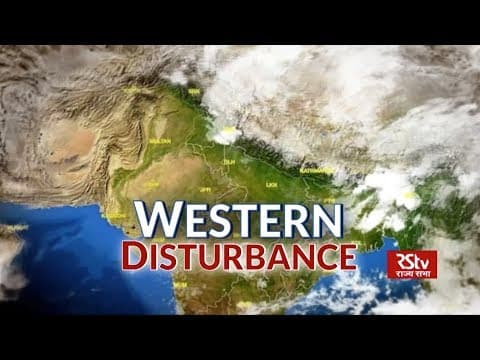
[0:13]Good evening. You are watching Rajya Sabha Television. I am Smriti Rastogi. An intense thunderstorm claimed over 64 lives on Tuesday. Rajasthan board the brand of the storm with as many as 25 people losing their lives. Deaths were reported in Madhya Pradesh, Gujarat, and Bihar as Gasty went swept the region. In Maharashtra, the total death toll reached 14. The severe weather was caused by the intense western disturbance. The Indian meteorological department also issued advanced warning for thunderstorms in several states. The western disturbance was strengthened by moisture coming in from the Arabian Sea and the Bay of Bengal. It is estimated that India gets close to 5 to 10% of its total annual rainfall from western disturbances. Weak western disturbances on the other hand are associated with crop failure and water problems across North India. But strong western disturbances can help residents, farmers, and governments avoid many of the problems associated with water scarcity. Today, we take a look at the phenomena in in-depth and analyze its implications.
[1:40]An unusually strong Western Disturbance Storming past the Northwest and the adjoining West India accompanied by heavy winds, lightning, hail storm and heavy showers has claimed 64 lives across Rajasthan, Madhya Pradesh, Gujarat, and Maharashtra this week. The Indian Meteorological Department has signaled that a follow-up Western Disturbance, much weaker than the current one in terms of intensity, may check in over the Northwest India by 23rd of April. Widespread rainfall with isolated thunderstorms, lightning and gusty winds are all over Punjab, Haryana, Chandigarh, and Delhi, Uttar Pradesh, and Himachal Pradesh. The Western Disturbance over North India is likely to produce fairly widespread snow or rain in Jammu and Kashmir and Uttarakhand. The Western Disturbance, after causing severe weather conditions over major parts of North and Central India, is moving eastwards and will hit the East and the North East in a swarm of lightning, accompanied by hail storm, high winds and Thunder Shars. It is likely to cause widespread rain or snow and thunderstorms over Arunachal Pradesh. Sikkim will also receive fairly widespread snow or rain. Other Eastern and Northeastern regions like Bihar, Jharkhand, West Bengal and Assam are also likely to receive fairly widespread rain and thunderstorms in the coming days. Down South, widespread rain and thunderstorms are expected over Kerala due to wind converging from Arabian Sea and the Bay of Bengal. Fairly widespread rain and thunderstorms are also expected over Tamil Nadu, Telangana, Andhra Pradesh, and the Andaman and Nicobar Islands. Rains and thunderstorms over Eastern, Central and Southern India will continue until Friday night due to the warm and moist winds from the Bay of Bengal creating unstable atmospheric conditions in the region. Maximum temperatures of 40 degree Celsius or more is likely to occur over Maharashtra, Karnataka, Telangana and Andhra Pradesh. The unseasonal rains and storms have caused immense damage to the property and crops in Punjab, Haryana, Gujarat, and Rajasthan. Rajasthan witnessed the maximum casualties with 25 people killed in the rain related incidents, followed by Madhya Pradesh where 22 people were killed. While 10 people were killed in Gujarat, three were killed in Maharashtra. Meanwhile, a severe cyclonic storm accompanied with heavy showers lashed several parts of Assam in the early hours of Wednesday, leaving three persons dead.
[4:36]I beg your pardon, leaving three persons injured and a trail of destruction. Prime Minister Narendra Modi has expressed concern over the loss of lives in the rains. Prime Minister said that nation stands in solidarity with all those affected due to unseasonal rainfall in various parts of the country. Home Minister Rajnath Singh said that the government is closely monitoring the situation in rain hit areas and is ready to provide all possible help to states affected by rains and thunderstorm. Rajasthan Chief Minister Ashok Gehlot condoled the deaths and directed officials to carry out a survey of losses and damage caused due to the rough weather. While Punjab Chief Minister Captain Amrinder Singh ordered a special revenue survey for the assessment of the crop loss resulting. Recently, the Western Disturbance which developed over Caspian Sea and Sea and moved across Iran, Afghanistan and Pakistan, affected Northwest India on 16th and 17th. Under its influence there was rainfall, thunderstorms, hail storms, square speed reaching about 60 KPH and lightning. But as you know this Western Disturbance has two terms, Western and Disturbance. Disturbance is always it is a perturbation in the normal climate. So as you saw that we were having very high temperatures in Delhi, even reaching up to 40 degrees and suddenly it cooled by 7 degrees. So this is a Western Disturbance. Natural climatic disasters in India cause massive loss of life and property. There might be in the form of flooding, tsunamis, hurricanes, and even frequent summer dust storms that track from north to south. Our report takes a look at the different types of storms and what makes them unusual and significant.
[6:55]Nature has always proved more powerful than humans. Despite development in weather forecast techniques and technological advancements, disasters at many times cannot be prevented. Time and again, we have seen and read about many natural disasters occurring in the country and outside, such as storm, tornadoes, hail, a thunderstorm, etc. causing great havoc. These storms have the potential to harm lives and property through a storm surge, heavy rain or snow causing flooding, lightning and vertical wind. But how does a storm occur? Storms are a natural phenomenon caused by violent atmospheric disturbances over land and water. Storms are created when a center of low pressure develops with the system of high pressure surrounding it. They are classified by how strong the winds are or by how heavy the rainfall, lightning or snow are. Storms that form north of the equator spin counterclockwise. Storm south of the equator spin clockwise. This difference is because of the Earth's rotation on its axis. As the storm system rotates faster and faster and I forms in the center. There are several different types of storms distinguished by the strength and characterization of atmospheric disturbances. When the winds in the rotating storm reach 39 miles per hour, the storm is called a tropical storm. When the wind speed reach 74 miles per hour, the storm is officially a tropical cyclone. Extra tropical cyclones are called winter storms and blizzards. Monsoon type storms are called tornadoes and thunderstorms. Certain violent winds, affecting limited areas are also called storms. This Western Disturbances develop in the mid latitude region, not in the tropical region. Therefore, they are called as mid latitude storms or extra tropical storms. This Western Disturbances, unlike the tropical storms or cyclonic storms, the cyclones usually develop in the tropical region, that is to the south of the Tropic of Cancer in northern hemisphere, whereas the Western Disturbances develop to the north of Tropic of Cancer. And they move across in that latitude, but sometimes when they become more intense in the Indian region, they can extend to the southern latitude even of to 15 degree north. Taking the case of the last Western Disturbances, its southern periphery was extending up to 17 degree north, resulting in a larger area of Indian region being affected because of rainfall and associated weather. It caused rainfall even of to North Maharashtra, Gujarat, and entire Madhya Pradesh to the south. The weakest tropical cyclones are called tropical depressions. If a depression intensifies such that its maximum sustained winds reach 39 miles per hour, the tropical cyclone becomes a tropical storm. Once a tropical cyclone reaches maximum sustained winds of 74 miles per hour or higher, it is then classified as a hurricane, typhoon, depending upon where the storm originates in the world. Tropical cyclones are revolving storms that begin in the tropics. Storms of this type are called hurricanes in the North Atlantic and Eastern Pacific, and typhoons in Southeast Asia and China. They are called tropical cyclones in the Southwest Pacific and Indian Ocean region. Tropical cyclones form near the equator and gain their energy from the heat that is released when the water vapor condenses into rain. The warm moist air over the ocean rises upward from near the surface. Because this air moves up and away from the surface, there is less air left near the surface. They are about 500 km across and may have a central region with relatively little cloud and light winds called the eye. Hurricanes are the most violent storms on Earth. In the Atlantic, hurricane season officially runs from June 1st to November 30th. 97% tropical cyclone activity occurs during this time period. However, there is nothing magical about these dates. Hurricanes can and do occur outside of the six month period. Bureau Report Rajya Sabha TV. And with that, we'll slip into our very quick break. Stay with us.
[11:53]Welcome back. Western Disturbances are the cause of the most winter and pre-monsoon season rainfall across Northwest India. This phenomena is usually associated with cloudy sky, higher night temperatures and unusual rain. Our next report takes a detailed look at the Western Disturbance phenomena.
[12:21]Western Disturbances are low pressure systems embedded in western winds that flow from the west to the east. A Western Disturbance begins as a low pressure system that originates in the mid latitude region near the Atlantic Ocean and Europe. The low pressure system typically forms over the Mediterranean Sea and travels over Iran, Iraq, Afghanistan and Pakistan before entering India loaded with moisture. These moisture laden western disturbances eventually come up against the Himalayas and are blocked. As a consequence, the moisture gets trapped and precipitation is shared in the form of snow and rain over Northwest India and sometimes other parts of North India.
[13:05]Western Disturbance is a weather system which develops over Caspian Sea, Mediterranean Sea area and it moves from west to east, therefore its name is Western. And it is weather system which disturbs when it passes through. Therefore its name is Western Disturbance. After its origin over Caspian Sea and Mediterranean Sea area, it moves eastwards or east northwards across Iran, Afghanistan, Pakistan and Northwest India. This Western Disturbance can be observed as an upper air cyclonic circulations in the lower troposphere or middle troposphere and sometimes when it becomes intense, it can be observed as a low pressure area which is popularly called as Western low. The word disturbance is used because the air within the low pressure systems tends to be unstable or disturbed. Western refers to the direction from which they originate with regard to India.
[14:10]The phrase Western Disturbance was first used in published literature in 1947. However, its precursor, winter disturbance was coined earlier in 1931. Western Disturbance is a term coined by Indian meteorologists for the weather phenomenon which is propagated from the west. It originates in the areas occupied now by Mediterranean Caspian Sea. And there whenever a high pressure zone is developed, then the winds, they through the westerly's, they start traveling towards east, via Afghanistan, Pakistan and ultimately to India.
[15:02]And this cloud laden moisture laden wind, it causes lot of rains, snow. Western Disturbances in winter bring moderate to heavy rain in low-lying areas and heavy snow to mountainous areas of the Indian subcontinent. India is a rain dependent country and while the Southwest monsoon covers most of India, parts of North India don't get much rain from it. These regions depend on snow and rain from Western Disturbances during the winter season from November to March. They are the cause of most winter and pre-monsoon season rainfall across Northwest India. Precipitation during the winter season has great importance in agriculture, particularly for the Rabi crops, including wheat, which is one of the most important Indian crops. An average of four to five Western Disturbances form during the winter season and the rainfall distribution and amount varies with every Western Disturbance. Western Disturbances start declining after winter. During the summer months of April and May, they move across North India and at times help in the activation of monsoon in certain parts of Northwest India. During the monsoon season, Western Disturbances may occasionally cause dense clouding and heavy precipitation. It is estimated that India gets close to 5 to 10% of its total annual rainfall from Western Disturbances. While weak Western Disturbances are associated with crop failure and water problems across North India, strong Western Disturbances can help residents, farmers, and governments avoid many of the problems associated with water scarcity. Since Western Disturbances are not high intensity weather systems, they are usually not associated with disasters, but in the recent past it is observed that this beneficial weather phenomenon is increasingly becoming disastrous during the summer and monsoon seasons. The 2010 cloud burst in Leh, in which 71 towns and villages were damaged and 225 people died, was caused due to the Western Disturbance. In September 2014, the Kashmir region suffered disastrous floods across many of its districts, killing over 200 people. This was also caused by the Western Disturbances. Expert opinion on Western Disturbances is divided regarding the 2013 floods in Uttarakhand, in which over 5,000 people were killed after three days of incessant rainfall. While many believe that Uttarakhand floods may have occurred due to interactions between Western Disturbances and the summer monsoon, many say that Western Disturbances and monsoon occur in completely different time frames. However, everyone agrees that Western Disturbances need to be studied in much more detail as availability of data on Western Disturbances is low. The phenomenon is not tracked extensively in some of the countries they cross before reaching India and unlike tropical cyclones or monsoon, there is no official end to end tracking of Western Disturbances. In an age where global warming and drastic change in climate are becoming all too common, studying the Western Disturbances will allow scientists to get deeper insights into the phenomenon. With inputs from Aastha Gulshreshth, Bureau Report for Rajya Sabha TV. Every year there are reports of large scale destruction caused by cyclones in India and the worst affected is the southern part. In fact, all the states which are settled on the coastline come in the grip of cyclones. Let's have a look at the major cyclones that have occurred in India.
[18:49]Life in coastal areas of India is never complete without cyclonic storms. Every year there is news of storms battering the state along the coastline. The worst affected are the southern states. Between 1990 and 2014, Andhra Pradesh has witnessed 10 cyclonic storms. Some of the important ones are Laila, Neelam, Helen, Lehar, Hudhud. In 2010, 65 people lost their lives in Storm Laila, while property worth 11 crore 74 lakh dollars was damaged. Even in Andhra Pradesh, this storm wrecked havoc. In 2012, 75 people were killed in Cyclone Neelam, and it damaged property worth 5 crore and 67 lakh dollars. Cyclone Helen in 2013 killed 11 people, but the loss was more than 80 crore dollars. Andhra Pradesh was very severely affected by the cyclone. In 2014, Hudhud cyclone killed 124 people and the destruction caused by it crossed 300 crore dollars. The neighboring states and surrounding countries suffered because of this. In Kerala, extremely severe cyclonic storm BOB06 hit the state in 2000, in which nine people lost their lives. Eight people went missing. Apart from India, a large part of Sri Lanka was badly affected. In the year 2016, the Nada Storm hit Kerala and brought heavy rain. However, there was not much loss of life and property. But in December 2017, the Cyclone Ockhi caused a major catastrophe in Kerala. Cyclone ARB04 in Maharashtra brought large scale destruction. It witnessed a loss of 1 crore 25 lakh dollars. Years later when Cyclone Phyan hit Maharashtra in 2009 and once again spelled disaster for the state. This storm killed 20 people and the damage caused was estimated more than 30 crore dollars. This loss is a total of India, Pakistan and Sri Lanka. In the year 1999 in Odisha, Cyclone BOB06 brought about huge destruction in the eastern coast.
[21:02]This storm is also called Paradip Cyclone with a speed of 160 miles per hour. This cyclone devastated Odisha and Myanmar. More than 10,000 people were killed in the storm. Property worth 400 crore dollars was damaged. Till date, this has been the most devastating cyclone of the North Indian Ocean. In the year 2013, Odisha had to undergo a massive catastrophe once again. This time Cyclone Phailin caused huge damage to Odisha. It also impacted the neighboring countries Thailand and Myanmar. 45 people were killed in this cyclone, while 69 crore 60 lakh dollar worth property was lost. 11 minor and major cyclones made landfall in Tamil Nadu from 2005 to 2018. The Fanoos Cyclone in 2005 killed 273 people, mostly from Tamil Nadu. It also caused a loss of 2 crore 14 lakh dollars. In 2008, Cyclone Nisha took the lives of 200 people, and there was a loss of 80 crore dollars. In 2010, the Cyclone Jal made a landfall in Tamil Nadu and killed 118 people and 12 people went missing. This storm damaged property worth 173 crore dollars. In 2011, the Cyclone Thane killed 48 people, damage estimated was 23 crore 50 lakh dollars. Storm affected southern part of India and Sri Lanka. In 2012, Cyclone Neelam killed 75 people and 5 crore 67 lakh dollar worth property was damaged. Cyclone Vardah in the year 2016 and Cyclone Ockhi in 2017 also racked havoc in Tamil Nadu. Bureau Report Rajya Sabha TV.
[22:54]And with that, it's a wrap on this edition of In-depth. You can also watch it online on YouTube and Twitter. And don't forget to send your feedback and suggestions about our program. Thank you for watching.


