[0:00]The year is 1806. The Serbian rebels have won two glorious victories, at Mishar, where they crushed a far superior enemy, and at Deligrad, where nearly 30,000 Ottomans were left dead on the battlefield. Strengthened by glory and confidence, the insurgents now turn their eyes toward Belgrade. But this time, alongside cannons and swords, diplomacy steps onto the stage. Serbia turns to Russia and seeks peace with the Ottomans. Encouraged by their recent successes, the Serbian insurgents launched a new offensive. Stanoge Glavash burned Prokuplje and advanced deep into the regions of Lab, Bunchka, and Branik. Karadorde pushed with his forces as far as Nish, while Melenko Stoikovich marched eastward toward Vidin. Serbia was no longer on the defensive. The uprising was beginning to take the shape of a true war of liberation. In these circumstances, at the end of July 1806, the Serbian envoy, Petar Icko, arrived in Constantinople. A skilled merchant and diplomat, and with the mediation of the patriarch of Constantinople, he began negotiations with the Porte. His mission was far from simple. He had to win concessions for a people who had only just risen from oppression. Yet, Icko knew how to seize the moment. The Ottomans were weakened, and relations with Russia were already on the brink of war. By September 1806, an oral agreement had been reached, later known as Icko's Peace. Its terms provided. One. Serbia would pay tribute in a fixed annual sum, collected by an imperial muhassil. Two. The muhassil would be accompanied only by a limited number of "attendants." Three. All public offices would be carried out by Serbs, under the Sultan's authority. Four. The Janissaries, Kurdjihi, and other violent Turks would be expelled from Serbia, and the borders would be guarded by the Serbs themselves. In September, Icko returned to Serbia together with the Muhassil. A month later, in October, the insurgent assembly in Smederevo accepted these conditions and sent Icko back to Constantinople to confirm them, firmly and finally. Yet, the peace never became permanent. No written treaty existed to guarantee the promises of the Porte. The fate of Serbia now rested on the wider conflict of empires. At that very moment, Russia seized Bucharest and entered into war with the Ottomans. The Serbs suddenly became its natural ally. Instead of counseling obedience to the Sultan, Russia now openly urged them to continue the uprising. Thus, Icko's peace remained an unfinished agreement, the first Serbian attempt to secure freedom not by force of arms, but through diplomacy. Petar Icko, together with the Muhassil Hassan Aga, sent by the Porte, returned to Serbia on September 10, 1806, without a written firman, relying solely on verbal promises. Karadorde decided to march on Belgrade, the city that had symbolized Ottoman authority in Serbia for decades. Since May 1804, the insurgents had been gradually tightening the siege around the city, but the first serious clashes with the Turks occurred only in 1806 near the Topcider River. When the insurgents secured positions closer to the city, by November 1806, Karadorde arrived beneath Belgrade with about 2,500 soldiers and 40 cannons. The insurgents took up key positions. Sima Marković, with 300 men, guarded the approach along the Sava River, tasked with penetrating the Varoš Gate, located at today's Koča Cičev venac. Karadorde and Janko Katič held the front at Tashmajdan, where the main camp was established. Milan Obrenović and his Rudničani occupied positions near the Cariwa bridge, while Mladon Milovanović and the Kragujevac detachments were at Hajducka Cesma. Vasa Čarapić, with the men from Grocka, was positioned along the Carigrad Road, and Miloje Petrović Trnavac, with 300 fighters, advanced on the Sava Gate near the Velekej Stepenice. Along the Danube, near the Vidin Gate, Stanoja Glavash and Vule Kolarac held positions, while Luka Lazarevic and Prota Mateja Nenadovic also took part in the siege. A key role was played by the defector from the Ottoman side, Buljubasha Konda, who, along with Uzan Mirko Apostolović and a small group of brave companions, planned to infiltrate the city first and open the gates from within. Speaking fluent Turkish, they successfully passed the Ottoman guard at the Sava Gate, which mistakenly let them through, thinking they were Ottoman soldiers. They then killed the guards and allowed the insurgents to enter the city. The main assault began on the night of December 12, 1806, November 30, old style, two hours past midnight, during Bayram. The insurgents advanced silently, using cold weapons, with Konda and Uzun Mirko leading the first penetration through the Sava Gate. Soon after, the Varoš Gate was also breached. Street fighting quickly spread, and the Turks opened fire with firearms, creating chaos in the city. Karadorde commanded from the camp at Tashmajdan, coordinating attacks on the central gates. During the fighting, Vasa Čarapić was mortally wounded while leading the assault on the Stambol Gate, which inspired and motivated the Serbian fighters. By 10:00 in the morning, most of the city was under insurgent control. In the 10-hour-long battle, about 300 Turks and 54 Serbian insurgents were killed. The insurgents also captured the strongest positions in Belgrade, including Stambol Gate, further boosting morale. During the night, trenches were dug, and cannons were positioned to threaten the upper fortress. Karadorde enforced strict discipline. He forbade vengeance or violence against the civilian population and prisoners, personally supervising and declaring, "Do not harm Turkish innocents. The Turks' atrocities were against us, but their children have done nothing wrong." Two insurgents who disobeyed this order were executed brutally and displayed as an example. Although the city was captured on December 12, some Ottoman forces remained in Belgrade Fortress. The siege continued until January 8, 1807, when the Turks surrendered, and Sulajman Pasha, along with his entourage, left the city. After more than three centuries, Belgrade finally became the center of a free Serbia. The liberation of Belgrade marked a turning point not only in the First Serbian Uprising, but also in the broader struggle for national identity. With the Ottoman garrison expelled and the city firmly under Serbian control, Karadorde and his commanders consolidated power and organized defenses to prevent the Turks from returning. The bravery of individuals like Vasa Čarapić, Buljubasha Konda, and Uzun Mirko Apostolović became legendary, symbolizing the determination and courage of the Serbian people. Belgrade's fall demonstrated that disciplined, coordinated action, combined with knowledge of the terrain and careful planning, could overcome even the strongest fortifications. This victory inspired further uprisings across Serbia and strengthened the resolve of the insurgents to continue the fight for independence. The liberation of Belgrade was not the end of the struggle, but a crucial step toward the creation of a free and independent Serbia. By defeating the strongest Ottoman fortress in the Balkans, the insurgents demonstrated their determination and courage, giving the people a symbol of freedom and hope for the future. This victory strengthened the morale of the fighters, solidified the organization of the resistance, and laid the groundwork for further liberation efforts. From that moment on, Belgrade became the center of the fight for independence and a symbol of Serbian national unity.
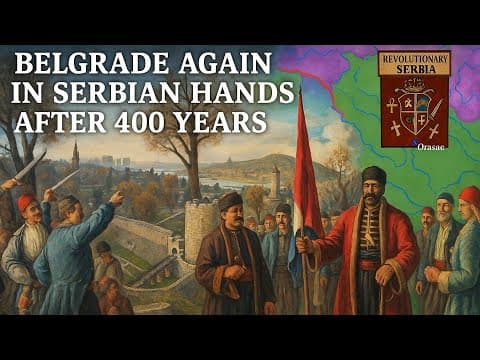
⚔️ Belgrade Falls to the Uprising 🔥 Serbs Capture the City, Insurgent conquest of Belgrade in 1806/7
Steps Through Time
7m 40s1,184 words~6 min read
Auto-Generated
Watch on YouTube
Share
MORE TRANSCRIPTS