[0:00]Jupiter has dramatically shaped our solar system. 4 and a half billion years ago, a huge amount of gas that still swirled around the Sun pulled Jupiter towards the inner solar system, before it migrated back again. During this hundreds of millions of years long journey, Jupiter crossed the primordial asteroid belt twice, mixing the rocky objects from the inner and icy objects from the outer solar system. Jupiter's massive gravity shattered any larger objects before they could form planets, while simultaneously pushing many of the water-bringing asteroids that will eventually also crash onto Earth towards the inner solar system. Once Jupiter arrived at the distance where Mars is now, it had already redistributed a lot of dust and particles into a concentrated band, which was just the ideal area for Earth to be formed. At the same time, it left the Mars region quite empty, which is why Mars is smaller than it could have been without Jupiter. Eventually, another gas giant, Saturn caught up. Locked together with Jupiter in resonance, they changed the balance of forces in the gas around them and began to drift outwards again, to where we find them today. So, for the solar system as a whole, and life on Earth - thanks Jupiter!
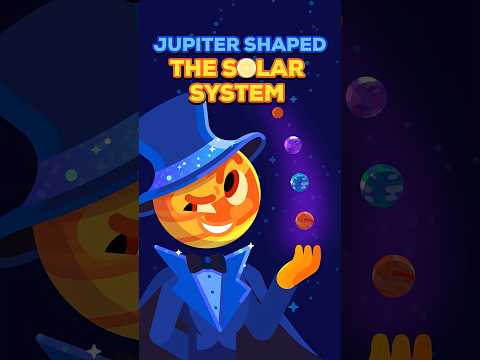
Jupiter Made Earth Possible
Kurzgesagt – In a Nutshell
1m 12s210 words~2 min read
AI audio transcription
Transcript source
AI audio transcription
This transcript was generated from the video's audio because no usable YouTube caption track was available. The transcript below is server-rendered so it can be read, searched, cited, and shared without opening the original YouTube player.
Pull quotes
[0:00]4 and a half billion years ago, a huge amount of gas that still swirled around the Sun pulled Jupiter towards the inner solar system, before it migrated back again.
[0:00]During this hundreds of millions of years long journey, Jupiter crossed the primordial asteroid belt twice, mixing the rocky objects from the inner and icy objects from the outer solar system.
[0:00]Once Jupiter arrived at the distance where Mars is now, it had already redistributed a lot of dust and particles into a concentrated band, which was just the ideal area for Earth to be formed.
[0:00]At the same time, it left the Mars region quite empty, which is why Mars is smaller than it could have been without Jupiter.
Use this transcript
Related transcript hubs
Watch on YouTube
Share
MORE TRANSCRIPTS


