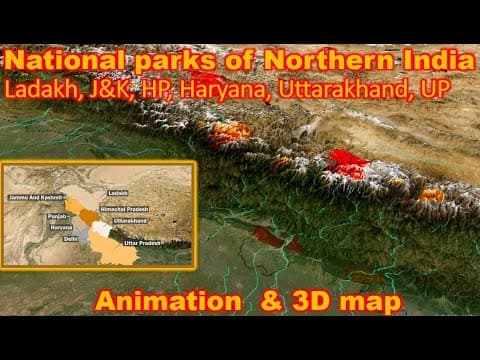
[0:11]Hello friends, welcome to another video of Zeta Axis, and today we are going to discuss National Parks of Northern India. We've divided this series on National Parks of India into different parts where in each video we will cover National Parks in a region of India, thus to keep the length of the video within manageable limit. In this video we will discuss about the National Parks in Ladakh, Jammu and Kashmir, Himachal Pradesh, Punjab, Uttarakhand, Haryana and Uttar Pradesh. So let's begin. The first is Ladakh, which is an Union Territory. And the Ladakh Union Territory has only one national park, that is Hemis National Park. So we will start with Hemis National Park in Ladakh. The Hemis National Park was established in 1981. It is a high altitude region and it is also a important bird area by Bird Life International. So here we can see this is the Hemis National Park. It is within Ladakh Union Territory of India. If we see this region then it is very close to Leh just in the southern side of Leh City. The Indus River forms the northern margin of Hemis National Park and the Zanskar River forms the southern margin. In fact, both of these rivers meet in the northern margin of Hemis National Park. The Hemis National Park is also the only national park in India which is in the north of Greater Himalayas. So you can see that this National Park is completely located in Trans Himalayan region. Here we can see the geographical characteristics of this region. You can clearly see that it comprises of high mountainous region. And because it is in Trans Himalayas, the average elevation is very high. We can see it ranges from 3300 meters to 6000 meters above sea level. Here is the satellite image of the Hemis National Park. We can see that there are these ice covered mountains. Now because of its high altitude and arid climate, much of the park features barren or dry forests. However, lower altitudes support fir forests and various medicinal plants. So in the lower parts we will see some vegetation, but the higher altitude regions are generally barren. If we see this diagram, we can see that this is a example mountain. Here we can see that there are coniferous forest and as we move higher we will see that there are Alpine Meadows, that is small grass lands on the hill slopes and then we have the snow line above which we do not find any vegetation. So in the Hemis National Park in this region, that is of the coniferous forest region, we will find these type of trees. Now to understand the landscape which we discussed in the previous slide we can see here in this figure. Here we have coniferous forest and as the altitude increases this coniferous forest transforms into Alpine Meadows, that is small grasslands. Now this Hemis National Park is in the Tibetan Plateau Alpine Steppe Eco region. Steppe is grasslands, Alpine is mountainous grasslands. So the Hemis National Park is basically in the region where there is Alpine Meadows or Alpine grasslands. The Snow Leopard is the most important species of Hemis National Park and it has one of the highest density of snow leopards in the whole world. The other important animals of this Hemis National Park are Himalayan Wolf, Eurasian Brown Bear, Bharal or Blue Sheep, Red Fox,
[4:10]the Himalayan Marmot and the Shapu or Urial. So you can see that this terms in the bracket they indicate what is the IUCN status of these animals. So VU means vulnerable, so all these animals are vulnerable where there is VU and LC means least concern, that is they don't have any current threat. Now let's move on to our next Union Territory that is Jammu and Kashmir Union Territory where we have four National Parks. These National Parks are Kishtwar National Park which is located in the southern side, then we have Dachigam and Salim Ali City Forest and then in the north we have Kazinag National Park. So let's see each of them one by one starting with Kishtwar National Park. It is again a high altitude National Park and it is a Important Bird Area designated by Bird Life International. It was established in 1981. So the Kishtwar National Park is located in the southern side or southeastern side of Jammu and Kashmir Union Territory near the Ladakh border. The Chenab River, it passes very close to the southern margin of Kishtwar National Park. Several tributaries of Chenab, it flows through the Kishtwar National Park. Rinnay is the river which forms the northern boundary of Kishtwar National Park, the Kibar Nala forms the southern boundary of the Kishtwar National Park, while the Marwah River forms the western boundary of Kishtwar National Park and all these they merge and they then meet the Chenab River. So we can see that all these are tributaries of Chenab River. The Kishtwar National Park is basically part of Greater Himalayas. So we can expect that these are high altitude mountains in this National Park. Here we can see the geographical characteristics of the region. And again, because the Kishtwar National Park is within Greater Himalayas, we know that there are going to be high rising mountains in the region, which forms these deep valleys. Here is a satellite image of this National Park. We can see the Kishtwar National Park over here which is covered by snow covered mountains. The park's elevation ranges from 1700 to 4800 meters above sea level. So we have seen that it is also high, but it is not as high as Hemis National Park. The landscape is rugged and steep, characterized by narrow valleys and high ridges. See, these rivers which flow in between these mountains, they form very narrow valleys and gorges. It lies in Central Crystalline belt of Greater Himalayas. Again, here because it is having high mountains, it will have these kind of vegetation.
[7:07]At the lowermost region we will have deciduous trees. The Hemis National Park, because it was at such a higher level, the deciduous trees were not there at the bottom. It started from here. But here in the Kishtwar National Park we will have deciduous trees at the lower level, then as the height increases in the National Park we will have coniferous trees, subalpine vegetation and then Alpine Meadows. And in each of these, these are the types of trees we find. Snow Leopard is again the most important animal in this National Park. Hangul Deer is also found in the Kishtwar National Park in lower numbers. Most of the Hangul Deers which are there in Dachigam National Park, they migrate to Kishtwar National Park during the winter season and they again move back to Dachigam National Park during the summer season. This Hangul is also a state animal of Jammu and Kashmir and it is the only breed of Red Deer within India. These are critically endangered species and therefore their conservation is very important. These are the other important animals found in the Kishtwar National Park. Musk Deer, which is endangered, then we have Himalayan Black Bear, which is vulnerable, and then we have Himalayan Brown Bear, which is critically endangered. Then we have Snow Leopard, which is vulnerable, Leopard Cat, least concern, and then Markhor, which is near threatened. Next is Dachigam National Park. The word Dachigam means 10 villages. So the name comes because 10 villages had to be emptied for making this National Park, hence the name Dachigam National Park. This National Park is also a high altitude National Park, that is it is located on the mountainous terrain. Here we have Project Hangul. Hangul is the state animal of Jammu and Kashmir, which is critically endangered. So a project to conserve the population of Hangul is being carried out in Dachigam National Park and it is also a Important Bird Area marked by Bird Life International. It was formed in 1981. So we can see the location of Dachigam National Park. It is in the central J&K region, it is very close to Srinagar and just east of Dal Lake. The Jhelum River flows over here. The Dachigam National Park is located over the Zabarwan Range. These Zabarwan Range are actually an extension of Greater Himalayas. So even the Dachigam National Park is within Greater Himalayan ecosystem. Here we can see the region or the terrain of the Dachigam National Park. This is the Dal Lake, here we have Srinagar and we can see that these are the Zabarwan Range and here we have Dachigam National Park. Here we can see the terrain of this region. It is again a mountainous region and having a river valley in between. Here is the Dal Lake. This is the satellite view of this region where we can understand the characteristics of this region. The Srinagar City is clearly visible. We can see the Dal Lake over here and this whole region is marked by Dachigam National Park. The average elevation of this region is 1600 to 4200 meters above sea level. So this is quite similar to Kishtwar National Park. Here is the distribution of vegetation in this National Park. In the lower part of the slopes of this National Park we find Broadleaf Forest. As the height increases we have coniferous forest in which in the lower slopes we see Deodar trees and in the higher slopes we see Fir and Spruce and as the height increases we have Alpine Meadows. The general characteristics of this National Park includes deep valleys formed by the rivers flowing in the mountains, rocky outcrops of these mountains, steep wooden slopes. The slopes are also very high or the gradient of the slopes is very high because of the terrain and then there are rolling Alpine pastures. So on these mountains, somewhere there are Alpine pastures and there is gentle up and down in this region. So all these types of landscapes can be seen in this National Park. Hangul is the most important animal in this National Park. It is critically endangered and therefore Project Hangul is carried out in this National Park to conserve the population of Hangul. It is also called Kashmir Stag. It is the state animal of Jammu and Kashmir and it is the only species of Red Deer found in India. The other important species found within the Dachigam National Park are Musk Deer, which is endangered, Himalayan Black Bear, which is vulnerable, Himalayan Brown Bear, which is critically endangered. Then we have Snow Leopard, which is vulnerable, Leopard Cat, least concern, and then Markhor, which is near threatened. Let's move on to next National Park that is Salim Ali or City Forest National Park, which was formed in 1992. This is a small national park located within Srinagar City. It is named after Salim Ali, who was an ornithologist or basically bird watcher. And that is why he is called Birdman of India. Here is the Salim Ali City Forest and we can see its location. It is very close to Dachigam National Park. This Salim Ali City Forest is located within Srinagar, right on the banks of Jhelum River in between Dal Lake. The Salim Ali National Park mainly has mix of wetlands, forest and grasslands. The other important animals are Hangul, Indian Leopard, Himalayan Black Bear and Musk Deer. The next important National Park of Jammu and Kashmir is Kazinag National Park, which was established in 1992. It is also a high altitude region. The Kazinag is located in the northernmost or northwestern side of Jammu and Kashmir. It is right on the LOC as we can see over here. The Kazinag National Park is located in Baramulla District of Jammu and Kashmir Treaty and is located right on the Jhelum River on the northern bank of the Jhelum River in the Baramulla City. It is very close to Srinagar and the LOC, it passes on the western side of this National Park. This Kazinag National Park was established as a method to protect Markhor animal in cooperation with Pakistan, which also has some protected areas in this region in continuation of the Kazinag National Park. The Kazinag National Park is part of Pirpanjal Range that is Lesser Himalayas. Here we can see the terrain of this region. The Jhelum River passes over here and this region is the Kazinag National Park. Here we can see the landscape in three dimensional view to give you a very good understanding of this region. These are the mountains of this region and here we can see the Jhelum River. Here is the satellite view of this region. The Jhelum River flows to the southern side of this Kazinag National Park, which has an average altitude of 1800 to 4300 meters above sea level. Here is the distribution of vegetation in this National Park. In the lower part of the slopes of this National Park we find broadleaf forest. As the height increases we have coniferous forest in which in the lower slopes we see Deodar trees and in the higher slopes we see Fir and Spruce and as the height increases we have Alpine Meadows. Here is the example of these three types of landscape. At the lowermost part we have broadleaf forest. As the height increases we have coniferous forest where Deodar trees are seen at lower altitude and fir and spruce are seen at high altitudes. And then we have Alpine Meadows, which we can see at the top over here. So these are grasslands, which are close to the peak or close to the higher latitudes. Markhor are the most important animals in the Kazinag National Park. The Kazinag National Park plays a very crucial role in conserving its population and it is also established or it also works in cooperation with Pakistan, because this Markhor is also National Animal of Pakistan. This is a variety of goat. The other important animals of this Kazinag National Park are Markhor, which is near threatened, then we have Musk Deer, which is endangered. Then there is Himalayan Brown Bear, which is critically endangered, then there is Indian Leopard, which is near threatened and then we have Himalayan Black Bear, that is vulnerable. Now let's move on to Himachal Pradesh, which also has five National Parks. These National Parks are Inderkilla National Park, Pin Valley National Park, Khirganga National Park, Greater Himalayan National Park, and the southernmost Simbalbara National Park. So let's see each of these National Park one by one starting with Inderkilla National Park. The Inderkilla National Park is also a high altitude National Park. It is also an Important Bird Area marked by Bird Life International. The Inderkilla National Park was established in 2010. The Inderkilla National Park is located in Kullu District of Himachal Pradesh. The Chandra River, which is a tributary of Chenab River, the Chandra River meets with Bhaga River to form the Chenab River. This Chandra River flows through the northern margin of Inderkilla National Park. The Inderkilla National Park is located within the realms of Greater Himalayas. So we can expect that some high rising mountains will be there in the National Park. Here is the terrain of this region. We can see that there are some snow covered mountains in this region. If we see the three dimensional view of this region. We can clearly see that there are some high rising mountains and river valleys in this region.
[17:19]This is the satellite view of this region. Again, the vegetation is also quite similar to other Greater Himalayan National Parks. There is at the lower slope deciduous trees, then coniferous trees and then Alpine Meadows. And here we see that in the coniferous forest we generally have spruce, fir, walnut, Juniper trees and at the higher slopes where the trees give place to the Alpine Meadows we have Rhododendrons trees. The Inderkilla National Park is located in the picturesque Kullu Valley and therefore it has some very scenic views. The park is known for its diverse ecosystem and scenic beauty. The important animals in this National Park are Himalayan Black Bear, Indian Leopard, Himalayan Ibex and Himalayan Brown Bear.
[35:47]The next important National Park of Uttarakhand is Jim Corbett National Park established in 1936. So it is the oldest National Park. It was established before independence. It has Terai ecosystem. It is part of Project Tiger, that is it is also a tiger reserve. It is also an elephant reserve, it is part of Shivalik Elephant Reserve and it is also an Important Bird Area marked by Bird Life International. The National Park is named after Edward James Corbett, who was an environmentalist and he played a key role in forming the National Park. Here we can see the location of Corbett National Park. It is located in Nainital District and Pauri Garhwal District of Uttarakhand. The Ramganga River, which is a tributary of Ganga River, flows right through the middle of Corbett National Park. Again it is part of Shivalik Mountain. If we see the three dimensional landscape of the region, then we can see that here we will again have very low altitude compared to other National Parks which we have seen or which we are going to see. So these are very close to the Indogangetic Plain and thus have very low altitude. It is situated in the foothills of the Shivalik Range, Terai region. This is the satellite view. We see the Ramganga River passing through Corbett National Park, many rivers, these are smaller rivers and therefore they give it a Terai landscape. There is another smaller river which is Kosi River which passes through the Corbett National Park. The Corbett National Park was the first National Park established in 1936. It also came under the Project Tiger initiative. It was the first tiger reserve established in India and therefore we have Corbett Tiger Reserve. The Jim Corbett has one of the highest tiger densities in India. The Corbett National Park is also part of Shivalik Elephant Reserve.
[37:44]Therefore, the Indian Elephants can be seen in herds in several hundred numbers. So there is a huge population of elephants also found in the Corbett National Park. The National Park mainly consists of Dense moist deciduous forest mainly consists of the Sal tree. So in this region you will mainly find Sal forests. Gharials and Mugger Crocodiles are also found in this National Park, especially in the Ramganga Reservoir.
[50:16]I hope you like our take on the National Park. We have tried to provide a very detailed view of the landscape as well as characteristics of the National Parks. Therefore, you can take on any questions coming from the competitive exams. We will be continuing this series in which we will cover all the national parks as well as tiger reserves, elephant reserves, wetlands, lakes of India. So keep watching, if you have liked the video then do subscribe to the channel and share it with your friends and if you like what we are doing then you can support us by using the Paytm ID. Thanks for watching the video.


