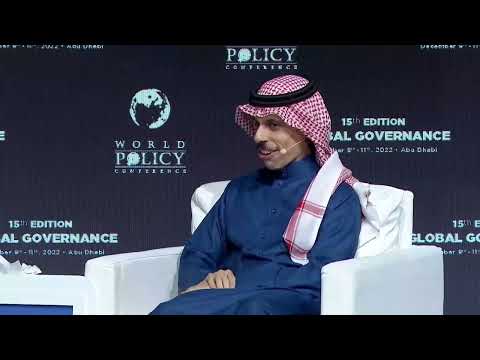
[0:06]Well, I want first to thank very much Prince Faisal Al-Farhan to have come here especially from Riyadh to to talk with us tonight. And immediately after our discussion, he will fly back to Riyadh for a dinner. My my only, I would be totally happy if you had invited me for dinner in Riyadh tonight. Uh, but nevertheless it is such a present to be here that nevertheless I am very pleased. Well, there you thank you. I'm extremely pleased to be able to be here and to have a conversation with you. I always enjoy our conversations and it's glad to share it with all of your friends here and you have an open invitation to come have dinner in Riyadh anytime you want. Thank you. Thank you very, very much. Uh, now, uh, I am grateful to you for a second reason. I apologize for your collaborators because I understand that you had a very good speech prepared. Maybe it could be distributed by the way to us, uh later on, but you have agreed to replace the speech by a a discussion between the two of us. So, uh, let me start by a simple question. I everybody understand that you have been extremely busy the last three days. So what can you tell us uh about the uh, the meetings uh you had in the last three days especially on China? Well, we had an excellent group of meetings. We actually had three summits yesterday. One was just our regular GCC summit, which again focused on continuing to improve and to grow into GCC cooperation. And actually something I did want to point out is that we announced in that summit, His Royal Highness announced that we will be proposing a renewed vision for the GCC. We already have what we call the King Salman Vision for the GCC program, which resulted in a lot of the economic integration that we've already seen, and we are now working on presenting basically version 2.0 of that. Uh, after that we had the GCC China Summit, and then we had the Arab China Summit. Both of them were inaugural events, the first of their kind, and uh for us, of course, it's an incredibly important uh uh prospect to continue to increase our cooperation with our main trade partner. It's China is the main trade partner for not just Saudi Arabia, but I believe for almost all of the Arab world. And having this dialogue with the second largest economy in the world is for us critically important as we continue to build our partnerships in the global environment in a way that fosters the opportunities for growth and prosperity for all. So in this global environment, how do you position yourself in the current increasing tensions between US, China, now the war in Ukraine and so forth and so on? And particularly as far as the oil production is concerned. So for us from our perspective, polarization is the last thing we need right now. You know, we already see tremendous pressures on the global economy, which you see tremendously, you know, inflation, uh, other issues, food security, and more polarization is not a way to solve that. It's only a way to exacerbate it. So our opinion is that we need to build bridges, that we need to strengthen connections, and that we need to find areas of cooperation. The China Arab world China GCC Summit was one iteration of that, just like the Jeddah Summit with the US was. It's our attempt to continue to build bridges with all of our international partners. You know, the kingdom is this year the 15th largest economy in the world. It is the fastest growing economy in the world. We will be hopefully this year the first time reaching a trillion dollars in GDP. So we are growing in importance in part of the, as part of the global economy, and our position, the Kingdom's position, but also the GCC's position as really a bridge between East and West is something that we want to emphasize, that we want to build on so as to address all of these challenges that we are facing. And, uh, you know, we live in a complicated world, a difficult world. There are always going to be issues that need to be addressed, but the best way to address them is through dialogue, is through interaction, is through cooperation, and that's our approach. Would you for to describe your own foreign policy, would you, uh, accept to use the word that the Indians use multi-alignment or maybe multi-non-alignment? Maybe you would prefer that. Yeah, it's not about alignment, it's about finding areas of cooperation. For us, our foreign policy is driven by our need to build sustainable prosperity, first for the Saudi people, but then for the people of our region, and we hope for the people of the world. Uh, and we look for every opportunity to build on that goal. So, if there is an opportunity to work with a partner on the global stage to further our uh uh ability to strengthen our economic programs, our social programs to strengthen our region, and that can happen only through cooperation, we will follow those avenues. But if you if you are interested in reducing contributing to reduce tensions in this, as you said highly more and more complex world, uh since you are not or not yet a superpower, uh the main interlocutors, I'm thinking of US and China, have to agree with the idea that reducing tension is a desirable goal.
[6:01]So, do you think uh that today the uh US and China are willing to reduce tensions on the whole? I can't speak for whether or not they're willing, but I can tell you that it is our firm conviction is that they must, and that a rise in tensions is not just detrimental to them, but of course to all of us. And here it's important that we, the Kingdom of Saudi Arabia, as uh a leading economy, as we just said, 15th largest economy, we expect by 2030 to be at least in the top 10 if not ahead of that. But also as a part of the developing world, to galvanize the voices of the developing world, to galvanize the voices of those countries that are most interested in a brighter future, in talking to all of our partners to say, look, let us focus on the future. Let us focus on cooperation, competition is a good thing, but uh competition that leads uh to conflict is a bad thing, it's bad for everyone. It can only, uh, be destabilizing, it can only, uh, raise, uh, uh, the prospects of, uh, uh, starvation in the developing world, of deprivation, all of these things. So we need to focus on building bridges. We need to focus on cooperation. We need to focus on how do we build sustainable prosperity for us as individual countries, but also for the global community. You did not answer to the question oil production because after all President Biden, as far as I can understand, visited Saudi Arabia somewhat reluctantly. But he did so, well, if I read the newspapers, he did so because he expected, uh, that, uh, OPEC and yourself would agree to increase, uh, production. Uh, so, uh, what, uh, what can we say about that? We can say that Saudi Arabia, OPEC, OPEC plus have a very consistent policy. Our policy is to maintain a stable market. We have worked very, very hard to ensure that market stability in very difficult times. If we go back to 2019-20, when we had COVID, we had a serious disruption in the oil markets, we saw prices in some areas go to negative, which disrupted investment in the production of energy, which led to constraints on the markets. We intervened, we brought markets back into balance. We continue to do that. And if you look at the oil market compared to the gas market, for instance, or compared to coal markets, whether in Europe or elsewhere, you will see that oil has been relatively stable compared to all other sources of energy, even renewable energy. And why is that? Because we have been actively engaged in maintaining stability in the market. Uh, you know, we have talked to all of our partners, the US, others, and we have explained very much our approach. And, uh, you know, the recent OPEC plus decision, uh, going back, uh, to October now, uh, where we announced the $2 million cup, uh, I think we can now see, given where prices are, that that decision was entirely justified.
[9:16]And one of the things we have to remember, uh, uh, the price has to be fair to consumers and suppliers. Because without a fair price for suppliers, suppliers will stop investing, and we are already seeing significant lack of investment in the hydrocarbon space because of the green agenda and other issues. But in the long term, that may be okay, but in the short and medium term, that is a problem because we are seeing spare capacity continuing to come down. If we see a significant recovery in China, which we all hope economically will benefit, you know, will happen. If we see, uh, the prospects of a recession dimming and global economic growth going up, we will see significant reductions of spare capacity because of the lack of investment. The only way we can ensure that there is enough investment and enough spare capacity to to cushion us from supply shocks in the near and medium term is if the price is fair to suppliers and consumers. And I would argue that the price at we we are where we are now is fair. Most important is it stable, which means that investors, whether it's governments or major companies can see the prospects of a stable oil price now and into the future, which means that they can make their investment decisions based on that stability.
[10:59]We don't see that in other energy markets, and that is our core priority. That is the mandate that OPEC and OPEC plus have, price stability.
[11:15]Thank you very much. This is a very precise answer. More generally, what can you tell us about Saudi Russia relations? So we have had relations, uh, uh, actually, uh, since, uh, after their first Gulf War, and we have continued to have strong relations, good relations. We've tried to improve them. We work very closely together, of course, with an OPEC, OPEC plus historically, and that, as we, I just explained, has delivered benefits to the energy market, to the oil market.
[11:51]Obviously, uh, the situation, the conflict in Ukraine, uh, is something that is of great concern to all of the global community, and, uh, you know, we have expressed our opinion that in the United Nations General Assembly. But we, as I said in my first remarks, believe in dialogue. So our priority is dialogue, and that includes talking to Russia, who we still consider, uh, uh, as, uh, uh, someone that we can deal with, that we have a good relationship with.
[12:31]We have seen, uh, that relationship, uh, help, uh, for instance, in, uh, some prisoner swaps. So, you can build on these connections, these relationships, these trusts, to help dialogue. You know, we have tried to continue to foster a dialogue between Russia and Ukraine, and we continue to have an engagement. Something that many don't know is that we actually have a commercially, our relationship with Ukraine is our trade relationship before the conflict with Ukraine was larger than it was with Russia. So, we have a strong relationship with both of those parties, and we are focused on continuing to foster the potential for dialogue. This conflict will only be in the end resolved through dialogue, and we need to focus on that. And well, now many experts and commentators complain that the US policy in the Middle East is not totally clear to to say the least. Which, of course, might have some serious implications because, as they say in physics, uh, nature abroad, uh, void. So, uh, could you comment on that? I certainly think that the US has an important role to play, and that part of that role is, of course, in the in our region, is being very engaged.
[14:20]I think they are engaged, and I think we have having a very good conversation with our partners in the US.
[14:54]But we do need to have a real strategic dialogue, and that's something that's happening, it's happening on the bilateral level, but it's also happening GCC, US, it's happening Arab World US. So we are, I think the US is playing an important role and will continue to play an important role in the region, especially from a security perspective. And if you compare Biden to Trump, or even Obama, can you, are there noticeable differences? Every president will have different in style. Every administration will have differences in approach and certainly you, you know, policy is very different between a Republican administration and Democratic administration. So there will be clear differences, but in the end, I believe US interests are the same, whether a Republican administration is in office, a Democratic administration in office. They may approach those interests differently, but we have had a strong relationship with the US through multiple administrations, Republican and Democratic. So we are very accustomed to dealing with changes in approach. In the end, the joint interests that bind the US to the region are the same, they continue to exist, and I believe they will continue to exist in the future. And that means that the space for cooperation between the kingdom, the GCC, and the US will continue to be very solid. So, to continue this tour de raison, uh, as we say in English, uh, the, uh, what about the JCPOA? A double question, in fact. Is there, in your judgment, is there still a chance that the treaty will be saved, or is it now inevitable that Iran will become a nuclear power, and if so, what do you do? So, is there still a chance? Certainly, there is always a chance. I cannot say there is no chance. Uh, what I will ask you, does necessarily reaching a JCP, a mean that we will not have a nuclear armed Iran? I am not so sure. You know, we are quite skeptical about the JCPOA. That said, we continue to support, uh, an engagement on the JCPOA and a return to JCPOA, uh, on the condition that that be a starting point, not an endpoint. So it would be a starting point to addressing some of the deficiencies within the JCPOA and some of the other issues of concern. The signs right now are not very positive, unfortunately. Uh, we hear from the Iranians that they have no interest in a nuclear weapons program. It would be, uh, very comforting to be able to believe that. Uh, we need more assurance on that level. If we don't reach a JCPOA, I think we enter a very, very complicated, uh, uh, period in our region, a very dangerous period that we should avoid. That said, even if we did come back to a JCPOA, I'm not sure that that is the end. I think we need then to look beyond that to a stronger agreement. Can you elaborate a little further? On what happens if they get a a operational nuclear weapon? I think, uh, clearly, if the if the if Iran, uh, gets an operational nuclear weapon, all bets are off. We are in a very dangerous space in the region. Uh, you know, we have already seen significant activity from Iran. We could see much more risk from that, and of course, regional states will not want to, uh, you know, to be exposed to such a threat without a reaction. So, you can expect that regional states will certainly, uh, uh, look towards, uh, how they can ensure their own security.
[19:07]A few words on Europe. Saudi, Europe, European Union, France, in particular, because France is my country. So, this is my country. Yeah. Of course. Uh, we have started last year, actually, uh, we signed an agreement strategic framework with the European Union, between the GCC and the European Union, which has already brought significant progress. We restarted our trade talks after they had been stalled for many, many years. So that's a positive sign, and I think, uh, you know, Europe is still one of our main trade partners, and it's a very important technological partner, so there's a lot we can do with Europe. I would say that Europe needs to be more engaged in this region. Uh, we have a lot to offer, uh, Europe in this region. We are, of course, already a very important energy partner, but we are also a very important partner for the energy transition. So Europe cannot achieve its carbon neutrality goals without this region, because you cannot produce enough renewable energy in Europe. We are investing, the kingdom, others in the region, tens of billions, hundreds of billions of dollars in developing green hydrogen capacity, in developing solar energy capacity, wind capacity, the capacity to export that green energy to Europe and elsewhere. So, we will be a key partner for Europe well into the next century, so we want to build on that partnership. The relationship between the kingdom and France is very, very strong. I can say, uh, that we can see President Macron is very engaged in the region, is very active in trying to work with France's partners in the region. And we have built a excellent working relationship with our French counterparts across the board, whether it's in the economic side, but also the political side, dealing with regional files, whether it's Lebanon, Iran, etc. So we, uh, we look towards strengthening that relationship, and France has been, as I said, very proactive, and that's something that we, uh, we appreciate. So, uh, I, I would like to spend the last few minutes to say a few words about the domestic situation because I think not so many people in Europe in particular understand what is going on in Saudi Arabia, and a lot of things are going on. But before that, is there any important question on foreign affairs that I did not ask? I would not presume, uh, uh, Terry, to tell you what is important in foreign affairs. That's what I call you and ask.
[22:11]Well, but if anyone here thinks there is one important question that I did not ask, which is very possible, you know. Because, uh, but apparently one, two, three, no. I'm talking of global affairs. Well, well. Apparently, I don't see. Oh, yes. Yes. Maybe you're right. Abraham Accord. That's good question. Sure. What's the question? Huh? What's the question? What is the answer? Because, you know, if the question, uh, it's, it's better to start from the answer, because after all, you have there are big actors. I can tell you what the answer is. Yeah. The answer is a Palestinian state. The answer is a Palestinian state. Yes. Yes. Yes. Yes. Yes. I remember the discussion in Paris on that, and that's, that's a very, uh, serious point. So, uh, next time we have the pleasure of being with you, perhaps we should concentrate with a few others on the issue of the, of the Palestinian state. Well, now, uh, if if I think we have maybe five for more minutes, something like that. Uh, I think we should it will be good to take the opportunity of having you because you are, uh, typically representative, the new generation of, uh, leaders in, uh, Saudi Arabia. If I may remind you, uh, of course, Saudi citizen, your father is Saudi, but your mother was, uh, German citizen. You speak, uh, Germany, uh, as as fluently as English. His English is extremely good, too, I must say. So you're a very international, there is a new generation of business people, open to the world. So, can you just tell us a few words about how you see your country today and the dream of the young Saudis for the next generation, let's say. First, I am actually already relatively old because I'm in my late 40s. And 70% of Saudis are under 35. So I am, uh, I'm actually one of the later generation. But I am happy to contribute as much as I can under the leadership of His Majesty the King and the Crown Prince to setting up the future for this younger generation. And I think it's a tremendously exciting time to be working in the Kingdom of Saudi Arabia. Uh, we are undergoing breakneck change. Uh, we are, uh, most importantly, working under a clear roadmap, under a clear vision. And I referred to it earlier, building sustainable prosperity for the Saudi people, and that is the absolute priority, the absolute driving ethos of everything that the government of Saudi Arabia does, whether it's domestic policy, whether it's foreign policy.
[25:40]So, my mandate as foreign minister is very clear. My mandate is to support and to enhance the prospects of achieving the goals of of that vision.
[26:01]Sustainable prosperity for the Saudi people. And that's what I spend most of my time on, and that's tremendously exciting to have a very clear direction, what you're working on, what are the goals, what are the objectives. And of course, we could go into any number of details, uh, but, you know, we mentioned one of them. The fact that we are, uh, this year going to, uh, probably reach $1 trillion GDP size for the first time in our history. The fact that Saudi Arabia with all of the challenges that this region presents is the fastest growing economy in, uh, uh, the world. That we are on track to being the fastest growing economy in the G20 for the next five years, according to our estimates. The fact that we have, uh, uh, plans in place that will likely mean that we are, uh, by 2030, in the top eight economies in the world.
[27:18]All of that means that it's a tremendously exciting time to be part of the government under the leadership of the king and the Crown Prince, and it means also that we have a lot, a lot, a lot of expectations to live up to. But you know, we have a fantastic team, we have fantastic energy within the government to work that. And most important, if you, you know, we hope you can visit us in the Kingdom and all of you here, you can see the energy in the Kingdom, and that energy is infectious. You can see people really being excited about the future. You can see people being, uh, engaged, uh, and in the future. Uh, unemployment numbers are down. Home ownership numbers are, are at historic highs.
[28:18]Um, you know, we are now already very long around on the path towards diversifying our economy away from a dependence on oil. Uh, all of these targets are moving steadily ahead, and that is contributing not just to the success of the kingdom, but also we hope and we believe to the regional success. Do you, of course, the country is extremely young, as you reminded us, but, uh, do you still have, uh, resistance, some kind of social resistance from the older and older generation? So, as one of that older generation, I can tell you that. No. No. I am talking the my generation, for instance. My generation of Saudis. You would be surprised. This is something that I think everything that the kingdom is doing because we are doing it in a very, very well-studied way. Because the leadership has taken care to study every decision and based it on a clear logic, a clear logic of numbers, a clear logic of, uh, uh, of necessity. Everyone understands, and everybody is excited. Even the older generation, you know, people that are older than I, people are very, very engaged, and I hope, you know, when you visit the kingdom, Terry, you will see how engaged everybody is across the board. You know, everybody will have their opinions, but in the end, the energy, the prospect of moving towards the future. I think what you will hear most of most people is we've been waiting for this for many years, and we're just so happy that we get to see it. So, a very last question, we could spend a lot of time with you, but you already were very generous. But a very last time that would bridge the two topics, that is foreign affairs and domestic affairs. There is a very classic subject, very much discussed by, uh, professors, that is the relationship between domestic and foreign policy. So, in your position today, how do you see this relation? Absolutely key. So, I I alluded to it earlier, my mandate from my leadership is very clear. Saudi Arabia's foreign policy is a tool for its domestic prosperity. That is the top priority. How can we deliver sustainable prosperity for the Saudi people? Everything we do on the foreign policy issue must be focused primarily on that, and that, of course, means protecting our interests, building partnerships, but it also means building a stable, secure region because you cannot build prosperity in a turbulent region. It also means working with our global partners to ensure global stability, because as we have seen from the conflict in Ukraine, uh, a crisis anywhere in the world can have impacts all around the world. So, we must, if we want to protect our pathways to sustainable prosperity, we must be engaged in the world. So, one of the results of that mandate is that we are trying to be more engaged, not just in our immediate region, but globally, in a way that serves our interests, but it serves the interests of the wider global community, with a focus, I have to say, really on the developing world. Because for us, uh, you know, we feel very strongly that the developing world's voice has not been heard enough, and we are, of course, part of the developing world, still. Uh, you know, and we see that the global agenda historically has often been set in a way that has ignored the interests of developing countries. Most of the time out of the best intentions, but still, uh, they have not served really effectively the developmental path of those developing countries in a way that is most effective. So, we want to be part of the global conversation in a way that ensures everybody has a pathway to prosperity, because we, you know, even in the regional context. We have taken an approach that it is absolutely key that our immediate neighbors are not just stable, they are also prosperous. Because if they have a growing economies, if they have, uh, uh, growing markets, that is for us an opportunity. And vice versa, if we are stable, if we are growing, we provide a great market for them. So that's the key focus for our foreign policy. You know, at a at a different scale, it seems to me that the formulation your formulation is very close to that that we had yesterday, a similar discussion with Dr. Anwar Gargash, uh, on, uh, the, uh, UAE foreign policy. So you, you're your general philosophy is, is quite similar. I think if you talk to any GCC foreign minister, you will hear the same message. And this is just a reflection again that we are very much a strong unified block, and that we work together very effectively. That we have very similar visions. Our leadership in the UAE, in the kingdom of Saudi Arabia, you know, our various countries' leaderships are very close to each other. They work together. They work towards ensuring prosperity for not just their countries, but the region. And we're going to continue to do that. I will ask our European Union friends to follow your example. We are happy to share our experiences. Well, it's time to end this session. Thank you very much. I think you were great if you allow me to speak in this way. Excellent discussion, and, uh, I wish you all the best for you personally, for your country, and I hope that Saudi Arabia will be more present in the World Policy Conference in the, uh, forthcoming years.
[35:36]Thank you very much, Terry. Thank you, all.


