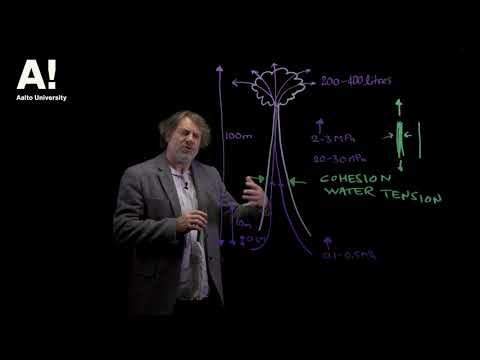
[0:05]Okay, so I'm going to talk about how water gets up the tree. Trees form structures that can be up to 100 meters in height, which is, that's pretty big.
[0:15]How does the water get up to the top of the tree? We're looking at evaporation of something like between 200 and 400 liters of water a day when a tree's being active and it's growing, and it's photosynthesizing.
[0:28]That's an enormous amount of water per tree that is being taken out the soil and put into the atmosphere.
[0:35]If we have a column of water and we apply vacuum to the top of that column, atmospheric pressure will force the water up something like 10 meters. So that's a tenth of the height of a tree.
[0:48]So it's not clearly not a vacuum that's pulling the water up the tree. If we relied purely on capillary forces, that's the small capillaries that we have in trees, we'd be looking at less than 0.6 of a meter.
[1:03]So it's not capillary forces. So what is it? It's water tension on the column inside the tree.
[1:10]So we have capillaries in here, and on the water column we have, or in the water column, we have cohesion between the water molecules because we have this hydrogen bonding which I talked about elsewhere.
[1:23]That cohesive force acting on this column, something like 2 to 3 mega Pascals gives you this tension in that column.
[1:34]So we're pulling on this column, and the column doesn't break because it can resist forces as high as 20 to 30 mega Pascals, which is something like the about 10% of the tensile strength of copper.
[1:50]So that's pretty significant, that's how strong hydrogen bonds can be. However, if we're pulling on this column in this capillary, we're going to be pulling inwards. The capillary is going to be collapsing.
[2:00]So the capillary itself has to resist these forces which they do extremely well. It's the lignin that really stops that collapse from occurring.
[2:12]But because we're pulling on this, when the tree is operating, it's photosynthesizing, it's operating during the day, it actually gets thinner because of the action of the tension on this water column.
[2:27]At night it will relax a bit because it isn't it's not photosynthesizing, it isn't undergoing evaporatranspiration.
[2:35]So a tree will actually pulse and this has been measured. Obviously there are dormant times during the winter and the demand from the crown isn't anything like what it would be during the growing season.
[2:46]So it's purely this water tension that supplies that ability to grow structures this high. And what I've drawn here is the kind of pressure that you'd get from the roots pushing up, nothing like what you need to be able to create this water column.
[3:00]And sometimes when it's dry, in terms of drought, the roots will actually have a tension on that water column. Water columns can break. Sometimes this force can be exceeded and a water column will break and if you're in a forest and you hear that happening, it goes with quite a bang, it's very obvious.
[3:22]And then you get all sorts of problems. The tree has all sorts of problems. That's one of the reasons that we have pit aspiration occurs in softwoods is when that happens, the pit slams shut and that the reason for that is to protect the tree, but then you get what's called embolism, you get air in water columns.


