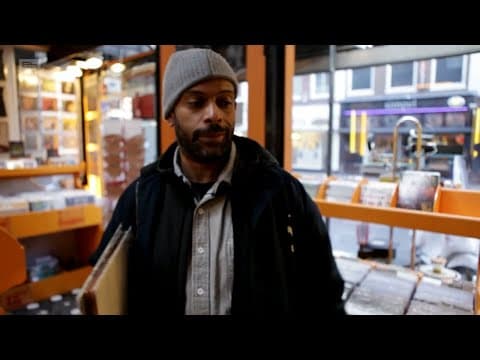
[0:07]How are you doing? I think I found a place. This is Record Mania, amazing record store. And I think I'm going to show you all what it's like to actually go digging and why.
[0:25]Theo Parrish, who comes from Detroit and Chicago, is certainly a producer and DJ whose passion for music comes straight from the heart.
[0:38]Boundaries of genre are quite us to him, and as long as he likes what he hears, basically anything goes. Theo's own productions have consistently set the bar very high while breaking the rules, and the same goes for his DJ sets. Not much is left to chance, so much so that he not only travels to his DJ gigs with full cases of vinyl, but even brings his own mixer and turntable needle. In fact, for Theo, vinyl still remains the essential medium of the professional DJ. For him, digging for records is much more than just part of the job.
[1:19]It's pretty apparent to me that the format for playing records is playing records. Real simple. Um, the advent of technology is always going to find uh, ways to, mm, make things convenient. So it starts with CDs, um, then it went into the digital thing. Basically, if you have the beginning of a of any art form, it's like uh, painting. You have a canvas. Um, you have for your your paints and your your brush. And yeah, you could, you fast forward the form to today, and you have all these different computer programs where you can mix colors online and move this over there, but it's not the same as having a canvas and a brush and a paint that's specific skill. They go along with it, so it's very much in the same way. Part of the beauty of a record store like this is you look around and things are pretty visual. Um, you can't get that online at all. Um, you don't get the scale of these, you don't get the uh, the improvisational idea of these these images jumping out at you, asking for your attention. Cuz there may be something, you know, you think it's in the rock section, but you, you pick it up, and you may have an idea about rock, a genrefied idea, you pick it up and it may be funkier than the most funk you ever had. So you're not going to know what you're getting. Um, it's it's an amazing thing the store itself. It's a, it's an experience.
[3:13]As soon as I see that these technological advances have merit in terms of it elevating the artistic form of it. But in order for it to elevate it, you have to see a lot more mastering of that form. So when I see an individual taking the technology and incorporating or moving it past where it's been, which I do see sometimes, but it's rare. I mean, there are examples, you got guys that can go out and play records on uh, laptop and then they'll be playing keys and uh, singing on top of it. Um, I've seen Carrie Chandler do that. But most times it's just using it to replace it because they simply either didn't dedicate themselves to finding the records or they're too lazy. So I'm not I'm not comfortable with uh, convenience replacing artistry, that's basically the philosophical thing about.
[4:26]Someone took one of these and another one of these and decided to mix them together. And now that artist is is somewhat being forgotten because everybody forgot about the records themselves and was worried about the mixing and that's more about the ego. Um, that's fine that people like to mix and mixing is great and yeah, and it's important to learn how to do it. But you're doing that only for um, the idea of a continuous movement of of rhythm. that you want everyone to keep dancing or to keep a continuous stream of of sonics running in your area. Um, you don't do it for the ooh and ah, the show of it. Um, in my opinion, there's a lot of different types of DJs and I'll get to that too but for me in the way that I know um, it hit me was that it was the magic of of playing music for people. and it being non-stop and it being honest. And to me, um, the selection process has starts here. You pick out as many different things that are natural to you, that are organic to you, that draw you in specifically. And then later you refine that process through listening. And then you present it to other people. That's DJ and that's selection to me.
[6:00]It's it's really simple to be a DJ, but it's it's another thing to take DJ to a point where you're not just the DJ. How do you elevate it past just playing records for people and being able to beat mix? I mean, they have a beat mix function on some of these things. It's already been done for us. So where's the art coming from? And it always comes from the human.
[6:33]To move forward into the future, you have to know what's going on in the past. Otherwise, you risk redundancy. And who wants to be stuck in a form that keeps going around and around and around and around and around? You have to know about things that are broken off and splintered here and splintered there and going over there and going over this way and turned upside down so that you know exactly how to do it, going forward. Otherwise, you might be stuck in something that's been done already over and over again, and how redundant is that? So you're only being avant-garde or artistic or forward thinking among a very, very limited amount of people. And then again also thinking about the technological part of it too is until we see an individual that's going to take these technological advances and really do something remarkable. But see, then it's not it has no value. Has no value. When you still have two people you're able to do the most basic thing and the most amazing things with those basic materials. You're good. Everything else tends to be just about what technologies we can do. How do we cheapen it and make it easier? I still seeing that being the attraction, more so than extreme artistry. Until until I can see someone document certain artists that are doing that. Then I'll be more interested, but until then I'm not seeing it. I just see convenience and that's it.
[10:05]One of the things that that really interests me in creation of music and the uh, and and music being played to people is frequency response and and frequency isolation. There are certain parts of the frequency range that will hit you depending on what's being played and how it's recorded. And a lot of times, one of the biggest gripes I have is there isn't a big enough range, um, available for people to come here what you're doing. And that's why I get to be be kind of hardcore about the sound systems I play on and that's why I don't like playing a lot of big places in terms of uh, outdoor venues and stuff like that because I know that the sound necessarily isn't going to carry because a lot of times the to make something work outdoors and in a big festival, that has to be a certain amount of focus. And without focus, frequencies don't really work. They tend to kind of get vacuous and lost and like the worst thing in the world is have there be a a double venue where you're playing and then when you're let's say you're working an EQ and you drop the lower frequencies, and that does something to the people there, and then you can hear the other the other people playing in another room, this now you're you've ruined that moment. Now there there's a distraction. And so there's little things like that that people don't think of because the promoters are thinking money. Those are those are focus points and those are those are very serious now when it comes to making music, it's important to not only have it balanced in the headphones but to listen to it on a scale in which you intend to present it. Or at least close. Because then it's going to give you an idea of what uh what you're doing and how you're hitting people.
[12:10]Being independent is indeed a big topic for me because let's get down to to cultural identity. And one of the biggest issues that um, that I've come across in my life is seeing black people relying on a larger culture for it's on identity. And the neuroses and the violence and the self-destruction that's uh that's happened as a result. And that and those same violent self- self-destructive tendencies being not only capitalized and sold to the rest of the world, along with this own prehistory of us being subordinate. But now also eroding our own community to the point where I can't even communicate with the youth. When when I was coming up, guys older than me didn't have a fear saying to me, hey, don't do that. Now I have a a general and a valid fear saying to a young guy, don't do that because he might shoot me because he feels disrespected. Now that is loss of identity. That's loss of individuality. That's loss of knowing who you are and being afraid, being afraid because a larger culture. is sitting there saying you can't make it. These doors are closed. You have no education. You have no health. So individuality and independence is very important because I can't look to the larger culture to help me. And so the the idea is I'm going to do for self because if I don't do for self, my son's not going to make it. And because I I I can't trust what's around and the structures that are there. They're eroded. They're false. So yes, it starts there. And so you you you move from that, it becomes an independent label. No, I don't want anyone telling me what to put out. Then it goes to independent thinking. No, I don't believe in these lines because that's binary, that's being controlled. So it's it's the idea that if you control your own destiny and you decide what you're going to be, then you will be something and you will survive.