[0:00]It's the year 1867. A bearded philosopher named Karl Marx sits in the dim light of the British Museum scribbling the foundational texts of Das Kapital. He is writing about a terrifying future where every human interaction is reduced to a cold transaction, a world where even kindness is a commodity bought and sold for a profit. He had no idea that over 150 years later, he would describe the career of Jimmy Donaldson, Mr. Beast with frightening accuracy. We view Mr. Beast as the internet's greatest philanthropist, a modern day saint who builds wells and pays for surgeries. But through a Marxist lens, Mr. Beast isn't the solution to capitalism's failures. He is its final most dystopian evolution. He has perfected an economy where human desperation is gamified and charity is no longer an act of mercy but a high yield digital asset. Marx warned us that under late stage capitalism, everything, even our empathy, would have a price tag. Mr. Beast didn't just find that price tag, he built a billion dollar empire on it. This is how the world's most popular creator perfected the exact dystopian economy Marx predicted over a century ago. Commodity fetishism. In the first volume of Das Kapital, Marx introduces a concept that explains why Mr. Beast's videos feel so mesmerizing yet so hollow. He wrote, "A commodity appears at first sight an extremely obvious, trivial thing, but its analysis shows that it is a very queer thing, abounding in metaphysical subtleties and theological niceties." When you watch a Mr. Beast video, what are you actually looking at? You see a suitcase filled with $100,000. You see a brand new Lamborghini. You see a house being given to a homeless family. To the average viewer, these are just good deeds. But to Marx, these are commodities in their most fetishized form. In a Mr. Beast production, money is never just a medium of exchange, it is a prop. It is a visual effect designed to trigger a biological response. Marx argued that "commodity fetishism" occurs when the social relationships between people are masked by the exchange of objects. Think about it, when Jimmy hands a random person $50,000 for staying in a circle, we aren't seeing a social connection. We are seeing a person's value reduced entirely to the cash in their hand. We don't see the systemic poverty that makes that $50,000 a life-altering miracle. We only see the magic of the money itself. The money becomes a god-like entity that solves all problems, hiding the ugly reality of the labor and desperation that created the need for the money in the first place. Mr. Beast is not giving away money in the traditional sense. He is converting human struggle into a high-yield digital asset. Marx warned that in a capitalist society, all that is holy is profaned. The sacred act of charity has been stripped of its human soul and redesigned to satisfy a recommendation algorithm. It is the ultimate modification, kindness itself has become a product you can subscribe to. Human alienation. Marx's theory of alienation is perhaps his most haunting critique of how capitalism breaks the human spirit. In his Economic and Philosophic Manuscripts of 1844, he wrote, "The worker becomes all the poorer the more wealth he produces, the more his production increases in power and range, the worker becomes an ever cheaper commodity the more commodities he creates." Now, look at a Mr. Beast challenge. A participant is placed in a white room for 100 days. Another is buried alive for 50 hours. Another survives in a wilderness for a week. On the surface, it's a game, but in Marxist terms, it is pure alienation. The participant is the worker and their production is their own suffering. They are separated from their family, their environment, and their basic human needs. All to produce a spectacle for a global audience. Marx argued that under capitalism, the worker is alienated from their species essence, their true human nature. By placing people in sensory deprivation or extreme physical conditions just to pay off student debt or buy a house, Mr. Beast literally strips them of their humanity to see how much value can be squeezed out of their endurance. They aren't there because they want to play a game. They are there because they are economically coerced. In one video, a man stays in a circle for months to win money for his family. We watch his mental health decline, we watch him weep. This is exactly what Marx meant when he said the worker's labor becomes an object, an external existence that exists outside him, independently as something alien to him. The contestant's pain is no longer their own, it belongs to the Beast brand. It is a raw material like coal or iron, mined from the human psyche and sold to us as entertainment. The more the contestant suffers, the more wealth the video generates. They are a cog in a machine that requires their total alienation to function. They sell their life activity to obtain the means of subsistence, turning their very existence into a game of survival. Exchange value. To understand the genius and the horror of the Mr. Beast model, we have to look at how he treats human life as a balance sheet. Marx famously distinguished between "use value" and "exchange value." In Value, Price and Profit, he noted, "As exchange values, all commodities are merely definite quantities of congealed labor time." Take the video where Mr. Beast pays for 1,000 people to have cataract surgery. The use value of that act is immense, 1,000 people can now see, it is a genuine good. But in the logic of the channel, the exchange value is what matters. The cost of the surgeries is a variable capital investment. The congealed labor time is the months of planning and editing. The goal to produce a thumbnail and a title that generates a surplus value of 150 million views. If curing 1,000 people only generated 100 views, the Beast empire would collapse. The mercy is only viable if it is marketable. This creates a terrifying feedback loop. Marx warned that capital must always seek to expand because the cost of curing blindness or building 100 houses is so high. The next video must be bigger, louder, and more viral to pay for the last one. This is the commodified charity loop. It is a self-sustaining microeconomy where the viewer's attention directly funds the next spectacle of wealth distribution. You, the viewer, are the consumer of this charity. Your attention labor is what gives the video value, which the brand then harvests to buy more good deeds. It turns the audience into passive participants in a digital Colosseum. We aren't being inspired to help, we are being conditioned to watch. Marx believed that the market eventually turns everything into a quantity. In the Mr. Beast universe, there is no quality of mercy. There is only the quantity of people helped versus the cost per click. It is a cold calculated breakdown of the human heart into a spreadsheet. Capital accumulation. Marx's most famous command for the capitalist was, "Accumulate, accumulate, that is Moses and the prophets." He understood that capital is not a thing, but a process. It has to move, it has to grow, if it stops, it dies. Jimmy Donaldson often says in interviews that he has $0 in his bank account because he reinvests every penny back into his videos. Mr. Beast ends every single month with $0 in his bank account. I mean, at the end of the day, I could spend less for videos if I want to. I'm just focused on making the best videos possible, period. I don't care about making money, I don't care about time, I don't care about anything. I don't care about anything. I just want to make the best videos on the planet. But at any point, if I was like, oh, I need to stop losing money, I just, you know, don't spend a million dollars on the next video, just spend 100 grand, you know what I mean? Many see this as the ultimate proof of his selflessness, but to a Marxist, this is the most aggressive form of capital accumulation imaginable. Jimmy is not a person, he is the personification of capital. By refusing to consume his wealth and instead dumping it back into production, he is accelerating the growth of his Beast empire at a rate that traditional charities could never dream of. Marx described the MCM cycle. Money is converted into a commodity, which is then sold for more money. Mr. Beast has perfected the MSM cycle. Money is converted into a spectacle, which is then sold for more money. Because he reinvests 100%, he is able to build a monopoly of attention. He creates a barrier to entry so high that no other creator can compete. This is the microeconomic engine your client asked about. By operating at a break-even point on individual videos, he is actually building a massive high-yield digital asset, the brand itself. This brand can then launch Feables, Mr. Beast Burger, and massive merchandising lines. The charity is the marketing department for a global conglomerate. Marx warned that as capital accumulates, it centralizes. We see this today. One man now controls the charity narrative for the entire internet. He has become a private state providing the services like water, housing, and health care that the actual state has failed to provide. He is the benevolent dictator of the Digital Age, exactly the kind of prince of industry Marx feared would replace traditional society. The reserve army. Finally, we have to look at the people who aren't in the videos. Marx spoke of the industrial Reserve Army, a mass of desperate unemployed people who exist on the fringes of society. He wrote, "The industrial reserve army, during the periods of stagnation, weighs down the active labor-army; during the periods of over-production and paroxysm, it holds its pretensions in check." In every Mr. Beast challenge, there are 100, 1,000, or even 10,000 people. But for every person in that video, there are millions more in the comments begging for a chance. Jimmy, please help me pay my mom's medical bills. Jimmy, I'm about to lose my house. Jimmy, please help. This is the Reserve Army of the Beast economy. They are the millions of desperate souls who make the contestants replaceable. Marxism teaches us that the system needs this desperation to function. If everyone had a house, if everyone had health care, if everyone had their debt paid off, Mr. Beast's content would be boring. There would be no stakes. The spectacle relies on the existence of a massive suffering underclass. The Reserve Army is what gives the video its tension. Mr. Beast is not a bad person. In fact, by all accounts, he's a very nice one, but that's the point. Marx wasn't interested in whether the capitalist was nice. He was interested in what the system forced them to do. We aren't watching a man fix the world, we are watching a man prove that the world is broken beyond repair. And the scariest part, we can't stop watching. We are the ones providing the living labor of our attention, keeping the vampire alive.
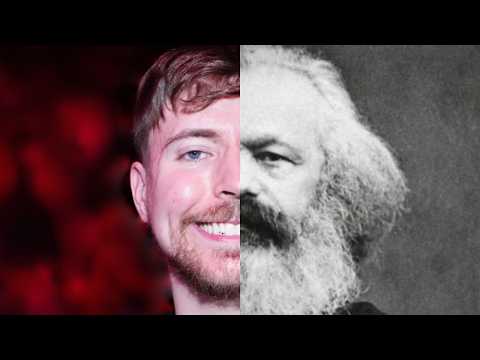
MrBeast Is What Marx Warned Us About
GEOGRAFEIN
11m 0s1,898 words~10 min read
YouTube auto captions
Transcript source
YouTube auto captions
This transcript was extracted from YouTube's auto-generated caption track. The transcript below is server-rendered so it can be read, searched, cited, and shared without opening the original YouTube player.
Pull quotes
[0:00]A bearded philosopher named Karl Marx sits in the dim light of the British Museum scribbling the foundational texts of Das Kapital.
[0:00]He is writing about a terrifying future where every human interaction is reduced to a cold transaction, a world where even kindness is a commodity bought and sold for a profit.
[0:00]He had no idea that over 150 years later, he would describe the career of Jimmy Donaldson, Mr.
[0:00]Beast as the internet's greatest philanthropist, a modern day saint who builds wells and pays for surgeries.
Use this transcript
Related transcript hubs
Watch on YouTube
Share
MORE TRANSCRIPTS


